
CAIRO: A senior US official said she is pushing for Libya to hold elections by June after the county missed a December deadline to elect its first president since the 2011 ouster and killing of longtime dictator Muammar Qaddafi.
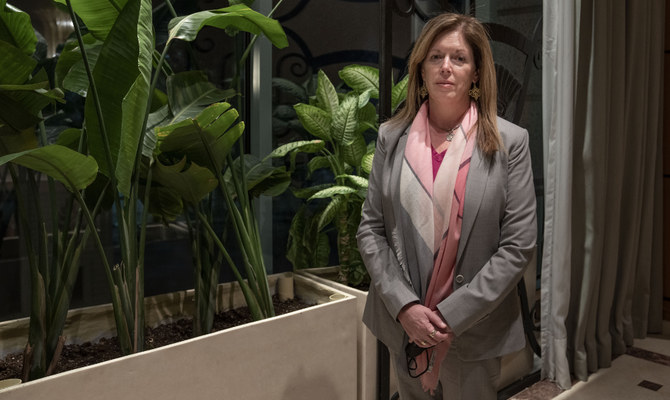
Stephanie Williams, the UN’s special adviser on Libya, said that it is still “very reasonable and possible” for the country’s 2.8 million voters to cast their ballots by June in line with the UN-brokered 2020 roadmap.
Libya failed to hold its first-ever presidential elections on Dec. 24 as scheduled, a major blow to international efforts to end a decade-long chaos in the oil-rich Mediterranean nation.
Williams, who led UN efforts to end the latest bout of violence in Libya in 2020, said elections are needed in the country to give credence to the country’s institutions.
“All the institutions are suffering a crisis of legitimacy,” she said.
“I don’t see any other exit for Libya other than a peaceful political process.”
The country plunged into turmoil after the NATO-backed 2011 uprising and split into rival governments — one in the east, backed by military commander Khalifa Haftar, and another UN-supported administration in the capital of Tripoli, in the west. Each side is supported by a variety of militias and foreign powers.
Mediated by the UN, an October 2020 ceasefire led to the formation of a transitional government and scheduled elections for Dec. 24. But the vote faced steep challenges that eventually forced its postponement.
Williams urged lawmakers, who are convening Monday in the eastern city of Tobruk, to agree on a “clear, time-bound process with a clear horizon and to not create an open-ended process.”
“They have to shoulder a great responsibility right now to respect the will of the Libyans who registered to vote,” she said.
“Libyans want an end to this long period of transition that the country has experienced since the events of 2011.”
The missed election deadline came after bitter disputes over the laws governing the electoral process. Outbreaks of fighting among armed factions and the presence of thousands of foreign fighters and troops in the North African country also fed mistrust between the rival groups.
Controversial figures declaring runs for the presidency have further polarized the political scene in recent months. Among them are Hifter, Prime Minister Abdul Hamid Dbeibah and Seif Al-Islam Qaddafi, the ousted dictator’s son and one-time heir apparent. Opponents of Hifter and Gadhafi have said they will never accept an election victory by them.
The country’s election commission didn’t name a final list of candidates for the presidential and parliamentary elections. Imad Al-Sayeh, head the commission, told the parliament Monday that militias threatened to stop the electoral process if a final list was announced.
Al-Sayeh said the commission needs between six and eight months to prepare for elections, given the uphill challenges that led to the postponement of Dec. 24 vote.
Williams said lawmakers and leaders in Tripoli should work out the disputes over the elections rules. She did not see the departure of foreign mercenaries as a “prerequisite for the elections,” saying that holding the cease-fire is the priority.
“There have been mercenaries in Libya since 1970s,” she said, adding later, “I don’t believe that that is a card that is necessary to play at this time.”
Williams also said all factions should accept the results no matter who wins.
“The way to solve this is (allowing) the Libyan voters go to the ballot box and make their own choice,” she said. “Results need to be respected.”
The vote’s delay also threatens to open a power vacuum. Lawmakers have argued that the mandate of Dbeibah’s government ended on Dec. 24. Aguila Saleh, the influential speaker of parliament, said Monday that the transitional government “should be restructured.”
The UN adviser called on the parliament to focus on delivering the vote rather than appointing a new transitional administration.
“What Libyans have clearly said is that they want to go to the ballot box and choose their government, a democratically government representing the entire Libya,” she said.