ISLAMABAD: Pakistan’s national security adviser Dr. Moeed Yusuf told a group of journalists in Lahore on Saturday the newly launched national security policy (NSP) was apolitical and the opposition should not surround it with controversy in the larger interest of the state, reported the local media.
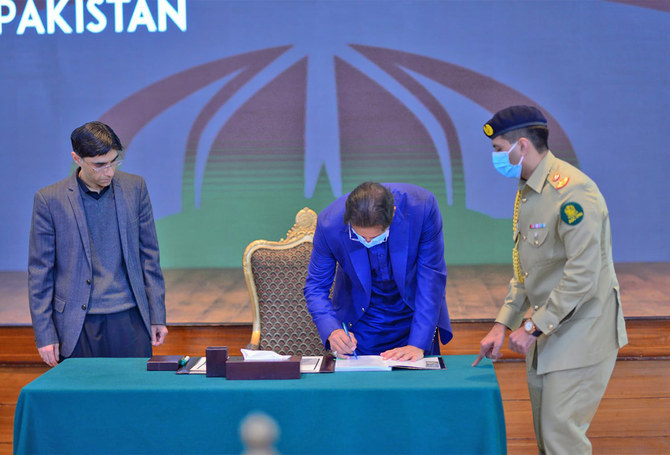
The public version of the country’s first policy document covering traditional and non-traditional security threats was launched by Prime Minister Imran Khan on Friday, who described it as an “all-encompassing and multidimensional” effort.
Apart from Pakistan’s defense and territorial integrity, the document focused on areas like economic stability, human security and national cohesion.
“If the opposition does not want to receive a formal briefing on the NSP and provide its input, does it want to delay this all-important policy that has already taken seven long years [to formulate],” Dawn quoted him as saying.
According to the state-run Associated Press of Pakistan news agency, Yusuf maintained the new policy did not need to be placed before parliament since it had been duly presented to the Parliamentary Committee on National Security.
However, Dawn reported him as saying he was willing to present the document to parliament or house committees to create greater political consensus on it.
The national security adviser informed that the Senate Defense Committee that is headed by an opposition leader, Mushahid Husain Sayed, had invited him for an in-camera briefing earlier this month and praised the policy.
“It is unfair to say the government does not want a consensus by not according any opportunity to the opposition to discuss and give its input,” he added.
Yusuf called the NSP an evolving document which would undergo mandatory annual reviews.
However, he noted “the key direction of the policy will never be reversed.”
The country’s opposition parties, meanwhile, asked the government to present the policy to parliament, adding it was not right to bypass the legislative forum on important issues covered in the document.
“Parliament has no knowledge of the National Security Policy,” the opposition Pakistan Peoples Party’s member Dr. Nafisa Shah was quoted by Express Tribune. “Bypassing the opposition and parliament on this issue is a matter of concern.”


Pakistan’s NSA asks opposition not to politicize newly unveiled national security policy
https://arab.news/yttw6
Pakistan’s NSA asks opposition not to politicize newly unveiled national security policy

- Dr. Moeed Yusuf says the new policy is an evolving document which will undergo mandatory annual reviews
- The opposition maintains it is not right for the government to bypass parliament on issues of vital national security

Pakistan backs peace efforts in Yemen, warns factions on ground against unilateral actions
- Foreign office reaffirms Pakistan’s firm commitment to Yemen’s unity and territorial integrity
- Pakistani administration also expresses solidarity with Saudi Arabia amid regional tensions
ISLAMABAD: Pakistan’s Foreign Office on Thursday said it welcomed regional efforts to ease tensions in Yemen and strongly opposed unilateral actions by any faction on the ground that could undermine peace or regional stability.
The development takes place after the Saudi-led Coalition to Support Legitimacy in Yemen said it carried out a “limited” airstrike on Dec. 30, targeting two shipments of smuggled weapons and military equipment sent from the United Arab Emirates (UAE) port of Fujairah to Mukalla in southern Yemen.
Addressing a weekly news briefing, Foreign Office Spokesperson Tahir Andrabi reiterated support and firm commitment to the unity and territorial integrity of Yemen.
“In this regard, Pakistan strongly opposes unilateral steps by any Yemeni party that may further escalate the situation, undermine peace efforts and threaten peace and stability of Yemen, as well as that of the region,” he said.
“Pakistan welcome regional efforts for de-escalation of the situation in maintaining peace and stability in Yemen.”
Andrabi highlighted that Pakistan supported a peaceful resolution in Yemen through dialogue and diplomacy, hoping that Yemenis and regional powers work together toward an “inclusive and lasting settlement.”
On Wednesday, Pakistan Prime Minister Shehbaz Sharif reaffirmed “complete solidarity” with Saudi Arabia during a phone call with Crown Prince Mohammed bin Salman following Riyadh’s weapon shipment bombing in Yemen.
The Saudi airstrike on a UAE shipment in Yemen’s southern port city of Mukalla followed rising tensions linked to advances by the Emirates-backed Southern Transitional Council in the war-torn country.
Saudi Arabia, a major oil supplier to Pakistan, has provided billions in loans to help manage its economic crisis. The two countries have also signed a mutual defense pact last September, treating an attack on one as an attack on both.