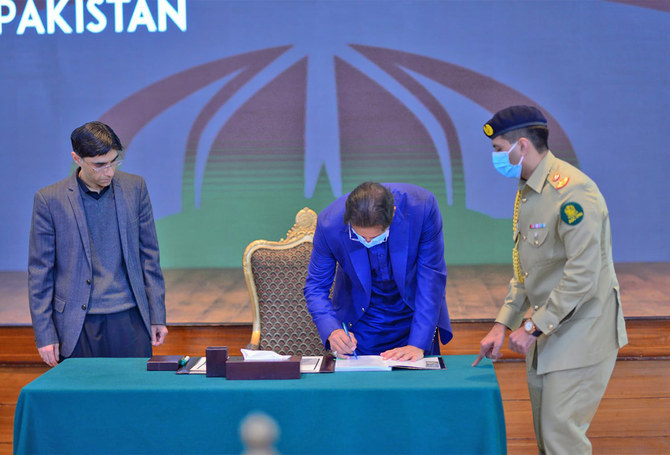
ISLAMABAD: Pakistan’s national security adviser Dr. Moeed Yusuf told a group of journalists in Lahore on Saturday the newly launched national security policy (NSP) was apolitical and the opposition should not surround it with controversy in the larger interest of the state, reported the local media.
The public version of the country’s first policy document covering traditional and non-traditional security threats was launched by Prime Minister Imran Khan on Friday, who described it as an “all-encompassing and multidimensional” effort.
Apart from Pakistan’s defense and territorial integrity, the document focused on areas like economic stability, human security and national cohesion.
“If the opposition does not want to receive a formal briefing on the NSP and provide its input, does it want to delay this all-important policy that has already taken seven long years [to formulate],” Dawn quoted him as saying.
According to the state-run Associated Press of Pakistan news agency, Yusuf maintained the new policy did not need to be placed before parliament since it had been duly presented to the Parliamentary Committee on National Security.
However, Dawn reported him as saying he was willing to present the document to parliament or house committees to create greater political consensus on it.
The national security adviser informed that the Senate Defense Committee that is headed by an opposition leader, Mushahid Husain Sayed, had invited him for an in-camera briefing earlier this month and praised the policy.
“It is unfair to say the government does not want a consensus by not according any opportunity to the opposition to discuss and give its input,” he added.
Yusuf called the NSP an evolving document which would undergo mandatory annual reviews.
However, he noted “the key direction of the policy will never be reversed.”
The country’s opposition parties, meanwhile, asked the government to present the policy to parliament, adding it was not right to bypass the legislative forum on important issues covered in the document.
“Parliament has no knowledge of the National Security Policy,” the opposition Pakistan Peoples Party’s member Dr. Nafisa Shah was quoted by Express Tribune. “Bypassing the opposition and parliament on this issue is a matter of concern.”


Pakistan’s NSA asks opposition not to politicize newly unveiled national security policy
https://arab.news/yttw6
Pakistan’s NSA asks opposition not to politicize newly unveiled national security policy

- Dr. Moeed Yusuf says the new policy is an evolving document which will undergo mandatory annual reviews
- The opposition maintains it is not right for the government to bypass parliament on issues of vital national security

Pakistan’s president defends ongoing strikes in Afghanistan, urges Kabul to dismantle militants
- Afghanistan on Thursday launched attacks in retaliation for Pakistani airstrikes the previous Sunday
- Pakistan’s military says it is only targeting Afghan military installations to avoid civilian casualties
ISLAMABAD: Pakistan’s president on Monday defended his country’s ongoing military strikes in neighboring Afghanistan, saying Islamabad tried all forms of diplomacy before targeting militants operating from Afghan territory, and called on the Taliban government in Kabul to disarm groups responsible for attacks in Pakistan.
Pakistan earlier said it is in “open war” with Afghanistan, alarming the international community. The border area remains a stronghold for militant organizations including Al-Qaeda and the Daesh (Islamic State) group.
“(The Afghan Taliban) must choose to dismantle the terror groups that survive on conflict and its war economy,” Asif Ali Zardari said during a speech to lawmakers, adding that “no state accepts serial attacks on its soil.”
Afghanistan on Thursday launched attacks in retaliation for Pakistani airstrikes the previous Sunday. Since then, Pakistan has carried out operations along the border, with Information Minister Attaullah Tarar claiming the killing of 435 Afghan forces and the capture of 31 Afghan positions.
Kabul has denied such claims.
In Afghanistan, the deputy government spokesman Hamdullah Fitrat said Pakistan’s military fired mortar shells at a refugee camp in eastern Kunar province, killing three children and injuring three others.
Afghanistan’s defense ministry said Afghan forces carried out strikes targeting a Pakistani military facility near Paktia province, causing “substantial losses and heavy casualties.”
Pakistan’s military did not respond to questions. It has said Pakistan is only targeting Afghan military installations to avoid civilian casualties.
Pakistan has witnessed a surge of violence in recent months and blames it on the outlawed Pakistani Taliban, known as Tehreek-e-Taliban Pakistan or TTP. It operates both inside Pakistan and from Afghan territory.
Islamabad accuses Afghanistan’s Taliban government of providing safe havens for the TTP, which Kabul denies.
The latest cross-border fighting ended a ceasefire brokered by Qatar and Turkiye in October. The two sides failed to reach a permanent agreement during talks in Istanbul.
Zardari reiterated Pakistan’s call for talks, saying, “We have never walked away from dialogue.”
The Pakistani leader again accused Afghanistan of acting as a proxy for India by sheltering militant groups.
“Stop being used by another country as a battlefield for their ambitions,” he said.
Zardari cited a recent report from the United Nations Security Council’s monitoring team that described the presence of militant groups in Afghanistan as an extra-regional threat.