



ISLAMABAD: Shaukat Mukadam, the father of 27-year-old Noor Mukadam who was murdered in Islamabad in July 2021, on Saturday demanded capital punishment for the prime suspect, Zahir Jaffer, as he recorded his statement before an Islamabad court.
Noor Mukadam, the daughter of a former Pakistani diplomat, was found beheaded at a residence in Islamabad’s upscale F-7/4 neighborhood, in a case that has sparked public outrage and grabbed media attention unlike any other recent crime against women. The key suspect, Zahir Jaffer, was arrested from the crime scene on the day of the murder.
Others charged in the case include Zahir’s parents, Zakir Jaffer and Asmat Adamjee, their three household staff, Iftikhar, Jan Muhammad and Jameel, and six workers from Therapy Works, a counselling center from where Jaffer had received certification to become a therapist and where he had been receiving treatment in the weeks leading up to the murder.
The case is now in the concluding stage in the Islamabad district court, where Additional Sessions Judge Atta Rabbani has been conducting the hearings. Eyewitnesses have been recording their statements in the case and defense attorney cross-examining their testimonies.
In Saturday’s hearing, Shaukat Mukadam recorded his statement in the court, saying he had no “personal enmity” with anybody.
“My daughter has been killed unlawfully,” he said. “Zahir Jaffer should be handed down death sentence.”
Recounting the unfortunate day’s events when her daughter was killed, Shaukat said he and his wife were not home on July 19 and upon their return, they didn’t find their daughter. He said they got worried and telephoned Noor, but her mobile phone was switched off.
“I started searching for her,” he said. “When she picked up [the call], she asked me not to worry and that she was going to Lahore with some friends.”
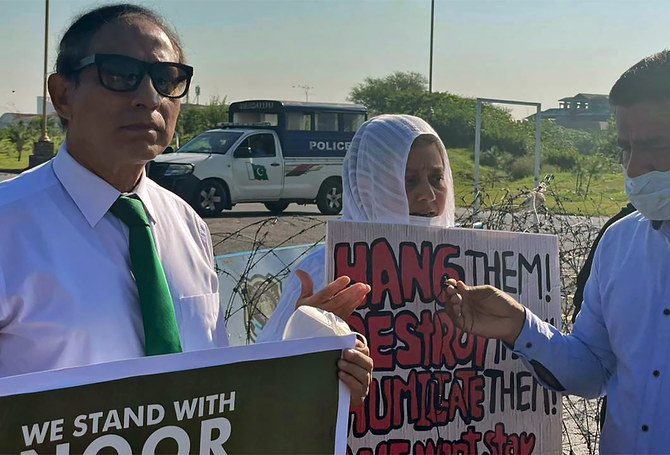
Noor Mukadam's mother is holding a placard during a protest demonstration in Islamabad, Pakistan, on October 20, 2021. Mukadam, daughter of a former Pakistani diplomat, was brutally murdered in the country's federal capital on July 20. (Photo courtesy: Justice for Noor)
On July 20, Shaukat said Zahir Jaffer called him and informed that Noor was not with him. He said he knew the Jaffer family well.
Shaukat said around 10pm the same day, he received a telephone call from the Kohsar police station and was informed that his daughter had been murdered.
“The police took me to Zahir Jaffer’s home where I saw my daughter brutally killed and decapitated,” he informed the court.
Shaukat said Noor’s mobile phone was recovered from a closet in the house, which showed the accused had snatched it from the victim.
After Shaukat recorded his statement, advocate Basharatullah Khan, who is representing Zahir’s father in the case, cross-examined him to verify the facts.
Shaukat said he had no information about any other suspects in the case except the Jaffer family.
Zahir’s lawyer, Sikandar Zulqarnain, did not show up for the hearing and a junior counsel informed the court that he was infected with COVID-19.
Advocate Shah Khawar, who is representing the Mukadam family, said they wanted transparent and open hearings in the case, therefore Zahir’s lawyer could cross examine his client on Monday.
The court summoned investigation officer in the case to record his statement and adjourned the proceedings till Monday.


