Pakistan’s Sindh decides not to close schools despite surge in virus cases

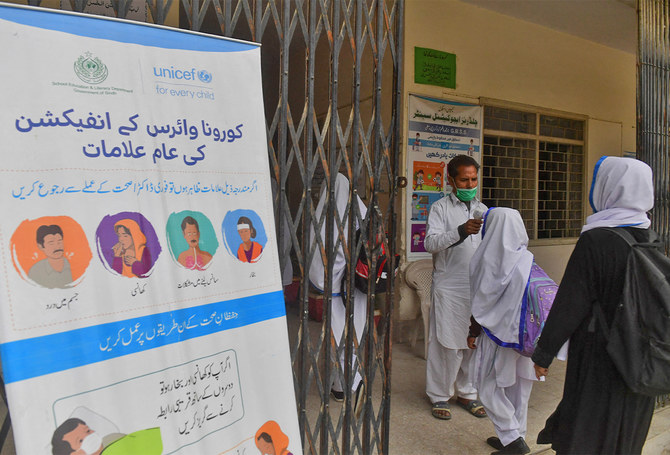
A school official checks the body temperature of students wearing facemasks as they enter a school amid coronavirus pandemic in Karachi, Pakistan, on November 25, 2020. (AFP/File)
Short Url
Updated 15 January 2022
Follow

Pakistan’s Sindh decides not to close schools despite surge in virus cases

  • Province reported 3,089 new coronavirus infections in last 24 hours
  • Chief minister calls the surge an outcome of not taking precautions

KARACHI: The provincial government in Pakistan’s southern Sindh province has decided not to close educational institutions despite a surge in coronavirus cases across the province, the Sindh chief minister’s office said on Saturday. 
The province, where the omicron strain of the virus is getting increasingly dominant, reported 3,089 new infections in the last 24 hours. 
In view of the recent situation, Sindh CM Murad Ali Shah presided over a meeting of the provincial taskforce on the pandemic to discuss the government’s response. 
“It was decided in the meeting that schools will remain open and education activities will continue,” CM Shah’s office said in a statement. 
The government, however, decided to assess the capacity of all public and private hospitals to accommodate patients. 
Only vaccinated people will be allowed to enter markets and commercial centers after showing their vaccination certificate to the management, according to the statement. 
The government also decided to expedite its vaccination campaign across the province and ensure strict implementation of virus-related precautionary measures.
“The surge in coronavirus cases is an outcome of not adopting precautionary measures,” CM Shah said, adding they would overcome the ongoing wave of virus infections if the masses cooperated with the government. 
On Saturday, Pakistan reported 4,200 new coronavirus infections, its highest caseload since the end of August, as a fifth COVID-19 wave sweeps the country, driven by the highly transmissible omicron strain of the infection. 
The National Command and Operation Center (NCOC), which oversees Pakistan’s pandemic response, reported 4,286 new COVID-19 cases and four deaths in Pakistan in the past 24 hours as the country’s test positivity rate rose to 8.16 percent from below 1 percent only two weeks ago. 
The omicron variant was first detected in southern Africa and Hong Kong in November, with the first known case in Pakistan identified last month in a woman who had no travel history outside the country. 
The last time Pakistan reported over 4,200 new cases was on August 25 last year, when 4,467 people tested positive for the virus in a single day. 


Pakistan joins 22 Muslim states, OIC to condemn Israeli FM’s visit to Somaliland

Updated 08 January 2026
Follow

Pakistan joins 22 Muslim states, OIC to condemn Israeli FM’s visit to Somaliland

  • Israeli Foreign Minister Gideon Saar visited breakaway African region of Somaliland on January 6
  • Muslim states urge Israel to withdraw Somaliland recognition, respect Somalia’s sovereignty

ISLAMABAD: A joint statement by Pakistan, 22 other Muslim states and the Organization of Islamic Cooperation (OIC) on Thursday condemned Israeli Foreign Minister Gideon Saar’s recent visit to Somaliland as a violation of the African nation’s territorial integrity and sovereignty.

Saar’s visit to Somaliland capital Hargeisa on Jan. 6 followed Israel’s move last month to recognize Somaliland, a breakaway region from Somalia, as an independent country. The move drew a sharp reaction from Muslim states, including Pakistan, who said it was in contravention of the UN Charter and international norms. 

Several international news outlets months earlier reported that Israel had contacted Somaliland over the potential resettlement of Palestinians forcibly removed from Gaza. Muslim countries fear Israel’s recognition of the breakaway region could be part of its plan to forcibly relocate Palestinians from Gaza to the region. 

“The said visit constitutes a clear violation of the sovereignty and territorial integrity of the Federal Republic of Somalia, and undermines established international norms and the United Nations Charter,” the joint statement shared by Pakistan’s foreign office, read. 

The joint statement was issued on behalf of 23 Muslim states, including Saudi Arabia, Bangladesh, Pakistan, Egypt, Iraq, Iran, Palestine, Jordan, Kuwait, Türkiye, Oman and others. 

It reaffirmed support for Somalia’s territorial integrity and sovereignty, pointing out that respect for international law and non-interference in the internal affairs of sovereign states was necessary for regional stability. 

“Encouraging secessionist agendas are unacceptable and risk exacerbating tensions in an already fragile region,” the statement said. 

The joint statement urged Israel to revoke its recognition of the breakaway region. 

“Israel should fully respect Somalia’s sovereignty, national unity and territorial integrity and honor its obligations in compliance with international law, and demand immediate revocation of the recognition issued by Israel,” the statement read.

Somaliland broke away from Somalia unilaterally in 1991 as a civil war raged in the country. Somaliland has its own constitution, parliament and currency, a move that has infuriated Somalia over the years as it insists the region is part of its territory.