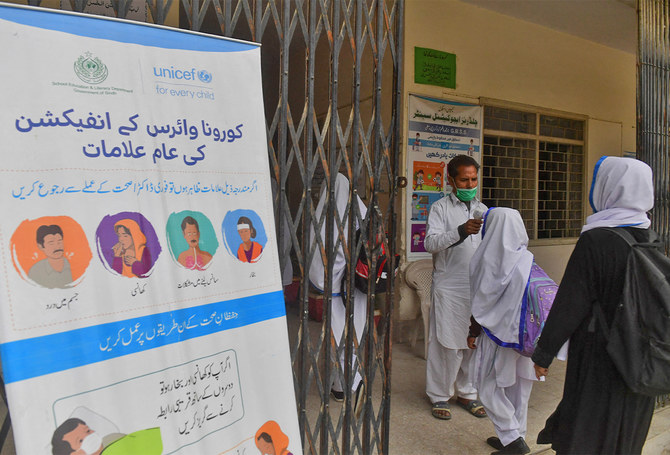
KARACHI: The provincial government in Pakistan’s southern Sindh province has decided not to close educational institutions despite a surge in coronavirus cases across the province, the Sindh chief minister’s office said on Saturday.
The province, where the omicron strain of the virus is getting increasingly dominant, reported 3,089 new infections in the last 24 hours.
In view of the recent situation, Sindh CM Murad Ali Shah presided over a meeting of the provincial taskforce on the pandemic to discuss the government’s response.
“It was decided in the meeting that schools will remain open and education activities will continue,” CM Shah’s office said in a statement.
The government, however, decided to assess the capacity of all public and private hospitals to accommodate patients.
Only vaccinated people will be allowed to enter markets and commercial centers after showing their vaccination certificate to the management, according to the statement.
The government also decided to expedite its vaccination campaign across the province and ensure strict implementation of virus-related precautionary measures.
“The surge in coronavirus cases is an outcome of not adopting precautionary measures,” CM Shah said, adding they would overcome the ongoing wave of virus infections if the masses cooperated with the government.
On Saturday, Pakistan reported 4,200 new coronavirus infections, its highest caseload since the end of August, as a fifth COVID-19 wave sweeps the country, driven by the highly transmissible omicron strain of the infection.
The National Command and Operation Center (NCOC), which oversees Pakistan’s pandemic response, reported 4,286 new COVID-19 cases and four deaths in Pakistan in the past 24 hours as the country’s test positivity rate rose to 8.16 percent from below 1 percent only two weeks ago.
The omicron variant was first detected in southern Africa and Hong Kong in November, with the first known case in Pakistan identified last month in a woman who had no travel history outside the country.
The last time Pakistan reported over 4,200 new cases was on August 25 last year, when 4,467 people tested positive for the virus in a single day.


![]()

Pakistan’s Sindh decides not to close schools despite surge in virus cases
Short Url
https://arab.news/22fha
Pakistan’s Sindh decides not to close schools despite surge in virus cases
- Province reported 3,089 new coronavirus infections in last 24 hours
- Chief minister calls the surge an outcome of not taking precautions
Latest updates


Recommended


© 2026 SAUDI RESEARCH & PUBLISHING COMPANY, All Rights Reserved And subject to Terms of Use Agreement.