

Thousands of Pakistanis lose life savings in $100 million cryptocurrency scam

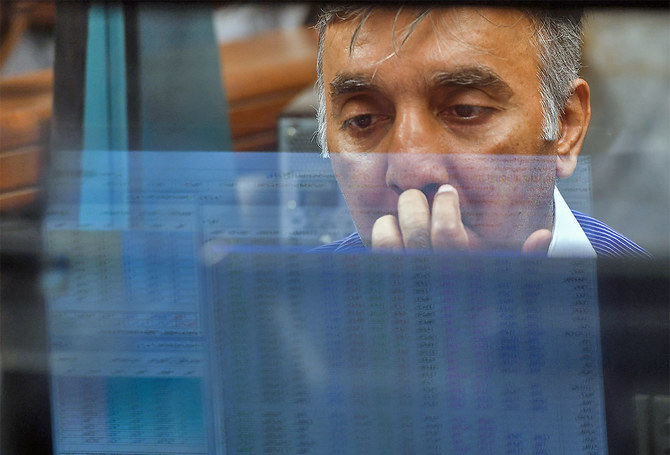
A Pakistani stockbroker looks at share prices on a computer monitor during a trading session in Karachi, Pakistan, on May 8, 2019. (AFP/File)
Short Url
Updated 14 January 2022
Follow

Thousands of Pakistanis lose life savings in $100 million cryptocurrency scam

  • Investigators estimate some 37,000 people, mostly from Punjab province, had invested money in the scheme that promised to multiply it
  • In the wake of the crypto scandal, State Bank of Pakistan has recommended banning cryptocurrency in the country

KARACHI: Thousands of Pakistanis have lost their life savings in a $100 million cryptocurrency scam, the Federal Investigation Agency (FIA) has said, as it is probing the case amid recommendations to ban digital currencies in the country. 
The State Bank of Pakistan on Wednesday recommended banning cryptocurrency, arguing that allowing it would cause capital flight. The recommendation followed another by a committee formed by the Sindh High Court that also urged imposing a “complete ban.” 
The recommendations came as the court has been hearing a constitutional petition filed in 2019, which seeks to overturn the central bank’s guidance from 2018 advising banks and payment system operators against processing and investing in virtual currencies. 
The current ambiguity surrounding the legality of digital currency trade has made it easier for Pakistanis to fall prey to the recent scheme. 
Investigators estimate some 37,000 people, mostly from middle-class households in Punjab’s Faisalabad had been defrauded after investing money in the scheme that promised to multiply it. 
“The range of investment was from $100 to $80,000,” Imran Riaz, head of the FIA’s cybercrime division in Sindh, told Arab News earlier this week. “On an average each member has invested $2,000, so with safe estimation we can say that it (amount involved) is $100 million.” 

"There are many stories, many victims stories," he said. "There was one victim ... he sold all the gold of his mother to just get rich quickly, and his mother didn't know about it. He was crying all the time that 'what should I do and how should I tell this to my mother that I've lost everything?'"
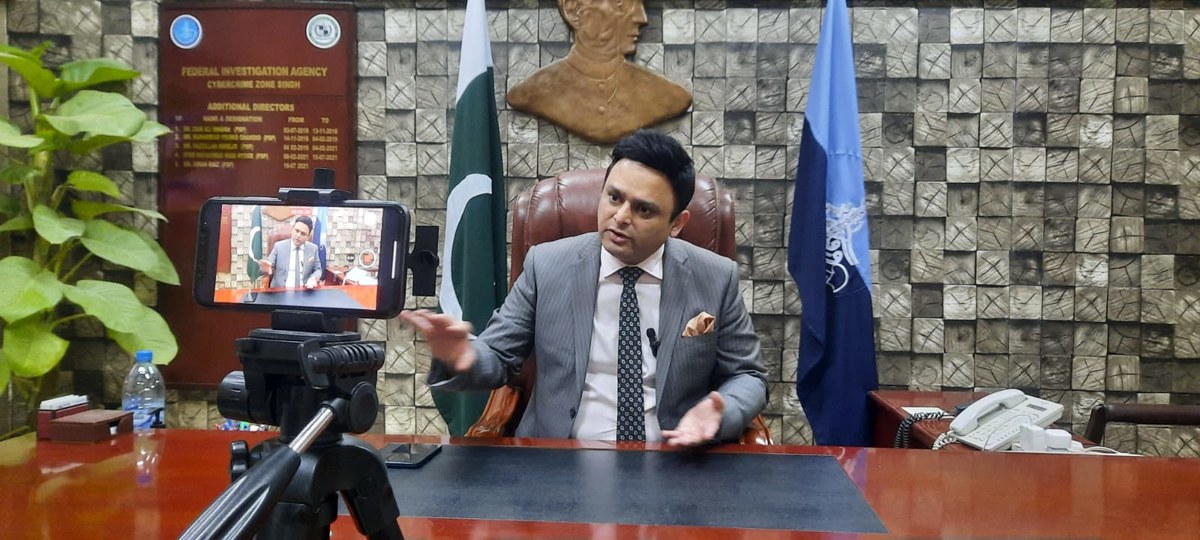


Head of Federal Investigation Agency’s Cybercrime Zone in Sindh, Imran Riaz, talks to Arab News about a mega cryptocurrency scam in Karachi, Pakistan, on January 11, 2022. (AN Photo)

The scammers used fraudulent apps such as MCX, HFC, HTFOX, FXCOPY, OKIMINI, BB001, AVG86C, BX66, 91FP, UG, TASKTOK, with the wallets of Binance, the world’s largest cryptocurrency exchange, linked to them. They would add their victims to Telegram groups where they shared advice on cryptocurrency trading. Once the users transferred their money from Binance to the apps used in the scheme, the applications would crash, and victims would no longer have access to their funds. 
Riaz said the FIA had approached Binance to get the record of 26 wallets that were used in the fraud. 
“We have asked Binance that, once you have integrated these apps with the system, (you) must have asked for certain additional security checks,” Riaz said. “On the basis of this information we can make a case and arrest people.” 
The company, he added, had agreed to extend its full support to the FIA and nominated a team comprising two former investigators of the US Department of Treasury to coordinate with FIA. 
Simon Mathews, Binance public relations director for Europe, told Arab News the company was in touch with FIA, but did not provide more details. 
Proponents of cryptocurrency trade in Pakistan argue that such scams are mostly caused by the absence of a legal framework. 
Waqar Zaka, a Pakistani television host and activist who is pleading a case for regulating digital currencies, believes regulation would help keep fraud at bay. 
“I pleaded the court that people have invested billions of rupees in crypto trade and the government should not declare it illegal,” he said. “Instead, it should devise a mechanism to legalize the business, and keep a check on transactions.” 


Pakistan announces four-day work week among steps to offset impact of Middle East crisis

Updated 15 min 22 sec ago
Follow

Pakistan announces four-day work week among steps to offset impact of Middle East crisis

  • The development comes as ongoing US-Israeli strikes on Iran disrupt oil supplies in Strait of Hormuz, push prices past $119 a barrel
  • Islamabad bans government purchases, cuts fuel allocation for vehicles as well as workforce in public and private offices by 50 percent

ISLAMABAD: Prime Minister Shehbaz Sharif on Monday announced austerity measures, including a four-day work week, cuts in government expenditures and closure of schools, to offset the impact of rising global oil prices due to an ongoing conflict in the Middle East.

Global fuel supply lines have been disrupted in the Strait of Hormuz, which supplies nearly a fourth of world oil consumption, after Tehran blocked it following United States-Israeli strikes on Iran and counterattacks against US interests in the Gulf region.

Oil prices surged more than 25 percent globally on Monday to $119.50 a barrel, the highest levels since mid-2022, as some major producers cut supplies and fears of prolonged shipping disruptions gripped the market due to the expanding US-Israeli war with Iran.

In his televised address on Sunday night, Sharif said global oil prices were expected to rise again in the coming days but vowed not to let the people bear their brunt, announcing austerity measures to lessen the impact of fuel price hikes.

“Fifty percent staff in public and private entities will work from home,” he announced, adding this would not be applicable to essential services. “Offices will remain open for four days a week. One-day additional off is being given to conserve oil, but it would not be applicable to banks.”

Sharif didn’t specify working days of the week and the government was likely to issue a notification in this regard.

He said a decrease of 50 percent was being made in fuel allocation for government vehicles immediately for the next two months, but they would not include ambulances and public buses.

“Cabinet members, advisers and special assistants will not draw salaries for the next two months, 25 percent salaries of parliamentarians are being deducted, two-day salaries of Grade 20 and above officers, or those who are paid Rs300,000 ($1,067) a month, are being deducted for public relief,” he said.

Similarly, there will be 20 percent reduction in public department expenses and a complete ban on the purchase of cars, furniture, air conditioners and other goods, according to the prime minister.

Foreign trips of ministers and other government officials will also be banned along with government dinners and iftar buffets, while teleconferences and online meetings will be given priority.

“All schools will be off for two weeks, starting from the end of this week, and all higher education institutions should immediately begin online classes,” he said.

Sharif’s comments were aired hours after Pakistani authorities said the country had “comfortable levels” of petroleum stocks and the supply chains were functioning smoothly, despite intensifying Middle East conflict.

Petroleum Minister Ali Pervaiz Malik said three oil shipments were due to reach Pakistan this week, state media reported.

Meanwhile, Pakistan Navy (PN) launched ‘Operation Muhafiz-ul-Bahr’ to safeguard national energy shipments, the Pakistani military said on Monday, amid disruptions to critical sea lanes due to the conflict.

The navy is conducting escort operations in close coordination with the Pakistan National Shipping Corporation (PNSC), according to the Inter-Services Public Relations (ISPR), the military’s media wing. It is fully cognizant of the prevailing maritime situation and is actively monitoring and controlling the movement of merchant vessels to ensure their safe and secure transit.

“With approximately 90 percent of Pakistan’s trade conducted via sea, the operation aims to ensure that vital sea routes remain safe, secure, and uninterrupted,” the ISPR said on Monday. “Currently, PN ships are escorting 2 x Merchant Vessels, one of which is scheduled to arrive Karachi today.”