

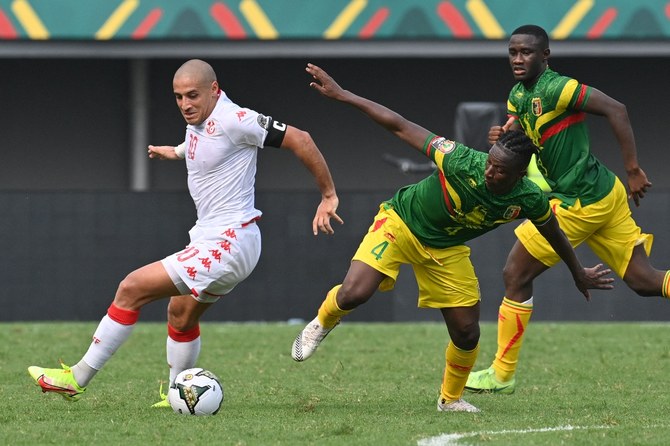

The first three days of the 2021 Africa Cup of Nations had been anything but exciting, as is sometimes the case in tournament group stages. There had been nine goals in nine games, but with the games broadcast around the world to a wider audience than ever before, there was a distinct lack of excitement and drama.
Then came game number 10 between Tunisia and Mali in the Cameroonian city of Limbe, and a sudden explosion of drama that made headlines around the world — but not in a way that anyone would have wanted
The history books will show that Mali beat Tunisia 1-0 in Group F, but while it is common for a defeated team to have deserved more from a game, in this case it is true in a number of ways. Tunisia did not deserve what happened on Wednesday, but neither did Mali and neither did African football.
As is often the case, complaints centered around the referee, but this was different.
Where to start with the performance of Janny Sikazwe? There were two controversial penalty decisions, one for each team, with Mali scoring from the spot and Tunisia failing to convert. And then came a controversial red card. That sometimes happens, but what came next does not. The Zambian official stopped the game after 85 minutes, blowing for full time.
Quickly realizing his error (some speculated that he had failed to stop his watch during the earlier water break), the game restarted, only for the whistle to sound before the 90 minutes were up.
Tunisia, pushing for the equalizer and expecting a good few minutes to be added on, were clearly incensed. Coach Mondher Kebaier and his assistants were quickly on the pitch to remonstrate with the referee, an experienced official who was in charge of two games at the 2018 World Cup.
Sikazwe was escorted off by security staff. The complaints continued. Mali coach Mohamed Magassouba had begun his post-match press conference when he was informed by breathless Confederation of African Football officials that the game would restart to play the additional minutes.
Mali came out, but Tunisia refused.
“The players were taking ice baths for 35 minutes before they were called back out again,” Kebaier said.
“I’ve been coaching for a long time and never seen anything like it. Even the fourth official was preparing to lift the board and then the whistle was blown. The referee’s decision is inexplicable. I can’t understand how he reached it. We’ll see what comes of it.”
Tunisia want a replay, but that will not happen and the 1-0 scoreline is set to stand, leaving the Carthage Eagles with work to do against Mauritania, who beat Gambia in their first game 1-0, the ninth such scoreline from the opening 12 matches.
Given that only eight of the 24 teams in the group stage will be eliminated ahead of the second round, Tunisia, ranked 30 in the world, really should have no worries about progressing, though the top spot is going to be difficult.
Kebaier needs to use this farce to inspire his players to step up and make some different headlines that can help take the team to a first African title since 2004. They have to use their anger to drive them forward.
However, there are bigger issues at play. While there is often too much focus on refereeing decisions to the detriment of the sport, there are certain basics that all expect to be met at all levels of the game.
Timekeeping usually becomes a problem when a referee adds on too much time (like the incredible 19 minutes given in the semifinal of the 2021 Arab Cup between Qatar and Algeria), but stopping a game before the 90 minutes are up is, as the Tunisia boss said, rare indeed.
There had been comments internationally before the game that the lack of action at the tournament had not been a great advert for African football. This did not really matter. AFCON is not an advert for anything — it is the pinnacle of continental football, a competitive tournament fashioned for Africa and for African nations to try to win. If it is an exciting spectacle for the neutral then all well and good, but that is not the primary function.
But what happened between Tunisia and Mali is different. This was a poor advertisement for African football and the headlines around the world have not been kind. The words “farce” and “chaos” are everywhere as media leap on more evidence of African mismanagement and incompetence, while perhaps hinting at something worse. This comes at a time when there have been complaints from Africa that certain parts of the world fail to give enough respect to this tournament. What happened in Limbe will not help.
The expectation is that sooner or later, probably in the knockout stage, the action really will get going on the pitch and then attention will be drawn elsewhere. If everything from here on in goes smoothly then Mali-Tunisia will be a footnote in the events of January and February.
But something similar must not happen again for the sake of African football. From now on, it has to be about the beautiful game, even if it comes a little too late for Tunisia.


