LONDON: The US State Department confirmed on Wednesday that an 80-year-old Palestinian-American man found dead in the West Bank was a US citizen.
Omar Abdalmajeed As’ad was found earlier on Wednesday after being detained and handcuffed during an Israeli raid on an occupied West Bank village, Palestinian officials and relatives said.
The State Department said had been in touch with the Israeli government for clarification over the death.
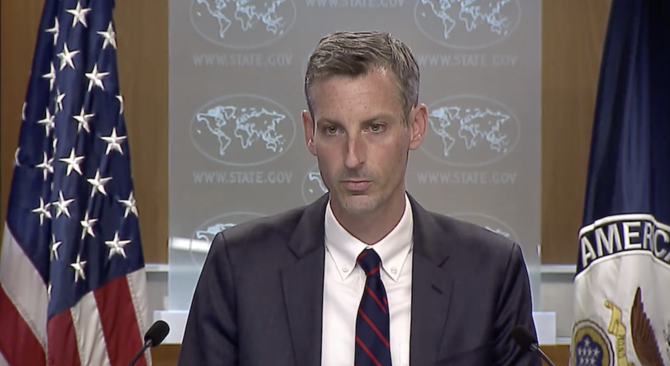
“The Israeli Defense Forces have indicated there’s an ongoing investigation into the matter,” said State Department spokesperson Ned Price, adding: “And we support a thorough investigation into the circumstances of this incident.”
As’ad’s body was found in Jiljilya, a city near Ramallah, in the early morning with a plastic zip-tie still around one wrist.
The Israeli military said it had carried out an overnight operation in the village, and that a Palestinian was “apprehended after resisting a check.” It said he was alive when the soldiers released him.
“The Military Police Criminal Investigation Division is reviewing the incident, at the end of which the findings will be transferred to the Military General Advocate Corps,” it said in a statement.
As’ad was a former Milwaukee, Wisconsin, resident who lived in the United States for decades and returned to the West Bank 10 years ago, his brother told Reuters.
Price told reporters that they have little more that they were able to offer during this time.
“We have been in touch with Mr. As’ad’s family to express our condolences about this tragedy (and) we are providing, as you would expect, all appropriate consular assistance to the family at this time,” he added.
(With Reuters)

US asks Israel for clarification over death of citizen in West Bank
Short Url
https://arab.news/grsfj
US asks Israel for clarification over death of citizen in West Bank
Sweeping US defense bill passes Congress, including real of Syria sanctions
WASHINGTON: The US Senate voted overwhelmingly on Wednesday to advance a $901 billion bill setting policy for the Pentagon, sending the massive piece of legislation to the White House, which has said President Donald Trump will sign it into law. The fiscal 2026 National Defense Authorization Act, or NDAA, is a compromise between separate measures passed earlier this year in the House of Representatives and Senate. It authorizes a record $901 billion in annual military spending, with a 4 percent pay raise for the troops. It also authorizes reforms to the system for acquiring military equipment and includes efforts to boost competitiveness with US archrivals China and Russia.
The Senate backed the bill by 77 to 20, with strong support from both parties. Two of the “no” votes were from Republican senators Mike Lee and Rand Paul.
“This will be the 65th year in a row, the 65th consecutive year, that Congress has come together across the aisle and across two chambers to send the president a bill designed to sustain and strengthen the national defense,” said Senator Roger Wicker of Mississippi, the Republican Senate Armed Services Committee chairman. The House passed the bill last week, by 312 to 112, also with broad bipartisan support. In a break with Trump, whose fellow Republicans hold majorities in both the House and Senate, this year’s NDAA includes several provisions to boost security in Europe, despite Trump’s release earlier this month of a National Security Strategy seen as friendly to Russia and a reassessment of the US relationship with Europe.
The fiscal 2026 NDAA provides $800 million for Ukraine — $400 million in each of the next two years — as part of the Ukraine Security Assistance Initiative, which pays US companies for weapons for Ukraine’s military.
It also authorizes the Baltic Security Initiative and provides $175 million to support Latvia, Lithuania and Estonia’s defense. And it limits the Department of Defense’s ability to drop the number of US forces in Europe to fewer than 76,000 and bars the US European Commander from giving up the title of NATO Supreme Commander.
WINS FOR BOTH PARTIES
Members of Congress take great pride in having passed the NDAA every year for more than six decades.
The measure’s record price tag is $8 billion more than Trump had requested. This month a handful of Republicans and Democrats called for the addition of a provision to strengthen military helicopter safety rules, following a fatal crash between an Army Black Hawk and an American Airlines passenger jet that killed 67 people.
Anger over that issue was not strong enough to derail the NDAA. Senate leaders have promised to address it in upcoming legislation. The NDAA also repeals the tough “Caesar” sanctions imposed on Syria under its former leader Bashar Assad. And it has a provision to withhold a chunk of Defense Secretary Pete Hegseth’s travel budget if he does not provide Congress with unedited videos of military strikes on boats in the southern Caribbean and eastern Pacific. The Trump administration has said the strikes are directed at Venezuelan drug-traffickers. The Senate vote came a day after Trump ordered a blockade of all sanctioned oil tankers entering and leaving Venezuela, his latest move to increase pressure on Venezuelan President Nicolas Maduro’s government.
It repeals the 1991 and 2002 Authorizations for the Use of Military Force (AUMFs) against Iraq, an attempt to reassert Congress’ role in deciding to send troops into combat.
During his first term, Trump said the 2002 AUMF provided legal authority for the 2020 killing in Iraq of senior Iranian military commander Qassem Soleimani.
The NDAA does not include funding to change the name of the Department of Defense to the Department of War, an idea championed by Trump but a change that cannot be formalized without congressional approval.
However, it includes some of the “culture war” efforts popular with politicians on the US right. One measure bars transgender women from participating in athletic programs designated for women at US military academies.
It also codifies into law executive orders by Trump ending diversity, equity and inclusion efforts at the Pentagon.
The Senate backed the bill by 77 to 20, with strong support from both parties. Two of the “no” votes were from Republican senators Mike Lee and Rand Paul.
“This will be the 65th year in a row, the 65th consecutive year, that Congress has come together across the aisle and across two chambers to send the president a bill designed to sustain and strengthen the national defense,” said Senator Roger Wicker of Mississippi, the Republican Senate Armed Services Committee chairman. The House passed the bill last week, by 312 to 112, also with broad bipartisan support. In a break with Trump, whose fellow Republicans hold majorities in both the House and Senate, this year’s NDAA includes several provisions to boost security in Europe, despite Trump’s release earlier this month of a National Security Strategy seen as friendly to Russia and a reassessment of the US relationship with Europe.
The fiscal 2026 NDAA provides $800 million for Ukraine — $400 million in each of the next two years — as part of the Ukraine Security Assistance Initiative, which pays US companies for weapons for Ukraine’s military.
It also authorizes the Baltic Security Initiative and provides $175 million to support Latvia, Lithuania and Estonia’s defense. And it limits the Department of Defense’s ability to drop the number of US forces in Europe to fewer than 76,000 and bars the US European Commander from giving up the title of NATO Supreme Commander.
WINS FOR BOTH PARTIES
Members of Congress take great pride in having passed the NDAA every year for more than six decades.
The measure’s record price tag is $8 billion more than Trump had requested. This month a handful of Republicans and Democrats called for the addition of a provision to strengthen military helicopter safety rules, following a fatal crash between an Army Black Hawk and an American Airlines passenger jet that killed 67 people.
Anger over that issue was not strong enough to derail the NDAA. Senate leaders have promised to address it in upcoming legislation. The NDAA also repeals the tough “Caesar” sanctions imposed on Syria under its former leader Bashar Assad. And it has a provision to withhold a chunk of Defense Secretary Pete Hegseth’s travel budget if he does not provide Congress with unedited videos of military strikes on boats in the southern Caribbean and eastern Pacific. The Trump administration has said the strikes are directed at Venezuelan drug-traffickers. The Senate vote came a day after Trump ordered a blockade of all sanctioned oil tankers entering and leaving Venezuela, his latest move to increase pressure on Venezuelan President Nicolas Maduro’s government.
It repeals the 1991 and 2002 Authorizations for the Use of Military Force (AUMFs) against Iraq, an attempt to reassert Congress’ role in deciding to send troops into combat.
During his first term, Trump said the 2002 AUMF provided legal authority for the 2020 killing in Iraq of senior Iranian military commander Qassem Soleimani.
The NDAA does not include funding to change the name of the Department of Defense to the Department of War, an idea championed by Trump but a change that cannot be formalized without congressional approval.
However, it includes some of the “culture war” efforts popular with politicians on the US right. One measure bars transgender women from participating in athletic programs designated for women at US military academies.
It also codifies into law executive orders by Trump ending diversity, equity and inclusion efforts at the Pentagon.
© 2025 SAUDI RESEARCH & PUBLISHING COMPANY, All Rights Reserved And subject to Terms of Use Agreement.