New COVID-19 cases cross 1,500 mark as omicron sweeps Pakistan

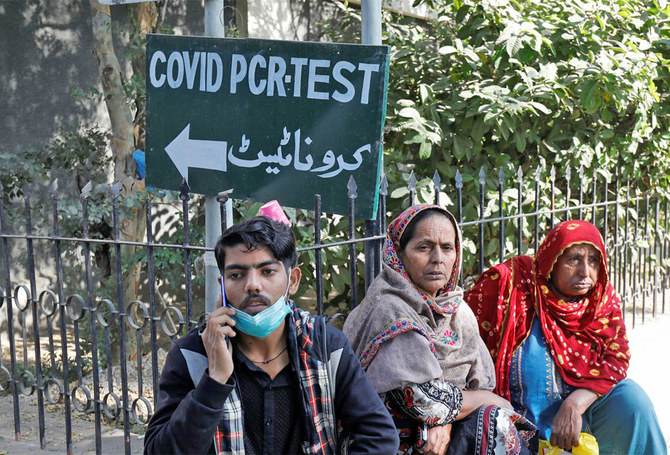
People sit next to a coronavirus disease test sign outside the School of Nursing in Jinnah Postgraduate Medical Centre, in Karachi, Pakistan, on December 9, 2021. (REUTERS)
Short Url
Updated 09 January 2022
Follow

New COVID-19 cases cross 1,500 mark as omicron sweeps Pakistan

  • Pakistan reported 1,572 new COVID-19 cases and seven deaths in the past 24 hours
  • Positivity rate climbed to 3.16 percent after remaining below one percent until last month

ISLAMABAD: New COVID-19 cases crossed the 1,500 mark in Pakistan on Sunday, the highest coronavirus daily caseload since October, as a fifth viral wave is sweeping the country fueled by the highly transmissible omicron strain of the infection.
The omicron variant was first detected in southern Africa and Hong Kong in November, with the first known case in Pakistan identified last month in a woman who had no travel history outside the country.
The National Command and Operation Center (NCOC), which oversees Pakistan’s pandemic response, warned last week that the new variant is already spreading in the country at a “great pace.”
NCOC reported 1,572 new COVID-19 cases and seven deaths in Pakistan the past 24 hours as the country’s test positivity rate increased to 3.16 percent from below 1 percent only about a week ago.

Last week, Planning Minister Asad Umar, who also heads the NCOC, said the new variant has been spreading mostly in big cities.
On Saturday, the chief minister of Sindh Murad Ali Shah said the number of omicron cases in the province had climbed to 328 after 21 more people tested positive between Jan. 6 and Jan. 7. Sindh’s capital is Karachi, Pakistan’s largest city and financial hub.
Out of 24 samples tested in Karachi, at least 21 individuals tested positive for the omicron variant, which meant the prevalence rate of the variant was 87.5 percent, Shah said.
WHO data shows the new strain has spread quickly and emerged in at least 128 countries, presenting dilemmas for many nations and people seeking to reboot their economies and lives after nearly two years of COVID-related disruptions.
However, while case numbers have surged to all-time records, the hospitalization and death rates are often lower than at other phases in the pandemic.


Pakistan, Indonesia sign MoUs to expand cooperation as Islamabad seeks to ease trade imbalance

Updated 4 sec ago
Follow

Pakistan, Indonesia sign MoUs to expand cooperation as Islamabad seeks to ease trade imbalance

  • Pakistan offers to send doctors and medical experts to support Indonesia’s expanding health needs
  • Indonesian president highlights close foreign policy coordination with Pakistan, including on Gaza

ISLAMABAD: Pakistan and Indonesia signed seven memoranda of understanding on Tuesday to deepen cooperation in trade, education and health, with Prime Minister Shehbaz Sharif saying Islamabad aimed to narrow a $4.5 billion bilateral trade imbalance heavily tilted in Jakarta’s favor.

The agreements were concluded during Indonesian President Prabowo Subianto’s two-day visit to Pakistan, his first trip to the country since taking office and the first by an Indonesian head of state in seven years.

Subianto, who arrived on Monday, held detailed talks with Sharif before the signing ceremony.

“Our discussion has been extremely productive,” Sharif said at a joint media appearance. “More than 90 percent of our current imports from Indonesia are palm oil. We have discussed how to take corrective measures to balance this through Pakistan’s agri-exports, IT-led initiatives and other areas.”

Sharif earlier noted Pakistan’s bilateral trade with Indonesia stood at around $4.5 billion, with the imbalance overwhelmingly in Jakarta’s favor.

Subianto thanked Pakistan for what he called an exceptionally warm welcome, noting his aircraft had been escorted by Pakistan Air Force JF-17 fighter jets.

He said the meeting had produced agreements across several fields, including trade, agriculture, education and science and technology.

The Indonesian president also welcomed Pakistan’s offer to help his country address critical shortages of medical professionals.

“Indonesia has vast needs for doctors, dentists and medical experts, and Pakistan’s support in this regard is strategic and critical,” he said.

Sharif noted Pakistan would be ready to send doctors, dentists and medical professors to assist Indonesia’s plans to expand its medical colleges and universities.

He added that Islamabad would “work closely and diligently” with Jakarta to achieve the targets set during the visit.

Subianto said both countries were also coordinating closely on foreign policy, particularly on developments in Gaza, and reaffirmed Indonesia’s support for a two-state solution.

He invited Sharif to visit Jakarta to deepen cooperation under the new agreements.

Pakistan and Indonesia marked the 75th anniversary of diplomatic ties this year, with both leaders saying the visit would help lift relations to what Sharif called “a much higher level” in trade, development and people-to-people links.