

Pakistan army deployed, continues rescue work to save snow-trapped travelers after 22 killed 

In this photo provided by the Inter Services Public Relations, army troops take part in a rescue operation in a heavy snowfall-hit area in Murree, some 28 miles (45 kilometers) north of the capital of Islamabad, Pakistan, Saturday, Jan. 8, 2022. (AP)
Short Url
Updated 09 January 2022
Follow

Pakistan army deployed, continues rescue work to save snow-trapped travelers after 22 killed 

  • Thousands arrived in Murree this week despite authorities’ appeals to postpone plans, snowstorm stranded motorists in freezing cold
  • Rawalpindi police, district administration, Pakistan Army and locals work through Saturday night to rescue people, clear roads

ISLAMABAD: Rescue operations involving the army continued into Sunday morning to evacuate stranded tourists in northern Pakistan where authorities said a day earlier 22 people had died in freezing temperatures while being stranded in their vehicles in the Pakistani hill station of Murree.

The Pakistan Meteorological Department (PMD) had predicted heavy snowfall in Murree and the Galiyat mountainous regions from January 6 to 9. But despite appeals by authorities to postpone plans due to bad weather and roadblocks, tens of thousands of snow-tourists arrived in Murree, 64 km (40 miles) northeast of the capital Islamabad, in the past two days.

On Saturday, the local administration declared Murree “calamity hit,” with long lines of cars stuck in the resort town after a snowstorm made the roads impassable, stranding motorists without food and water in the freezing cold. The Rescue 1122 emergency service announced that 22 people, including nine children, had died.

Prime Minister Imran Khan’s special assistant on communication, Shahbaz Gill, said early Sunday morning that major roads in Murree had been cleared for traffic.

“About 600 to 700 vehicles were evacuated from Murree last [Saturday] night,” Gill wrote on Twitter. “Rawalpindi police, district administration, Pakistan Army men and our locals remained active throughout the night.”

The Pakistan army’s media wing said army engineers’ troops with road clearance machinery were working to clear roads.

“More Than 300 snow affected people including children have been provided medical care by team of army doctors and paramedics. Cooked meal served to more than 1000 stranded people in Jheekagali, Kashmiri Bazar, Lower Topa and Kuldana,” the military said, adding that stranded people had been accommodated and provided shelter with hot meals and tea at various military rescue centers set up in the area. 
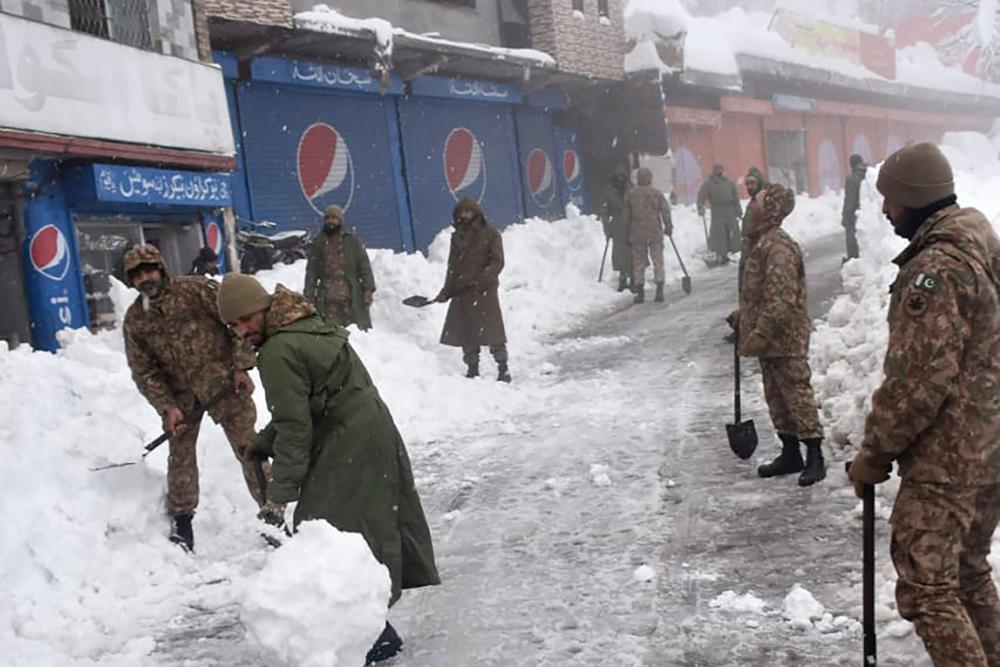


In this photo provided by the Inter Services Public Relations, army members take part in a rescue operation in a heavy snowfall-hit area in Murree, some 28 miles (45 kilometers) north of the capital of Islamabad, Pakistan, Saturday, Jan. 8, 2022. (AP)

On Friday evening, the Islamabad administration announced it was closing the roads leading to Murree for the rest of the weekend “in public interest.”

For hours overnight and well after daybreak on Saturday, thousands of cars lined the snow-clogged roadway as their drivers grew increasingly desperate about their predicament and exasperated by what appeared to be a slow response by authorities.
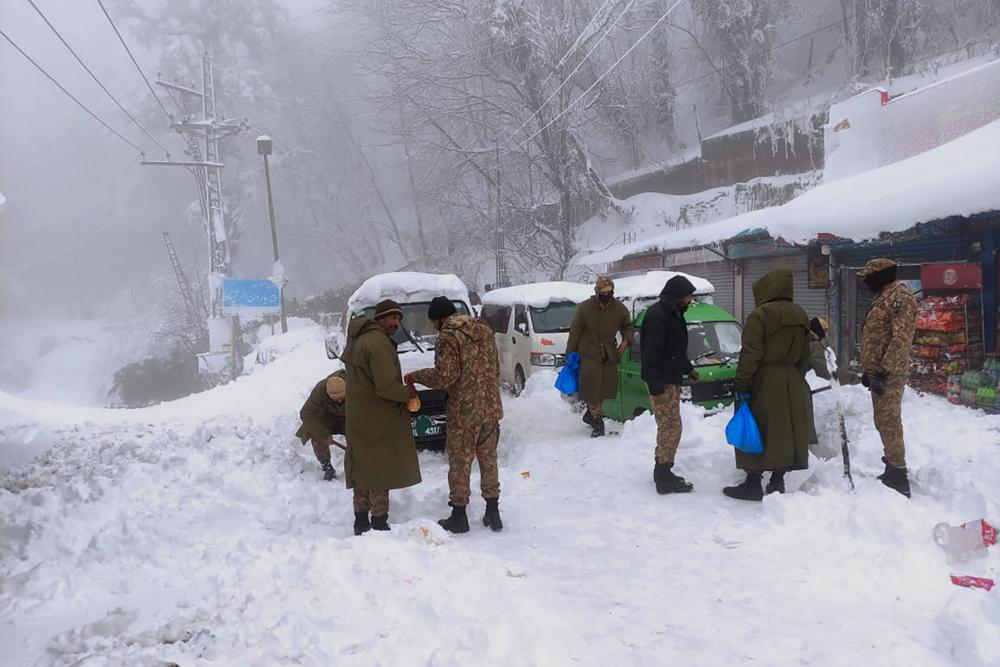


In this photo provided by the Inter Services Public Relations, army members take part in a rescue operation in a heavy snowfall-hit area in Murree, some 28 miles (45 kilometers) north of the capital of Islamabad, Pakistan, Saturday, Jan. 8, 2022. (AP)

Authorities in Rawalpindi, which is adjacent to Islamabad, said on Saturday over 23,000 stranded vehicles had been already evacuated from Murree and around 1,000 were still stranded.

A strong westerly wave entered Pakistan’s western and upper parts earlier this week, producing rain and snowfall. It is forecast to grip the areas until Sunday.


Pakistan embassy, UN Tourism mark International Day of Mountains in Riyadh

Updated 6 sec ago
Follow

Pakistan embassy, UN Tourism mark International Day of Mountains in Riyadh

  • Event highlights Pakistan’s mountain ecosystems, mountaineering heritage, climate risks
  • Diplomats, artists and climbers gather to promote sustainable mountain tourism

ISLAMABAD: The Embassy of Pakistan in Riyadh, in collaboration with the UN Tourism Office, hosted an event this week to mark the United Nations-designated International Day of Mountains, bringing together diplomats, civil society members, mountaineers and artists to spotlight the global and Pakistani significance of mountain ecosystems.

Pakistan is home to some of the world’s largest mountain ranges and glacier systems outside the polar regions, including the Himalayas, Karakoram and Hindu Kush, which feed major rivers that sustain agriculture, hydropower and drinking water for millions of people. Rising temperatures linked to climate change are accelerating glacial melt, increasing the risk of floods, landslides and glacial lake outburst floods, while also threatening long-term water security as ice reserves shrink. 

These changes are already affecting mountain communities whose livelihoods depend on farming, tourism and pastoralism, exposing them to displacement, loss of income and environmental degradation, and amplifying the human and economic costs of extreme weather events across downstream regions.

Ambassador of Pakistan to Saudi Arabia Ahmad Farooq is briefing guests about mountain ecosystems in Pakistan at the UN Tourism Office in Riyadh on December 11, 2025. (Pakistan Embassy in Saudi Arabia)

Held at the UN Tourism Office in Riyadh, Thursday’s event focused on the ecological, cultural and economic importance of mountains, with particular attention to Pakistan’s vast high-altitude landscapes.

The evening opened with a micro-documentary titled Mountains of Pakistan, showcasing the country’s mountain ranges and their ecological value. Ambassador of Pakistan to Saudi Arabia Ahmad Farooq, in his opening remarks, highlighted the essential role mountains play in sustaining water systems, food security and communities, while also drawing attention to the growing threats posed by climate change.

“Mountains are not just landscapes, they are life-giving ecosystems, repositories of culture, and sources of inspiration,” Farooq said. “Tonight, we celebrate not only their beauty but our shared responsibility to protect them for future generations.”

Ambassador of Pakistan to Saudi Arabia Ahmad Farooq posing for picture with guests at the UN Tourism Office in Riyadh on December 11, 2025. (Pakistan Embassy in Saudi Arabia)

He also referred to challenges facing Pakistan’s mountain regions, including climate-change-driven glacial melt and related environmental risks, reaffirming Islamabad’s commitment to sustainable mountain development.

The program included remarks by the director of the UN Tourism Office, who underscored the importance of international cooperation in preserving fragile mountain ecosystems. A second micro-documentary, Spirit of Mountaineering, paid tribute to the courage and resilience of Pakistani climbers and their contributions to global mountaineering.

Among the featured speakers was Naila Kiani, a prominent Pakistani mountaineer and environmental advocate, who shared her experiences scaling some of the world’s highest peaks, including K2 and Nanga Parbat. Kiani is the first Pakistani woman and overall third Pakistani to climb 12 of the 14 eight-thousanders.

A prominent Pakistani mountaineer and environmental advocate, Naila Kiani, is addressing an event to mark International Day of Mountains in Riyadh on December 11, 2025. (Pakistan Embassy in Saudi Arabia)

Ambassador Farrukh Amil, a senior Pakistani career diplomat and former ambassador, spoke about Pakistan’s mountain heritage and ongoing initiatives to promote conservation and eco-tourism, while landscape photographer Awais Ali presented a photographic exhibition capturing the majesty of Pakistan’s northern regions and the lives of their communities.

The event concluded with the formal inauguration of the mountain photography exhibition curated by Ali, offering guests an immersive visual journey through Pakistan’s highlands.

The embassy said the celebration reaffirmed Pakistan’s commitment to raising global awareness about mountain ecosystems, promoting sustainable tourism and fostering international collaboration to address climate challenges affecting these fragile environments.