



DUBAI: The inaugural Future Minerals Forum in Riyadh will mark the beginning of a new era for Saudi Arabia’s mining industry.
Key mining players across the globe are taking part in the event, which is hosted by the Saudi Ministry of Industry and Mineral Resources.
The ministry said that the event promotes three themes: Mining’s contribution to society, reimagining mining, and investing in new and emerging mining regions.
It comes as part of Saudi Vision 2030’s goal to diversify the economy.
Opinion
This section contains relevant reference points, placed in (Opinion field)
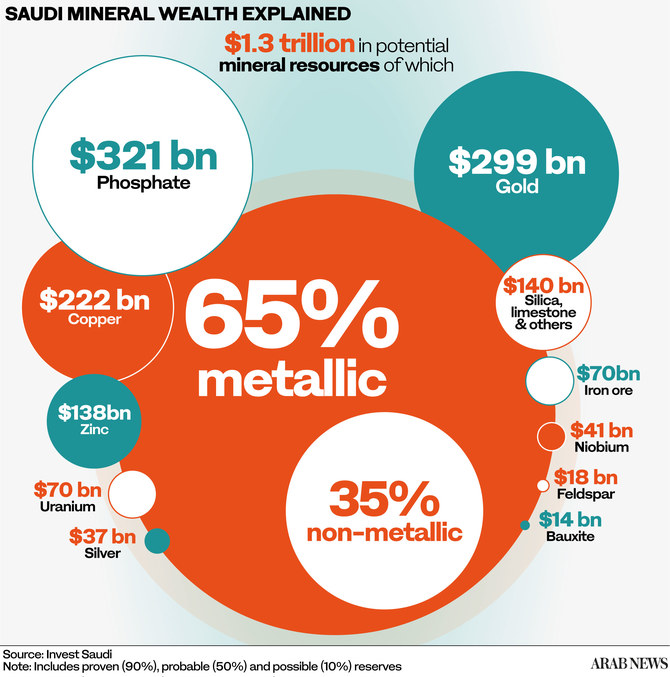
The Kingdom has identified mining as a key sector of the future, with an untapped potential of $1.3 trillion, according to recent data.
Saudi authorities have launched one of the world’s largest geophysical and geochemical surveys, on top of other reforms to fully take advantage of the growing industry.
Organizers are optimistic that miners and global investors will see the opportunities that the emerging region presents.
According to an event briefing document, the Middle East, West and Central Asia, and Africa “represent a blank canvas on which to develop modern mining industries.”
The ministry hopes that the Riyadh forum will kick-start a global conversation about the future of the industry, with minerals expected to play a crucial role in a global energy transition.
The future global economy is characterized by low-carbon technologies including electric vehicles, solar panels and wind turbines, organizers said, adding that these innovations are “powered by mined materials such as copper, zinc, tin, tungsten and lithium.”
More than 2,000 participants are expected to attend the three-day event at the King Abdulaziz International Conference Center.
More than 150 international investors will also attend, along with thought leaders and global speakers who will take part in speaking sessions.
Among the mining leaders and industry experts who have confirmed their attendance to the conference are Canada’s Mark Bristow of Barrick Gold Corporation, Robert Friedland of Ivahone Mines, Anil Agarwal of UK-based Vedanta Resources, Jeffrey Dawes of US-based Komatsu Mining Corporation and Roy Harvey of US aluminum producer Alcoa.
Major Saudi figures are also taking part in the event: Abdulaziz Al-Harbi, CEO of Ma’aden; Yousef Al-Benyan, CEO of SABIC; and NEOM chief Nadhmi Al-Nasr.
A key part of the event is showcasing investment opportunities, drawing major investors and sovereign fund leaders, including officials from Resource Capital Funds, Pacific Road Capital, Rousseau Asset Management, EMR Capital and Sprott.
The forum will discuss the “establishment or transformation of a new, modern and responsible future minerals industry in the Middle East, West and Central Asia, and Africa.”
Attendees will experience an in-depth look at the resource endowment of these regions as well as better understand legal and regulatory frameworks, the organizers said.
Another key theme of the summit is the application of environment, social, and governance principles in the industry. One session will discuss “building a sustainable mining future.”
A brochure said that the event will mark “growing societal expectations for a mining industry that protects the environment, contributes to community development and behaves ethically.”
The Kingdom is optimistic about the potential role of mining in its ambitious diversification strategy, and aims to “emerge as a major new player in global mining.”
#WATCH: The #FutureMineralsForum in #Riyadh will mark the beginning of a new era for #SaudiArabia’s #mining industry. The Kingdom has identified mining as a key sector of the #future, with an untapped potential of $1.3 trillion, according to recent data. #FMF2022 pic.twitter.com/dkb8z6YPnR
— Arab News Business (@ArabNewsBiz) January 9, 2022


