Iran ready for bilateral talks on downed jet, ignores call for reparations

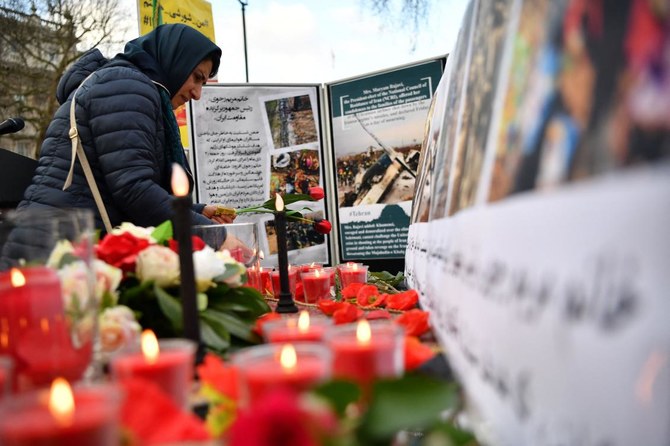
Demonstrators from the Anglo-Iranian Communities in the UK attend a vigil opposite 10 Downing Street, London, for the victims of the Ukrainian airliner which crashed on January 8, killing all 176 onboard. (AFP/File)
Short Url
Updated 07 January 2022
Follow

Iran ready for bilateral talks on downed jet, ignores call for reparations

  • Canada, Britain, Sweden and Ukraine said on Thursday they had abandoned efforts to talk to Tehran about reparations
  • Most of the 176 people killed when Iran shot down the Ukrainian airliner in January 2020

DUBAI: Iran said on Friday it was prepared to hold bilateral talks with concerned countries over a Ukrainian airliner downed by its forces in 2020.
That came after ignoring a joint statement on reparations made by Canada and other states whose citizens were killed.
Canada, Britain, Sweden and Ukraine said on Thursday they had abandoned efforts to talk to Tehran about reparations for an airliner brought down by Iran and would try to settle the matter according to international law.
Most of the 176 people killed when Iran shot down the Ukrainian airliner in January 2020 were citizens from those four nations, which formed a group aiming to hold Tehran to account.
“Despite certain countries’ illegal actions and attempts to exploit this tragic event ..., Iran remains ready to negotiate bilaterally with each of the relevant states,” Iran’s Foreign Ministry said in a statement on state media.
It said any talks should respect “sovereignty, domestic laws and international obligations.”
Tehran says its Revolutionary Guards accidentally shot down the Boeing 737 plane, which was hit at a time when tensions were high between Iran and the United States. Tehran blamed a misaligned radar and an error by the air defense operator.
A Canadian court this week awarded nearly $84 million plus interest to the families of six people who died. In June, Canada said it had found no evidence that the downing of the plane had been premeditated.


Army chief says Switzerland can’t defend itself from full-scale attack

Updated 2 sec ago
Follow

Army chief says Switzerland can’t defend itself from full-scale attack

ZURICH: Switzerland cannot defend itself against a full-scale attack and must boost military spending given rising risks from Russia, the head of ​its armed forces said.
The country is prepared for attacks by “non-state actors” on critical infrastructure and for cyberattacks, but its military still faces major equipment gaps, Thomas Suessli told the NZZ newspaper.
“What we cannot do is defend against threats from a distance or even a full-scale ‌attack on ‌our country,” said Suessli, who is ‌stepping ⁠down ​at ‌the end of the year.
“It’s burdensome to know that in a real emergency, only a third of all soldiers would be fully equipped,” he said in an interview published on Saturday.
Switzerland is increasing defense spending, modernizing artillery and ground systems ⁠and replacing aging fighter jets with Lockheed Martin F-35As.
But the ‌plan faces cost overruns, while ‍critics question spending on artillery ‍and munitions amid tight federal finances.
Suessli said ‍attitudes toward the military had not shifted despite the war in Ukraine and Russian efforts to destabilize Europe.
He blamed Switzerland’s distance from the conflict, its lack of ​recent war experience and the false belief that neutrality offered protection.
“But that’s historically ⁠inaccurate. There are several neutral countries that were unarmed and were drawn into war. Neutrality only has value if it can be defended with weapons,” he said.
Switzerland has pledged to gradually raise defense spending to about 1 percent of GDP by around 2032, up from roughly 0.7 percent now – far below the 5 percent level agreed by NATO countries.
At that pace, the Swiss military would only be ‌fully ready by around 2050.
“That is too long given the threat,” Suessli said.