

Iran displays missiles amid nuclear talks with world powers

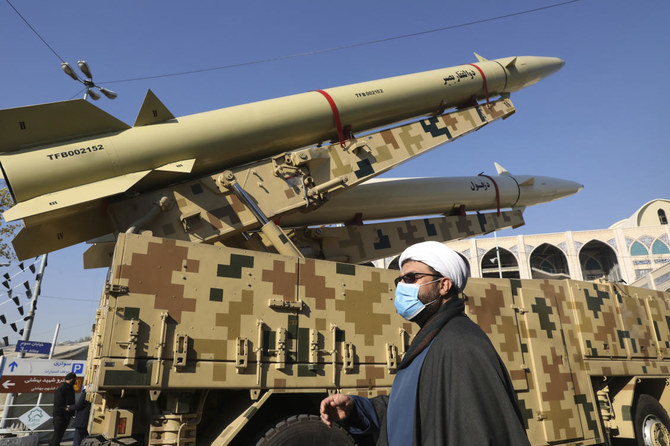
A cleric walks past Zolfaghar, top, and Dezful missiles displayed in a missile capabilities exhibition at Imam Khomeini grand mosque in Tehran, Iran on Jan. 7, 2022. (AP)
Short Url
Updated 08 January 2022
Follow

Iran displays missiles amid nuclear talks with world powers

  • The missiles, known as Dezful, Qiam and Zolfaghar and with official ranges of up to 1,000 kilometers, are already-known models

DUBAI/PARIS : Iran displayed three ballistic missiles at an outdoor prayer esplanade in central Tehran on Friday as talks in Vienna aimed at reviving Tehran’s nuclear deal with world powers flounder.

The missiles — known as Dezful, Qiam and Zolfaghar — have official ranges of up to 1,000 km and are already-known models, the paramilitary Revolutionary Guard said.

A report by Iranian state television said the missiles on display were the same types as those used to strike US bases in Iraq.

The display came on the second anniversary of a ballistic missile attack on bases housing American troops in Iraq in retaliation for the US drone strike that killed top Iranian general Qassem Soleimani in Baghdad in 2020.

Diplomats from countries that remain in the 2015 nuclear deal — Britain, France, Germany, Russia and China — are working with Tehran to revive the accord, which had sought to limit Iran’s nuclear ambitions in exchange for lifting of economic sanctions.

HIGHLIGHT

The missiles — known as Dezful, Qiam and Zolfaghar — have official ranges of up to 1,000 km and are already-known models, the paramilitary Revolutionary Guard said.

American diplomats are present at the nuclear talks in Vienna but they are not in direct talks with Iranians. The accord collapsed in 2018 when then-President Donald Trump unilaterally withdrew the US from the deal and reimposed sanctions on Iran.

Western diplomats have indicated they are hoping to have a breakthrough by the end of January or early February, but sharp differences remain with the toughest issues still unresolved. Iran has rejected any deadline imposed by Western powers.

“I remain convinced we can reach a deal. Bits of progress have been made in the last few days,” Jean-Yves Le Drian, France’s foreign minister, told BFM TV and RMC Radio. “We have been heading in a positive direction in the last few days, but time is of the essence, because if we don’t get an accord quickly there will be nothing to negotiate.”

The eighth round of talks, the first under Iran’s new hard-line President Ebrahim Raisi, resumed on Monday after adding some new Iranian demands to a working text.

Another important development this week was the arrival in Vienna of South Korea’s Vice Foreign Minister to discuss with Iran, the US and other parties the possible release of $7 billion in frozen Iranian assets held in the Asian country because of US sanctions.

Any release would need to be approved by Washington.

The ministry said in a statement that the vice minister had agreed with the Iranians that the release of the frozen assets “should take place in an urgent manner.”

“It will be discussed at the sanctions removal working groups in Vienna,” an Iranian official said, clarifying that the funds would not be released immediately.

Western powers have said progress was too slow and negotiators had “weeks not months” left before the 2015 deal becomes meaningless.


Lebanon ex-central bank chief's corruption case being sent to top court, officials say

Updated 10 sec ago
Follow

Lebanon ex-central bank chief's corruption case being sent to top court, officials say

BEIRUT: The corruption case of Lebanon's former central bank governor, who is widely blamed for the country’s economic meltdown, has been transferred to the country's highest court, judicial officials told The Associated Press on Tuesday.
Riad Salameh was released on $14 million bail in September after a year in prison while awaiting trial in Lebanon on corruption charges, including embezzlement and illicit enrichment.
The trial of Salameh, 75, and his two legal associates, Marwan Khoury and Michel Toueini, will now be heard at the Court of Cassation, according to a copy of the notice obtained by the AP. Salameh and the others will be issued with arrest warrants if they don't show up for trial at the court.
No trial date has been set yet. Salameh denies the charges. The court’s final ruling can't be appealed, according to the four officials who spoke on condition of anonymity, because they weren't authorized to speak with the media.
In September 2024, he was charged with the embezzlement of $42 million, with the court later adding charges of illicit enrichment over an apartment rented in France, supposedly to be a substitute office for the central bank if needed. Officials have said that Salameh had rented from his former romantic partner for about $500,000 annually.
He was once celebrated for steering Lebanon’s economic recovery, after a 15-year civil war, upon starting his long tenure in 1993 and keeping the fragile economy afloat during long spells of political gridlock and turmoil.
But in 2023, he left his post after three decades with several European countries investigating allegations of financial crimes. Meanwhile, much of the Lebanese blame his policies for sparking a fiscal crisis in late 2019 where depositors lost their savings, and the value of the local currency collapsed.
On top of the inquiry in Lebanon, he is being investigated by a handful of European countries over various corruption charges. In August 2023, the United States, United Kingdom and Canada imposed sanctions on Salameh.
Salameh has repeatedly denied allegations of corruption, embezzlement and illicit enrichment. He insists that his wealth comes from inherited properties, investments and his previous job as an investment banker at Merrill Lynch.
Lebanon’s current central bank governor, Karim Souaid, announced last week that he's filing legal complaints against a former central bank governor and former banking official who diverted funds from the bank to what he said were four shell companies in the Cayman Islands. He didn't name either individual.
But Souaid said that Lebanon's central bank would become a plaintiff in the country's investigation into Forry Associates. The U.S. Treasury, upon sanctioning Salameh and his associates, described Forry Associates as “a shell company owned by Raja (Salameh’s brother) in the British Virgin Islands” used to divert about $330 million in transactions related to the central bank.
Several European countries, among them France, Germany, and Luxembourg, have been investigating the matter, freezing bank accounts and assets related to Salameh and his associates, with little to no cooperation from the central bank and Lebanese authorities.
Souaid said that he will travel later this month to Paris to exchange “highly sensitive” information as France continues its inquiries.