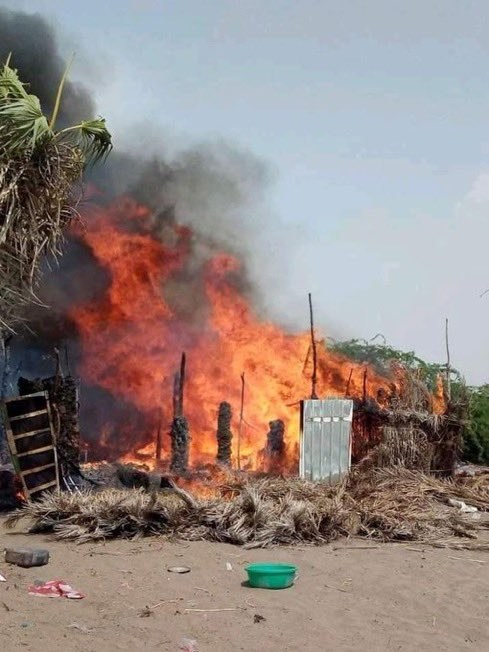

AL-MUKALLA: The Iran-backed Houthis set ablaze dozens of empty houses belonging to the Yemeni government supporters in the western province of Hodeidah as they kicked off reprisal attacks against people who opposed them, residents told Arab News on Thursday.
Military officials and ordinary people who had supported the government forces in Hodeidah said that armed Houthis stormed several villages in the province’s Durihimi district and burnt their houses and seized their property.
“The Houthis burnt more than 40 houses belonging to 40 families and confiscated our farms,” Ibrahim Al-Lahji, a military official at the government’s Tehama Resistance, said.
Images posted on social media showed several huts on fire.
Al-Lahji is among hundreds of local people who joined the Arab coalition-backed Yemeni forces that took part in a major military offensive that led to seizing control of a large swathe of land in Hodeidah province in December 2018.
In November last year, the Yemeni forces announced an unexpected withdrawal from areas under their control as part of a coalition-sponsored plan to reinforce government troops battling the Houthis in the other parts of Yemen.
Fearing Houthi reprisal attacks, many families fled their homes and took shelter in government-controlled areas in southern Yemen. “They have taken all our belongings and property. We urge people to assist us,” Lahji said from a safer location in the government-controlled province of Hadramout.
Muammar Al-Eryani, Yemen’s minister of information, on Thursday strongly condemned the Houthi revengeful raids on houses of civilians in Hodeidah, repeating his government’s demands to the world to punish the terrorist Houthis for their crimes.
1- We strongly condemn the crime of burning more than (40) houses of citizens in the villages of (Al-Taif, Markoudha, Al-Shujaira, Al-Nakhila) located southern of Hodeidah city. pic.twitter.com/hZf9b7clWa
— معمر الإرياني (@ERYANIM) January 5, 2022
He said on Twitter that his government demanded that the UN and human rights organizations “clearly and explicitly condemn this heinous terrorist crime.”
He called on the international community to designate “the Houthi militia as a terrorist organization and prosecute its leaders in international courts as war criminals.”
Since seizing power militarily in late 2014, the Houthis have abducted thousands of people and put on trial hundreds of military commanders, politicians, activists, journalists and tribal and religious leaders, confiscating their houses and other property in Sanaa.
On the ground, heavy fighting between the Houthis and government troops broke out on Thursday in the southern Shabwa province as loyalists pushed to seize back two districts in the oil-rich area.
The government’s Giants Brigades attacked the Houthis in areas between Bayhan and Ouselan to seize control of a strategic road linking Shabwa with Marib, an important supply route for the Houthis.
A local official told Arab News that at least 14 government soldiers were killed and eight more were wounded on Wednesday when a missile fired by the Houthis exploded at a house in Ouselan district during a meeting for local military officials.
“The missile strike hit the house of Ouselan district director who was holding a meeting with military leaders,” the official said, adding that the leaders, including Hamedi Shoukri from the Giant Bridges, were unharmed.
Earlier this month, the Giants Bridges launched a push in Shabwa province to expel the Houthis from the districts of Al-Aid, Bayhan and Ouselan.
The Yemeni military forces recaptured Ouselan district and are currently marching towards Al-Aid and Bayhan.
Heavy fighting also sparked in Marib province where government troops scored limited military gains in Juba district in the south and Al-Kasara in the west.
The Arab coalition supporting the Yemeni government forces said it killed more than 390 Houthis and destroyed 44 of their vehicles in 63 air raids in the provinces of Marib and Shabwa over the past 24 hours.
Thousands of combatants and civilians have been killed since early last year when the Houthis renewed an offensive to control the energy-rich city of Marib, the government’s last bastion in the north.

keywords