

Blair’s defense secretary says he was ordered to burn crucial document ahead of Iraq war

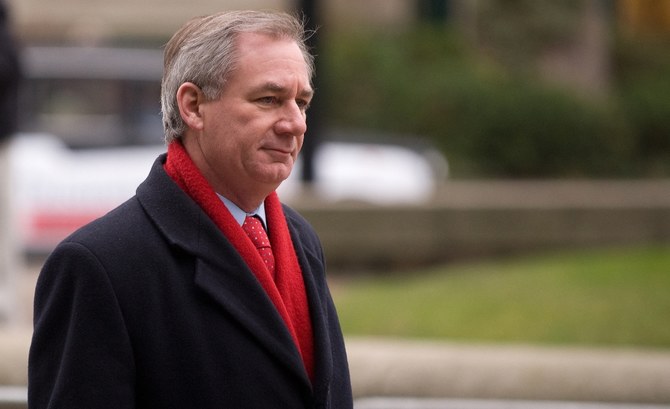
Geoff Hoon builds on 2015 allegations that secret memo exposed how invasion could be illegal. (File/AFP)
Short Url
Updated 05 January 2022
Follow

Blair’s defense secretary says he was ordered to burn crucial document ahead of Iraq war

  • Geoff Hoon builds on 2015 allegations that secret memo exposed how invasion could be illegal
  • Blow-by-blow account detailed as pressure mounts to strip former UK PM of knighthood

LONDON: Tony Blair’s defense secretary during the invasion of Iraq has bolstered a campaign to strip the former British prime minister of his knighthood by revealing that he was ordered to burn a secret document that detailed how the war could be illegal.

In his new memoir “See How They Run,” Geoff Hoon said Blair’s chief of staff, Jonathon Powell, told his private secretary “in no uncertain terms” to destroy the document.

Blair rubbished the claim when it first emerged in 2015, but Hoon has now stood by the accusations in a detailed account.

In his book, Hoon outlines how the Ministry of Defense civil servant was shocked by Powell’s demand, and that they opted to ignore Downing Street’s “burn it” orders by locking the memo in a safe instead.

He describes his shock at being told to destroy secret advice on the legality of the conflict, which came from the Attorney General Lord Goldsmith. Days before fighting began, Goldsmith changed his mind and gave the British invasion a legal green light.

Hoon, who has since retired from frontline politics, goes on to claim that Blair signed a “deal in blood” with former US President George Bush to support the war a year before it kicked off.

The former minister also argues that he paid the price of his political downfall after standing up against the war, claiming that he was sacked and “hung out to dry” by Blair who was looking to escape blame for the deeply unpopular invasion and continuing conflict.

The fresh allegations come as a furore broke out over the British Queen Elizabeth II’s decision to knight Blair, who will now take the title Sir Tony. More than 680,000 people have signed a petition calling for Blair’s knighthood to be retracted.

The Chilcot report, the official review into the Iraq war, dealt with Hoon’s controversy and the issues surrounding Lord Goldsmith’s legal advice.

The report found “that the circumstances in which it was decided that there was a legal basis for UK military action were far from satisfactory.”

Human rights lawyer Philippe Sands revealed Goldsmith’s legal advice in his 2005 book “Lawless World.”

He told the Daily Mail: “When Lord Goldsmith wrote the legal advice warning that war in Iraq could be illegal, he can hardly have expected that those who received a copy would be told to ‘burn after reading.’

“Yet Mr Hoon says that this is what he was told, offering further confirmation of what has long been known — ministers, parliament, and the public were misled by Mr Blair into supporting a war that was seen by many as unlawful and a crime.

“In modern Britain, it seems, such a manifest act of wrongdoing does not preclude the offering of a high-level gong.”


Afghan mothers seek hospital help for malnourished children

Updated 11 sec ago
Follow

Afghan mothers seek hospital help for malnourished children

HERAT: Najiba, 24, keeps a constant watch over her baby, Artiya, one of around four million children at risk of dying from malnutrition this year in Afghanistan.
After suffering a bout of pneumonia at three months old, Artiya’s condition deteriorated and his parents went from hospital to hospital trying to find help.
“I did not get proper rest or good food,” affecting her ability to produce breast milk, Najiba said at Herat Regional Hospital in western Afghanistan.
“These days, I do not have enough milk for my baby.”
The distressed mother, who chose not to give her surname for privacy reasons, said the family earns a living from an electric supplies store run by her husband.
Najiba and her husband spent their meagre savings trying to get care for Artiya, before learning that he has a congenital heart defect.
To her, “no one can understand what I’m going through. No one knows how I feel every day, here with my child in this condition.”
“The only thing I have left is to pray that my child gets better,” she said.
John Aylieff, Afghanistan director at the World Food Programme (WFP), said women are “sacrificing their own health and their own nutrition to feed their children.”
Artiya has gained weight after several weeks at the therapeutic nutrition center in the Herat hospital, where colorful drawings of balloons and flowers adorn the walls.
Mothers such as Najiba, who are grappling with the reality of not being able to feed their children, receive psychological support.
Meanwhile, Artiya’s father is “knocking on every door just to borrow money” which could fund an expensive heart operation on another ward, Najiba said.

- ‘Staggering’ scale -

On average, 315 to 320 malnourished children are admitted each month to the center, which is supported by medical charity Doctors Without Borders (MSF).
The number of cases has steadily increased over the past five years, according to Hamayoun Hemat, MSF’s deputy coordinator in Herat.
Since the Taliban regained power in 2021, low-income families have been hit hard by cuts to international aid, as well as drought and the economic fallout of five million Afghans forced across the border from Iran and Pakistan.
“In 2025, we’d already seen the highest surge in child malnutrition recorded in Afghanistan since the beginning of the 21st century,” Aylieff said in Kabul.
The crisis is only set to worsen this year, he told AFP: “A staggering four million children in this country will be malnourished and will require treatment.”
“These children will die if they’re not treated.”
WFP is seeking $390 million to feed six million Afghans over the next six months, but Aylieff said the chance of getting such funds is “so bleak.”
Pledges of solidarity from around the globe, made after the Taliban government imposed its strict interpretation of Islamic law, have done little to help Afghan women, the WFP director said.
They are now “watching their children succumb to hunger in their arms,” he said.

- ‘No hope’ -

In the country of more than 40 million people, there are relatively few medical centers that can help treat malnutrition.
Some families travel hundreds of kilometers (miles) to reach Herat hospital as they lack health care facilities in their home provinces.
Wranga Niamaty, a nurse team supervisor, said they often receive patients in the “last stage” where there is “no hope” for their survival.
Still, she feels “proud” for those she can rescue from starvation.
In addition to treating the children, the nursing team advises women on breastfeeding, which is a key factor in combating malnutrition.
Single mothers who have to work as cleaners or in agriculture are sometimes unable to produce enough milk, often due to dehydration, nurse Fawzia Azizi said.
The clinic has been a lifesaver for Jamila, a 25-year-old mother who requested her surname not be used out of privacy concerns.
Jamila’s eight-month-old daughter has Down’s syndrome and is also suffering from malnutrition, despite her husband sending money back from Iran where he works.
Wrapped in a floral veil, Jamila said she fears for the future: “If my husband is expelled from Iran, we will die of hunger.”