HONG KONG: Hong Kong announced a two-week ban on incoming flights from eight countries on Wednesday and tightened local COVID-19 restrictions as authorities feared a fifth wave of coronavirus in the city.
The latest restrictions were announced as health authorities scoured the city for the contacts of a COVID-19 patient, some of whom had been aboard a Royal Caribbean ship that was ordered to cut short its “cruise to nowhere” and return to port.
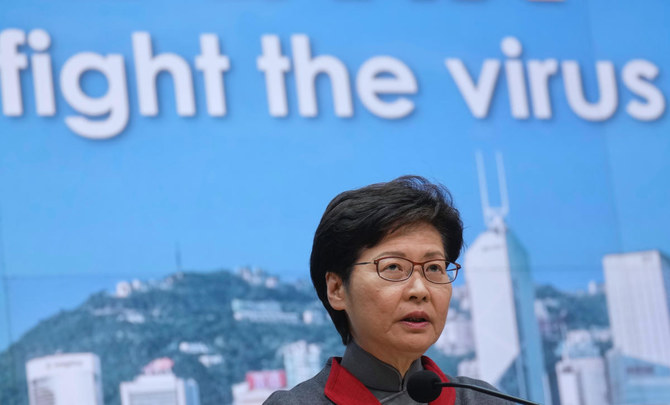
Incoming flights from Australia, Canada, France, India, Pakistan, Philippines, Britain and the United States, including interchanges, would be banned from Jan. 8 to Jan. 21, Hong Kong leader Carrie Lam told reporters on Wednesday.
Lam said the government would ban indoor dining after 6.00 p.m. from Friday, and close swimming pools, sports centers, bars and clubs, museums, and other venues for at least two weeks. Future cruise journeys would be canceled.
“We’re yet to see a fifth wave yet, but we’re on the verge,” Lam said.
The global finance hub has stuck to a zero-COVID strategy by largely isolating itself from the world and enforcing a draconian and costly quarantine regime.
On Dec. 31, a streak of three months without community cases ended with the first local transmission of the new omicron variant.
Since then, authorities have scrambled to track down and test hundreds of people who had been in contact with a handful of omicron patients. One patient, however, had no known links, raising fears of a large outbreak.
“We are worried there may be silent transmission chains in the community,” Lam said. “Some confirmed cases had a lot of activities before being aware they got infected.”
The latest contact tracing campaign was sparked by a patient who danced with some 20 friends in a central park on New Year’s Eve. Two of the fellow dancers, one of whom was a domestic helper, came up positive in preliminary tests.
The helper’s employer and eight other of her close contacts then went on a cruise journey on Jan. 2.
As part of its coronavirus restrictions, Hong Kong has restricted cruises to short trips in nearby waters, with ships asked to operate at reduced capacity and to only allow vaccinated passengers who test negative for the virus.
The “Spectrum of the Seas” ship, which returned a day early, had about 2,500 passengers and 1,200 staff on board. The nine close contact passengers were isolated from the rest of the people on board and preliminary tests taken during the journey returned negative results, authorities said.

Hong Kong bans some inbound flights, tightens domestic COVID-19 restrictions
https://arab.news/ngemd
Hong Kong bans some inbound flights, tightens domestic COVID-19 restrictions
- Incoming flights from Australia, Canada, France, India, Pakistan, Philippines, Britain and the United States, including interchanges, would be banned from Jan. 8 to Jan. 21
Trump’s Iran war violates international law, experts say
- Mary Ellen O’Connell, a professor at the University of Notre Dame, said the attack on Iran “had no justification under international law“
- “The US probably could have prevented any Israeli attack on Iran by virtue of the leverage afforded by critical US military support,” said Finucane
WASHINGTON: The United States insists it attacked Iran to curb “direct threats” from the Islamic republic, but legal experts say the dangers cited by Washington do not justify war under international law.
US and Israeli forces launched a massive air campaign against Iran on February 28, with Washington saying it aimed to curb nuclear and missile threats from Tehran. Yet the war has also decapitated the country’s government, and President Donald Trump is now demanding “unconditional surrender.”
The White House laid out Washington’s justification for the war during a news conference this week.
“This decision to launch this operation was based on a cumulative effect of various direct threats that Iran posed to the United States of America, and the president’s feeling, based on fact, that Iran does pose (an) imminent and direct threat,” Press Secretary Karoline Leavitt said Wednesday.
She went on to cite Iranian sponsorship of “terrorism,” its ballistic missile program and its alleged efforts to “create nuclear weapons and nuclear bombs.”
But Mary Ellen O’Connell, a professor at the University of Notre Dame, said the attack on Iran “had no justification under international law.”
“The law is clear that international disputes are to be resolved using peaceful means — negotiation, mediation, the intervention of international organizations,” said O’Connell, an expert in international law on the use of force and international legal theory.
The Trump administration has offered “vague mentions of imminent attacks by Iran and to prevent Iran from acquiring a nuclear weapon,” while the UN Charter “requires, at the least, that evidence of a significant attack by Iran be underway,” she said.
- ‘Even less plausible’ -
“No shred of such evidence has been provided. Nor is there any right whatsoever to start a war over a weapons program.”
While Leavitt cited threats from missiles and militants, US Secretary of State Marco Rubio offered a different justification for the war earlier in the week: fears that an Israeli attack would trigger reprisals against US forces.
Brian Finucane, senior adviser for the International Crisis Group’s US Program, said there were several issues with Rubio’s explanation, including that the Trump administration has since offered other rationales for the war.
“The US probably could have prevented any Israeli attack on Iran by virtue of the leverage afforded by critical US military support,” said Finucane, who previously worked in the Office of the Legal Adviser at the US Department of State.
The Iran war is not the only legally dubious military intervention by the Trump administration.
In early September, the United States began carrying out strikes on alleged drug-smuggling boats in the Caribbean and later the eastern Pacific — a campaign that has killed more than 150 people.
The US government has yet to provide definitive evidence that the vessels it targets are involved in drug trafficking, and legal experts and rights groups say the strikes likely amount to extrajudicial killings.
Trump also ordered strikes on Iranian nuclear sites last year, and sent US forces into Caracas in early January to seize leftist Venezuelan leader Nicolas Maduro, who is now on trial in the United States.
Finucane said Trump’s Friday demand for “unconditional surrender” by Iran “further undercuts prior justifications for US military action.”
“The administration has not even bothered to argue that Operation Epic Fury complies with international law, but certainly statements like this make any such argument even less plausible,” he said, referring to the Iran operation.


