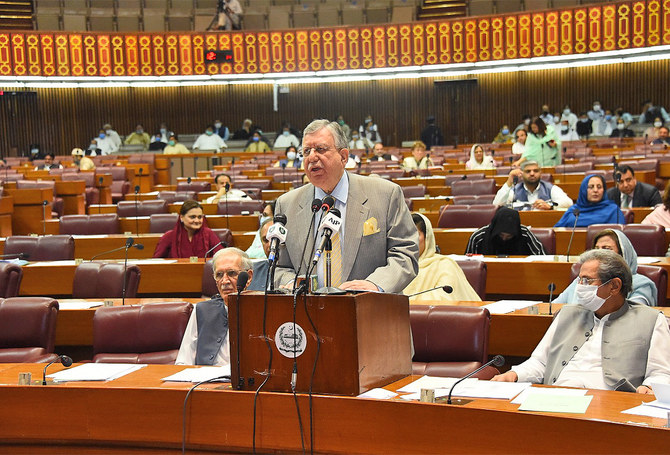
KARACHI: Pakistan’s finance minister Shaukat Tarin on Tuesday presented a contentious finance bill, popularly known as the ‘mini budget,’ in the Senate for the revival of a $6 billion International Monetary Fund (IMF) loan program, amid uproar from opposition parties.
The Finance (Supplementary) Bill 2021, which was presented in the lower house of parliament last week, aims to end tax exemptions on nearly 150 items as a prior action for the revival of the IMF program.
It will empower the government to level a uniform 17 percent General Sales Tax (GST) on goods that were taxed at 5 percent or 12 percent rates. The amendment will also enable the government to generate over Rs343 billion in additional revenue.
The Senate chairman on Tuesday sent the supplementary bill to standing committee on finance for a review. The committee will submit its recommendations within three days.
Opposition senators protested the bill, saying it was being presented on the conditions of the IMF and the government’s next move would be an increase in the power tariff.
“The finance minister has said that petroleum prices have been increased on the recommendation of the IMF and that the IMF was under the pressure of USA,” Pakistan Peoples Party (PPP) Senator Raza Rabbani said, while speaking on the floor of the Senate.
“People want to know what American pressure was that. The nation will resist IMF and USA pressure.”
Calling the mini-budget an anti-people budget, Senator Sherry Rehman said this bill would be “a cause of the fall of this government.”
“The government of Pakistan Tehreek-e-Insaf (PTI) will fall because of mini-budget and its other controversial bills,” she said.
Pakistani opposition lawmakers and economists have warned that the measures introduced by the government are anti-growth and will trigger inflation.
Earlier, Shehbaz Sharif, the leader of the opposition in the National Assembly, described the mini-budget as a “death knell” for the country, while PPP chairman Bilawal Bhutto-Zardari called it an “anti-public budget.”
The measures Pakistan has agreed to meet for the IMF would have a monetary impact of around Rs600 billion, including around Rs350 billion through tax exemption withdrawals and new tax imposition, Rs200 billion through cuts in development funds, and Rs50 billion through other adjustments.
The government has downplayed the opposition’s fears of the mini-budget causing more inflation in Pakistan. Finance minister Shaukat Tarin said new taxes worth only Rs2 billion were being imposed, which would not lead to widespread inflationary pressures.
The IMF executive board will meet on January 12 to decide whether it should revive the stalled loan program, which the two sides entered in 2019 to limit the South Asian nation’s mounting debts and stave off a looming balance-of-payments crisis, in exchange for tough austerity measures.
Five reviews of the program had been completed by March. The sixth review has been pending since June 2021. The revival of the IMF program would allow the release of over $1 billion loan tranche to Pakistan, which would bring total disbursements to over $3 billion. The IMF program revival would also unlock significant funding from bilateral and multilateral donors.
The finance ministry on Sunday said the government had introduced both the bills in the National Assembly, and the IMF had moved the 6th tranche recommendation to its board for consideration on January 12.
As soon as the prior actions are completed by Pakistan, “which the government is pushing hard, the IMF board will consider it for approval. IMF board can move whenever our actions are completed,” it said in a statement.


![]()

Pakistan presents mini-budget in Senate as prior action for IMF loan program revival
Short Url
https://arab.news/c2drz
Pakistan presents mini-budget in Senate as prior action for IMF loan program revival
- Senate’s finance committee will review amendments and submit recommendations within three days
- Amendment bill seeks waiver of tax exemptions to generate around Rs343 billion additional revenues
Latest updates


© 2026 SAUDI RESEARCH & PUBLISHING COMPANY, All Rights Reserved And subject to Terms of Use Agreement.