

Blair knighthood stirs controversy over Iraq, Afghanistan wars

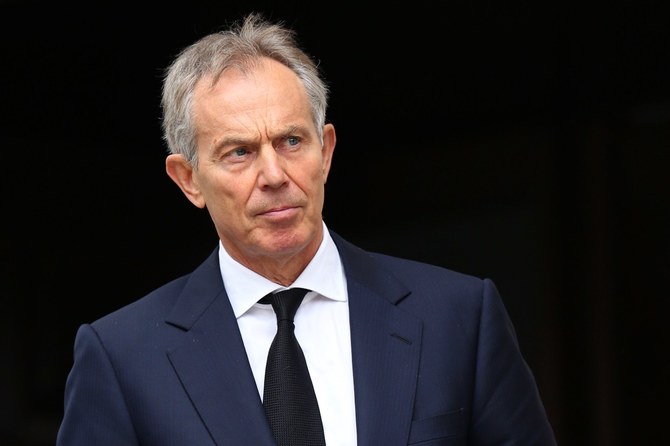
Sir Tony Blair was named a knight companion of the most noble order of the garter in the queen's 2021 honors list. (File/AFP)
Short Url
Updated 04 January 2022
Follow

Blair knighthood stirs controversy over Iraq, Afghanistan wars

  • Over 550,000 people have signed a petition against knighthood of ex-UK PM
  • He remains a controversial figure for leading Britain into invasions of Iraq, Afghanistan

LONDON: More than half a million people have called on the British government to rethink the award of a knighthood to former Prime Minister Tony Blair.

Sir Tony, who served as prime minister from 1997 to 2007, was named a knight companion of the most noble order of the garter — the highest accolade possible — in the queen’s honors list for 2021.

An online public petition calling on the government to push the queen to rescind the honor has accrued over 550,000 signatures.

The petition says: “Tony Blair caused irreparable damage to both the constitution of the United Kingdom and to the very fabric of the nation’s society. He was personally responsible for causing the death of countless innocent, civilian lives … in various conflicts. For this alone he should be held accountable for war crimes.”

Online petitions in the UK have legal standing if they are created on Parliament’s website — this one was not.

If petitions reach 100,000 signatures on the parliamentary website, they must be considered for debate by MPs.

Sir Tony, who led the Labour Party, has been a controversial figure in UK politics ever since he led the country into the invasions of Afghanistan and Iraq, which led to the deaths of hundreds of British soldiers.

Labour Party leader Sir Keir Starmer defended the award, telling ITV’s “Good Morning Britain” program: “I think he deserves the honor. Obviously I respect the fact that people have different views.”

He added: “I understand there are strong views on the Iraq war. There were back at the time and there still are, but that does not detract from the fact that Tony Blair was a very successful prime minister of this country and made a huge difference to the lives of millions of people in this country.”

Hungary says it will block a key EU loan to Ukraine until Russian oil shipments resume

Updated 9 sec ago
Follow

Hungary says it will block a key EU loan to Ukraine until Russian oil shipments resume

  • Szijjártó said: “As long as Ukraine blocks the resumption of oil supplies to Hungary, Hungary will block European Union decisions that are important and favorable for Ukraine”
  • Hungary’s decision to block the key funding came two days after it suspended diesel shipments

BUDAPEST: Hungary will block a planned 90-billion-euro ($106-billion) European Union loan to Ukraine until the flow of Russian oil through the Druzhba pipeline resumes, Hungary’s foreign minister said.
Russian oil shipments to Hungary and Slovakia have been interrupted since Jan. 27 after what Ukrainian officials said was a Russian drone attack damaged the Druzhba pipeline, which carries Russian crude across Ukrainian territory and into Central Europe.
Hungary and Slovakia, which have both received a temporary exemption from an EU policy prohibiting imports of Russian oil, have accused Ukraine — without providing evidence — of deliberately holding up supplies. Both countries ceased shipping diesel to Ukraine this week over the interruption in oil flows .
In a video posted on social media Friday evening, Foreign Minister Péter Szijjártó accused Ukraine of “blackmailing” Hungary by failing to restart shipments. He said his government would block a massive interest-free loan the EU approved in December to help Kyiv to meet its military and economic needs for the next two years.
“We will not give in to this blackmail. We do not support Ukraine’s war, we will not pay for it,” Szijjártó said. “As long as Ukraine blocks the resumption of oil supplies to Hungary, Hungary will block European Union decisions that are important and favorable for Ukraine.”
Hungary’s decision to block the key funding came two days after it suspended diesel shipments to its embattled neighbor and only days before the fourth anniversary of Russia’s full-scale invasion.
Nearly every country in Europe has significantly reduced or entirely ceased Russian energy imports since Moscow launched its war in Ukraine on Feb. 24, 2022. Yet Hungary and Slovakia — both EU and NATO members — have maintained and even increased supplies of Russian oil and gas.
Hungary’s nationalist Prime Minister Viktor Orbán has long argued Russian fossil fuels are indispensable for its economy and that switching to energy sourced from elsewhere would cause an immediate economic collapse — an argument some experts dispute.
Widely seen as the Kremlin’s biggest advocate in the EU, Orbán has vigorously opposed the bloc’s efforts to sanction Moscow over its invasion, and blasted attempts to hit Russia’s energy revenues that help finance the war. His government has frequently threatened to veto EU efforts to assist Ukraine.
On Saturday, Slovakia’s populist Prime minister Robert Fico said his country will stop providing emergency electricity supplies to Ukraine if oil is not flowing through the Druzhba by Monday. Orbán’s chief of staff, Gergely Gulyás, said earlier this week that Hungary, too, was exploring the possibility of cutting off its electricity supplies to Ukraine.
Not all of the EU’s 27 countries agreed to take part in the 90-billion-euro loan package for Kyiv. Hungary, Slovakia and the Czech Republic opposed the plan, but a deal was reached in which they did not block the loan and were promised protection from any financial fallout.
