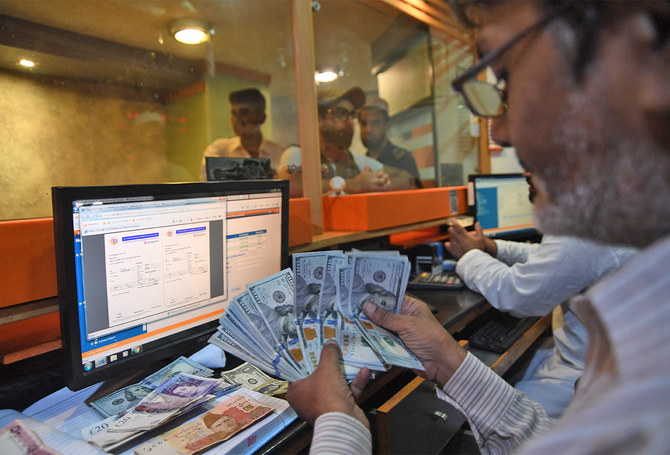
ISLAMABAD: The Pakistani government’s proposed cash incentive to foreign exchange companies on surrendering US dollars in the interbank market will help boost remittances, discourage illegal money transfers and currency smuggling, Pakistani currency dealers said on Saturday.
The Economic Coordination Committee of the federal cabinet on Friday approved a proposal to provide exchange companies with cash incentives of Re1 for surrendering each dollar mobilized from inward remittances.
Exchange companies are now required to surrender 100 percent of their inward remittances in the interbank market to take full advantage of the scheme.
The government has approved the proposal and directed authorities to review the model for further improvement as the country struggles to boost its foreign reserves and stabilize rupee against dollar.
“We welcome the government’s initiative as this will help us compete with hawala/hundi (illegal money transfer channels) by offering different schemes to remitters,” Zafar Paracha, general secretary of the Exchange Companies Association of Pakistan (ECAP), told Arab News.
He said exchange companies would now be offering better exchange rates to remitters besides offering gifts, schemes and other incentives. “This will ultimately help Pakistan boost its much-needed foreign remittances from different countries and stabilize our currency.”
Paracha said exchange companies were playing a major part in facilitating inward remittances as they deposited around $5 billion in banks last year.
He said this was their core business and their network operated across the globe to facilitate people in sending remittances back home.
Earlier, the government was only offering incentives to banks for receiving and delivering inward remittances, which experts said was helping hawala/hundi do majority of business by offering better exchange rates to remitters.
Paracha said banks were getting around Rs6-8 against each dollar, while the government was offering only Rs1 to exchange companies. “We hope the government will further increase our margin to completely document this whole business,” he said.
Exchange companies would be buying dollars from everywhere to deposit in banks to earn more and this would ultimately result in preventing smuggling of foreign currencies, the ECAP general secretary said.
Besides inward remittances, these companies also receive funds by exporting currencies other than the US dollar and receiving an equivalent in greenbacks in return from their customers. But this part of their business is not part of the recently announced incentive scheme.
“Once the whole business of foreign currency is regularized and documented through different incentives, it would help the government meet its FATF (Financial Action Task Force requirements as well,” Paracha said.
Exchange companies were earlier required to surrender 10 percent of their export proceeds and 15 percent of inward remittances in the interbank market, as per the State Bank of Pakistan’s (SBP) regulations.
They were free to use the rest of the funds to either sell in the open market or make outward remittances on behalf of their customers.
“This government incentive to exchange companies will break the backbone of hawala/hundi and the whole business will become legal,” Saleh Mohammad Khan, chairman of AA Exchange Company in Islamabad, told Arab News.
“We will now be offering competitive and even better rates to remitters as more remittances will increase our incentive.”
Overseas Pakistanis who used to carry cash while traveling to Pakistan would now prefer to remit their money through legal channels for better exchange rates, Khan added.


![]()

Pakistan’s cash incentive to exchange companies to help boost remittances — currency dealers
Short Url
https://arab.news/r83ws
Pakistan’s cash incentive to exchange companies to help boost remittances — currency dealers
- Under the scheme, exchange companies will get Re1 against each surrendered US dollar in inward remittances
- Currency dealers say initiative will help discourage illegal money transfers, stabilize rupee against greenback
Latest updates


© 2026 SAUDI RESEARCH & PUBLISHING COMPANY, All Rights Reserved And subject to Terms of Use Agreement.