

Tunisia wallows in uncertainty as President Kais Saied pushes ahead

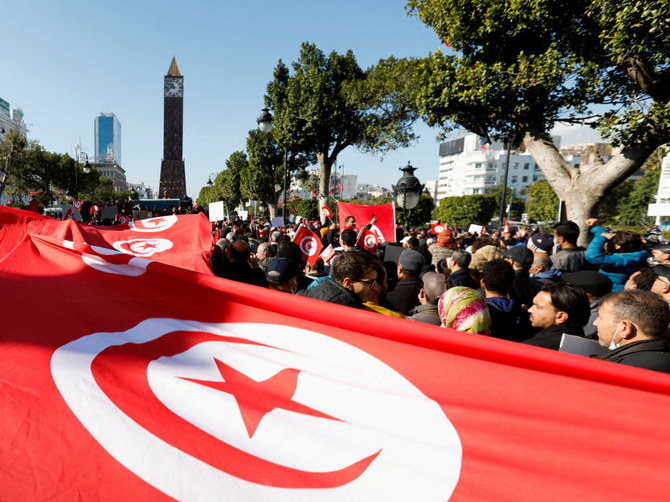
People protest against Tunisian President Kais Saied's seizure of governing power and declaration of putting a new constitution to public referendum, in Tunis, Tunisia, December 17, 2021. (Reuters)
Short Url
Updated 31 December 2021
Follow

Tunisia wallows in uncertainty as President Kais Saied pushes ahead

TUNIS: Opposition voices silenced and an economy on the brink: experts say Tunisia is “wallowing in uncertainty” as President Kais Saied readies to ask the public for their thoughts on a new constitution.
The former law professor, who on July 25 sacked the government, suspended parliament and seized wide-ranging powers, has long called for an overhaul of the country’s dysfunctional post-revolution political system.
On December 13, he laid out a roadmap for drafting a new constitution, which is set to grant more powers to the executive branch at the expense of the legislature in the small North African nation.
The public has been asked to send in suggestions via electronic platforms from January 1 to March 20 ahead of a referendum on the resulting constitution on July 25, 2022.
Critics have said the move underlines the “populist” approach of the president, who won elections in 2019 with a landslide 73 percent of votes.
But Saied’s one-man crusade to rebuild Tunisia’s broken political structures has sparked accusations that he is establishing a new autocracy in the birthplace of the Arab Spring uprisings.
Rights groups have pointed to military trials of opposition figures on charges such as “insulting the president.”
The accusations come not just from his nemesis, the Islamist-inspired Ennahdha party that dominated the suspended assembly, but also from the powerful UGTT trade union.
“The country is wallowing in political uncertainty, even after Saied announced his roadmap, which doesn’t seem to have reassured partners either domestically or internationally,” said analyst Hamza Meddeb.
“There are many questions marks over the reliability of this process,” Meddeb said.
“We have never tried this kind of referendum in Tunisia and we don’t know how the president is aiming to organize these consultations.”

Meddeb said the consultations will begin “amid socio-economic unrest, with questions regarding freedoms” and what he described as “repression in disguise.”
Saied’s July power grab came with Tunisia engulfed in a political and economic crisis exacerbated by mounting coronavirus cases.
His move was initially backed by some Tunisians who were tired of a political elite viewed as corrupt and incapable of resolving the country’s problems.
On Tuesday, the debt-ridden country unveiled a 2022 budget that will see it borrow almost $7 billion, as it seeks to stimulate an economy stricken by 18 percent unemployment.
Authorities are also hoping to reach a bailout deal with the International Monetary Fund.
But as the administration grapples with deep economic woes, it has also clamped down on rights.
On December 24, activist and former MP Bochra BelHajj Hmida was sentenced to six months in prison — a verdict that sparked questions as it came days after she criticized the president.
“Since July 25, there is a single institution and a single person deciding the future of this country,” she told AFP. “There is nothing to suggest that there will be hope.”

Hmida is not the only Saied critic to have been prosecuted after publicly criticizing the president.
Perhaps the most prominent is exiled former president Moncef Marzouki, who was sentenced in absentia to four years in prison on December 22 for “undermining the security of the state from abroad” after launching blistering public criticism against Saied.
“All these hasty trials against critical voices clearly show that the judiciary is unfortunately in the hands of the executive,” Meddeb said.
Rights groups have repeatedly warned of the threat to freedom of speech in Tunisia since July 25.
Human Rights Watch said in December that Tunisian authorities are using “repressive” dictatorship-era laws to snuff out criticism of Saied.
The journalists’ union also has warned of an “imminent danger to freedom of the press, media and expression” since Saied’s power grab.
On December 23, a group of prominent anti-Saied figures under the banner “Citizens against the Coup” launched a hunger strike against what they call “a complete abolition of freedoms.”
The group called for a boycott of the public consultation pushed by Saied, accusing him of seeking to “conceal his coup.”
“Tunisia is on a slippery slope and we can expect high tensions,” Meddeb said.


Sudan defense minister dismisses ‘intelligence document’ as fabrication after convoy strike

Updated 12 February 2026
Follow

Sudan defense minister dismisses ‘intelligence document’ as fabrication after convoy strike

  • Gen. Hassan Kabroun tells Arab News claims that army hid weapons in aid convoy are “completely false”

RIYADH: Sudan’s defense minister has firmly denied reports attributed to Sudanese intelligence alleging that a convoy targeted in North Kordofan was secretly transporting weapons under the cover of humanitarian aid.

Gen. Hassan Kabroun described the claims as “false” and an attempt to distract from what he called a militia crime.

The controversy erupted after news reports emerged that a document attributed to Sudan’s General Intelligence Service claimed the convoy struck in Al-Rahad on Friday was not a purely humanitarian mission, but was instead carrying “high-quality weapons and ammunition” destined for Sudanese Armed Forces units operating in the state.

The report further alleged that the convoy had been outwardly classified as humanitarian in order to secure safe passage through conflict zones, and that the Rapid Support Forces had destroyed it after gathering intelligence on its route and cargo.

Kabroun categorically rejected the narrative.

“First of all, we would like to stress the fact that this news is false,” he told Arab News. “Even the headline that talks about the security of the regions, such as Al-Dabbah, is not a headline the army would use.”

He described the document as fabricated and politically motivated, saying it was designed to “cover up the heinous crime they committed.”

The minister affirmed that the area targeted by drones is under full control of the Sudanese Armed Forces and does not require any covert military transport.

“Second, we confirm that the region that was targeted by drones is controlled by the army and very safe,” Kabroun said. “It does not require transporting any military equipment using aid convoys as decoys because it is a safe area controlled by the army, which has significant capabilities to transport humanitarian aid.”

According to the minister, the Sudanese military has both the logistical capacity and secure routes necessary to move equipment openly when needed.

“The army is professional and does not need to deliver anything to Kadugli or Dalang on board aid convoys,” he said. “The road between Dalang and Kadugli is open. The Sudanese forces used that road to enter and take control of the region. The road is open and whenever military trucks need to deliver anything, they can do so without resorting to any form of camouflage.”

Kabroun further rejected any suggestion that the military uses humanitarian operations as cover.

“Aid is transported by dedicated relief vehicles to the areas in need of this assistance,” he said. “Aid is not transported by the army. The army and security apparatus do not interfere with relief efforts at all, and do not even accompany the convoys.”

He stressed that the Sudanese Armed Forces maintains a clear institutional separation between military operations and humanitarian work, particularly amid the country’s crisis.

“These are false claims,” he said. “This fake news wanted to cover up the heinous crime they committed.”

Sudan has been gripped by conflict since April 2023, when fighting broke out between the Sudanese Armed Forces and the Rapid Support Forces, plunging the country into what the United Nations has described as one of the world’s worst humanitarian disasters.

The latest dispute over the convoy comes amid intensified fighting in South Kordofan, a strategically sensitive region linking central Sudan with the contested areas of Darfur and Blue Nile.

The false report suggested that intelligence monitoring had enabled the RSF to strike what it described as a military convoy disguised as humanitarian aid. But Kabroun dismissed that version outright.

“The intelligence agency is well aware of its duties,” he said. “The Sudanese Army has enough weapons and equipment to use in the areas of operations. These claims are completely false.”

He argued that the narrative being circulated seeks to shift blame for attacks on civilian infrastructure and humanitarian movements.

“This shows that they are trying to cover up the atrocities,” he added, referring to the militia.

Kabroun maintained that the army has regained momentum on multiple fronts and remains fully capable of sustaining its operations without resorting to deception.

“The region is secure, the roads are open, and the army does not need camouflage,” he said. “We are operating professionally and transparently.”

“These claims are completely false,” Kabroun said. “The Sudanese Army does not use humanitarian convoys for military purposes.”