

OIC organizations, Pakistan join hands to enhance virtual education across Muslim world

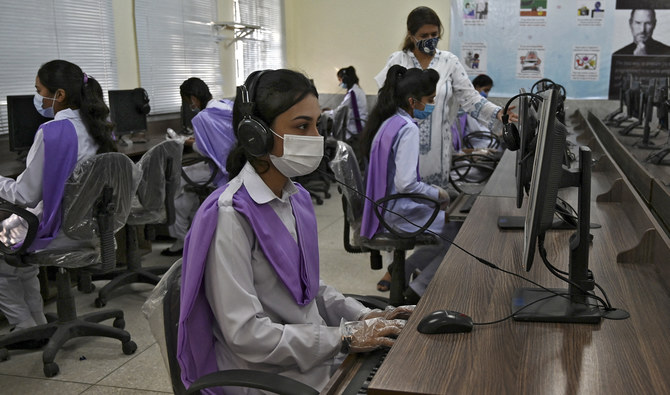
Students wearing facemasks attend a computer class at the Islamabad Model College of Commerce for Girls in Islamabad, Pakistan, on September 15, 2020. (AFP/File)
Short Url
Updated 29 December 2021
Follow

OIC organizations, Pakistan join hands to enhance virtual education across Muslim world

  • Virtual University of Pakistan and OIC’s ICESCO to arrange boot camps with experts from various Muslim countries invited
  • COMSTECH and ICESCO to start four new programs to promote science and technology education in Muslim nations

ISLAMABAD: The Virtual University of Pakistan (VU) and the Islamic World Educational, Scientific and Cultural Organization (ICESCO) are working together to develop bilateral cooperation and establish digital platforms to help enhance virtual education across the Muslim world, a senior official said on Wednesday.

ICESCO is a specialized organization that operates under the aegis of the Organization of Islamic Cooperation (OIC), working to support and strengthen relations among member states in the fields of education, science, culture and communication. The Virtual University of Pakistan is a public university headquartered in Lahore. 

“During a meeting with the head of science and technology of ICESCO, Professor Dr. Raheel Qamar, we discussed various aspects of virtual learning and discussed the phenomenal success of the 'Digiskills' program in Pakistan,” VU Rector Professor Dr. Arshad Saleem Bhatti told Arab News, referring to a program launched four years ago to provide digital skills training to Pakistanis from different walks of life.

“Moreover, with ICESCO, VU will arrange boot camps by inviting experts from various Muslim countries,” he said, adding that it had also been agreed that VU would use its platform to overcome the digital divide in North African Muslim states and equip young people there with digital skills.

“For this purpose VU will play a key role in developing content in their languages,” Bhatti added. 

ICESCO’s Qamar has also held a separate meeting with COMSTECH officials in Pakistan to promote cooperation in science and technology among OIC member states.


This undated file photo shows a general of COMSTECH premises in Islamabad, Pakistan. (Photo courtesy: comstech.org)

Launched by 57 OIC member states at the platform’s Islamic Summit in Makkah in 1981, COMSTECH is the OIC’s Ministerial Standing Committee on Scientific and Technological Cooperation. The headquarter of COMSTECH is in Islamabad, Pakistan. One of the body’s main goals is to enhance member states’ capabilities in science and technology.

“During the meeting of officials of COMSTECH and ICESCO, which are OIC organizations, we have discussed four programs to promote science and technology innovations in the Muslim world,” COMSTECH coordinator general Professor Dr Muhammad Iqbal Choudhary told Arab News.

Under the first program, COMSTECH and ISESCO will provide fellowships to women scientists in Africa, he said. 

“The objective is to promote women scientists as they get minimum opportunities there. Majority of these women scientists will come to Pakistan and work on top research institutions here. Others will be sent to Indonesia, Malaysia and UAE.”

Chaudhary said the second program would pick top Pakistani researchers for COMSTECH and ISESCO fellowships to travel to different countries for the capacity building of Muslim youth there. 

The third program relates to space technology where both OIC organizations would launch a space awareness program for youth in the Muslim world.

“The UAE has launched a Mars mission which is a great news and a very proud moment for the Muslim world,” Chaudhry said. “This has brought a visible difference in science and technology education in the Emirates so that should be used for the capacity building of other Muslim countries scientists.”

Another program will promote the innovative work of Muslim scientists, Chaudhry added, in the fields of computer and mobile applications, artificial intelligence, pharmaceutical, food and agriculture.

“We also discussed possibilities of starting exhibitions of made-in-OIC products,” the professor said. “We want to organize a dedicated exhibition of innovative products of the member states in fields related to science and technology.”


Pakistan inflation could cross 7 percent if Middle East war pushes oil to $130, economists warn

Updated 5 sec ago
Follow

Pakistan inflation could cross 7 percent if Middle East war pushes oil to $130, economists warn

  • Petrol prices could climb to Rs392 ($1.40) per liter if crude surges, advisory note says
  • LPG prices rise 13 percent amid Gulf conflict as industry expects fresh shipments before Eid

KARACHI: Pakistan’s fragile economic recovery could face renewed inflationary pressure if global oil prices surge to $130 per barrel amid the escalating Middle East conflict, economists and industry stakeholders warned this week.

The warning comes after crude prices briefly spiked above $110 per barrel following hostilities involving the United States, Israel and Iran, raising fears of disruptions to energy shipments through the Strait of Hormuz, a strategic waterway that carries roughly one-fifth of the world’s oil supply.

Although prices have since retreated from their recent highs, analysts say continued volatility could quickly translate into higher fuel costs in Pakistan, which imports most of its energy needs.

On Friday, Pakistan raised consumer prices for diesel and petrol about 20 percent, citing the higher oil prices caused by the Iran war. Last week, the central bank said headline inflation accelerated to 7 percent in February from 5.8 percent in January, while core inflation reached about 7.6 percent.

It said inflation could remain above 7 percent through the rest of the fiscal year ​ending in June and ​into the next fiscal ⁠year, though improved food supply and better agricultural prospects may partly offset pressure from higher energy prices.

“If global oil reaches $130 per barrel, petrol in Pakistan could approach Rs392 ($1.4) per liter with inflation rising by 7.11 percent,” Karachi-based tax and corporate advisory firm Tola Associates said in a note to its clients.

The projection highlights the vulnerability of Pakistan’s import-dependent energy sector at a time when the country is still recovering from a prolonged economic crisis marked by high inflation, currency depreciation and rising fuel costs.

Pakistan imported petroleum products worth about $16 billion last year, accounting for the largest share of the country’s $58.4 billion import bill, according to official data.

Ashfaq Tola, chairman of Tola Associates and a former tax adviser to several Pakistani governments, said his firm had modeled how different global oil price scenarios could affect domestic fuel prices and inflation.

“If oil is priced at $88 per barrel, we have an indicative price of Rs313 ($1.1) per liter. If it reaches $130, its inflationary impact on the overall economy will be 7.11 percent,” Tola said.

He noted that global oil prices had recently eased from their peak and expressed hope markets would stabilize.

“The oil prices are settled today. We are seeing prices at $88. The prices will reach the same level at $65-$66. The economy will recover.”

However, Tola said Pakistan’s recent decision to raise fuel prices by Rs55 ($.20) per liter had come too quickly given the country’s fuel reserves.

“I don’t see any rationale for this knee-jerk Rs55 per liter increment in the prices of fuel given the fuel stock we had in reserves. You should have waited,” he asked the government.

Pakistan’s petroleum ministry spokesperson Zafar Abbas did not respond to requests for comment. Nazir Abbas Zaidi, secretary general of the Oil Companies Advisory Council (OCAC), also declined to comment.

Finance adviser Khurram Schehzad said on social media platform X that oil prices had already started declining.

“Oil continues plummeting,” the official said, noting Brent crude had fallen 16 percent to about $83 per barrel while US benchmark WTI declined 17 percent to around $78.

LPG PRICE HIKE

Even as crude prices fluctuate, rising energy costs are already beginning to ripple through Pakistan’s retail markets, particularly in liquefied petroleum gas (LPG), which is widely used in households, restaurants and vehicles across the country, especially in areas without piped natural gas.

Khubaib Sabir, an LPG retailer in Karachi’s Keamari neighborhood, said prices had climbed sharply since the conflict intensified.

“Before this war started it stood at Rs310 ($1.1) per kilogram. Now the LPG prices have increased by Rs40 to Rs350 ($1.3),” he told Arab News while filling gas cylinders for customers.

Sabir said the price of a 42-kilogram LPG cylinder had risen by Rs400 to Rs14,600 ($52) since Monday.

“It would cross the Rs400 ($1.4) limit if the war persisted,” said the father of six.

Pakistan consumes roughly 8,000 tons of LPG daily, according to industry estimates, of which about 2,200 tons are produced locally while the rest is imported.

Irfan Khokhar, chairman of the LPG Industries Association of Pakistan, said panic buying had increased demand but insisted supplies remained adequate.

“Two ships namely Aries and Atlantic carrying 11,000 tons and 12,000 tons LPG consignments have already anchored at Port Qasim,” Khokhar told Arab News, referring to Pakistan’s second-largest seaport. “Gas will be available in the market and there will be no shortage in Pakistan.”

He added that additional cargoes were expected before the Eid Al-Fitr holiday.

“Two more LPG consignments are expected to arrive in Pakistan before Eid-ul-Fitr, 3,700 tons via a ship named Ullswater and 3,500 tons via MD23,” he said.

Despite the supply outlook, Khokhar said LPG prices had climbed due to uncertainty in the Middle East and rising freight costs linked to disruptions near the Strait of Hormuz.

“The gas mafia has been selling LPG at Rs350 to Rs450 ($1.6) per kilogram, using the energy crisis and the sharp rise in global crude oil prices as justification,” he lamented.

ECONOMIC RISKS

Economists say Pakistan’s heavy reliance on imported fuel means geopolitical tensions often translate quickly into domestic economic pressure, pushing up transportation costs, food prices and broader inflation.

“If you are talking about oil and LPG prices, it’s anybody’s guess. It’s all dependent on this conflict,” said energy expert Muhammad Saad Ali, head of research at Lucky Investments Limited.

Ali said sustained oil prices above $110 per barrel could trigger economic stress globally.

“That’s the kind of level that can force recession in these developed economies. And you saw that yesterday it was going up to $120,” he said.

Ali noted that Pakistan still has alternative options to manage gas supply disruptions.

“It’s not a shortage like it was after the Ukrainian war,” he said, adding that Islamabad could secure additional cargoes through spot purchases or suppliers such as the State Oil Company of the Republic of Azerbaijan (SOCAR).