

Pakistani army says will play ‘due part’ in achieving vision of new national security policy

Pakistani troops patrol along Pakistan-Afghanistan border at Big Ben post in Khyber district in Khyber Pakhtunkhwa province, Pakistan, on August 3, 2021. (AFP/File)
Short Url
Updated 29 December 2021
Follow

Pakistani army says will play ‘due part’ in achieving vision of new national security policy

  • Maj Gen Babar Iftikhar says framework recognizes interlinkages between strands of national security
  • The policy has been formulated over last seven years in consultation with all relevant stakeholders

ISLAMABAD: The armed forces of Pakistan will play their “due part” in achieving the vision laid out in the National Security Policy (NSP) 2022-2026, the Pakistani military spokesman said on Tuesday. 
Pakistan’s National Security Committee (NSC) endorsed the policy in a high-level huddle on Monday, aiming to ensure safety, security and dignity of its citizens. 
Earlier in the day, Prime Minister Imran Khan's cabinet approved the new strategy, with the national security adviser saying it was “citizen-centric” and had “economic security” at its core. 
"NSP is an important milestone in strengthening national security of Pakistan. The comprehensive framework recognizes interlinkages between various strands of national security, imperative to meet emerging challenges in evolving global environment through a whole-of-government effort," said Major General Babar Iftikhar, the director-general of the Inter-Services Public Relations (ISPR), the Pakistani military’s media wing. 
"Pakistan’s armed forces will play their due part in achieving the vision laid out in the policy," he added. 
Pakistan's National Security Adviser Moeed Yusuf earlier said the approval of the NSP by the cabinet was a “historic achievement.” 
"A citizen-centric comprehensive National Security Policy with economic security at the core will now be pursued in earnest," Pakistani NSA Moeed Yusuf said on Twitter. 
“This umbrella document will, over time, help guide sectoral policies for the fulfilment of our national security objectives.” 
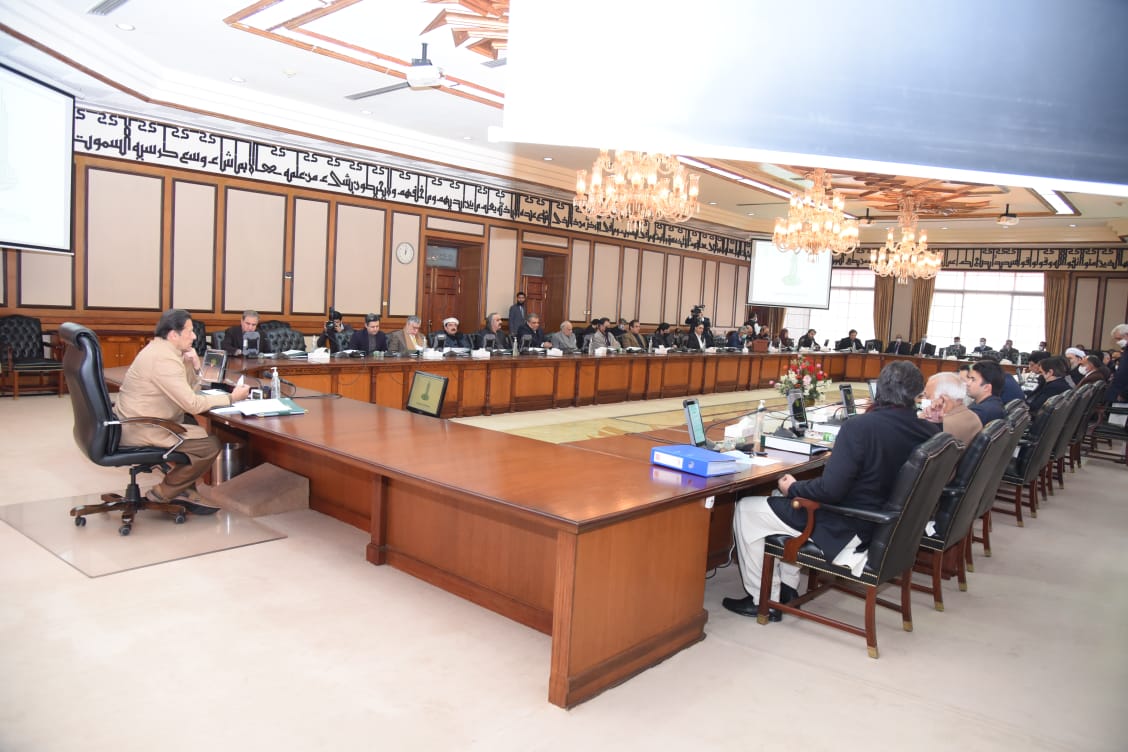


Prime Minister Imran Khan (center) chairs cabinet meeting in Islamabad, Pakistan, on December 28, 2021. (PM Office)

He thanked the civil and military leadership for all their support and input, saying the policy would not have seen the light of day without the prime minister’s constant leadership and encouragement. 
“The success of the policy will lie in its implementation for which a plan has been developed,” Yusuf said, adding a public version of the document would be released in due course.  
On Monday, PM Khan directed that the policy must guide all organs of the government to ensure their efforts were synchronized with the overall direction of the strategy.  
“The security of Pakistan rests in the security of its citizens,” he emphasized during the NSC meeting, while reposing confidence that Pakistan was well prepared to thwart any internal and external threats.  
Pakistan’s National Security Division has devised a detailed framework to review the implementation of the policy in collaboration with relevant ministries and departments. 


Daesh media chief for ISKP in Pakistan’s custody — state media

Updated 18 December 2025
Follow

Daesh media chief for ISKP in Pakistan’s custody — state media

  • Sultan Aziz Azzam, a senior member of ISKP, used to head its Al Azzam media outlet, says state media
  • Azzam was arrested in May while attempting to cross into Pakistan from Afghanistan, says state media

ISLAMABAD: Pakistani authorities have taken into custody Sultan Aziz Azzam, the head of Daesh regional affiliate ISKP’s media outlet, state media reported on Thursday citing intelligence sources. 

The state-run Pakistan TV Digital reported that Azzam was a senior member of ISKP and hailed from Afghanistan’s Nangarhar province. As per the state media report, he is also a graduate of the University of Nangarhar where he studied Islamic jurisprudence. 

Pakistan TV Digital reported Azzam joined ISKP in 2016 and later became a prominent member of its leadership council.

“He was arrested in May 2025 while attempting to cross from Afghanistan into Pakistan,” Pakistan TV Digital reported, citing intelligence sources. 

“He is believed to have overseen media operations and headed ISKP’s Al Azzam media outlet.”

In November 2021, Washington listed Azzam as a “Specially Designated Global Terrorist” (SDGT). The move bars American citizens from engaging in transactions with persons designated as SDGTs. 

According to a report on the UN Security Council’s website, Azzam has played an “instrumental role” in spreading Daesh’s violent ideology, glorifying and justifying “terrorist acts.” 

“Building on his former experience as an Afghan journalist, his activity as ISIL-K’s spokesperson has increased ISIL-K’s visibility and influence among its followers,” the report states. 

The report further states Azzam claimed responsibility on behalf of Daesh for the suicide attack near Hamid Karzai International Airport on Aug. 26, 2021, which killed at least 170 Afghans and 13 US service members and injured 150 more. 

The development takes place amid tense relations between Pakistan and Afghanistan, with Islamabad alleging militants use Afghan soil to carry out attacks against Pakistan. Kabul denies the allegations.

Tensions surged in October when Pakistan and Afghanistan engaged in fierce border clashes, claiming to have killed dozens of soldiers of the other side.

Pakistan has urged the Afghan Taliban-led government to take “decisive action” against militants it says operate from its soil. Afghanistan says it cannot be held responsible for Pakistan’s security challenges.