

In Pakistan’s Gilgit-Baltistan, centuries-old ‘May Fung’ new year festival returns 

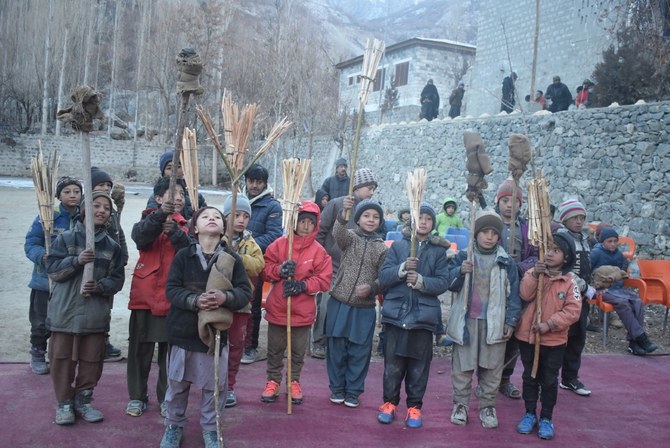
A group of children hold sticks in their hands and pose for a photo in the Bara valley of Gilgit-Baltistan, Pakistan on December 21, 2021. (AN Photo)
Short Url
Updated 25 December 2021
Follow

In Pakistan’s Gilgit-Baltistan, centuries-old ‘May Fung’ new year festival returns 

  • Festival rooted in Tibetan Buddhist culture marks end of longest night of year 
  • People celebrate the ‘May Fung’ festival with music, dance and fireworks 

KHAPLU: A large group of people in Pakistan’s northern Gilgit-Baltistan region gathered in a valley this week to partake in a centuries-old festival that marks an end to the longest night of the year and brings the spring season a step closer in a territory notorious for its harsh winters. 

“May Fung” is said to be a centuries-old festival annually celebrated on December 21. It has its roots in Tibetan Buddhist culture and involves fireworks, music and dance. 

“People gather in large numbers to celebrate the ancient festival of May Fung,” Hajji Abdul Hameed, Gilgit-Baltistan’s local government minister, told Arab News, amid festivities in Ghanche district’s Bara valley. 

“This is a historic festival of the area which should be celebrated by everyone since it reminds us of our connection with our ancestors who started celebrating it centuries ago.” 
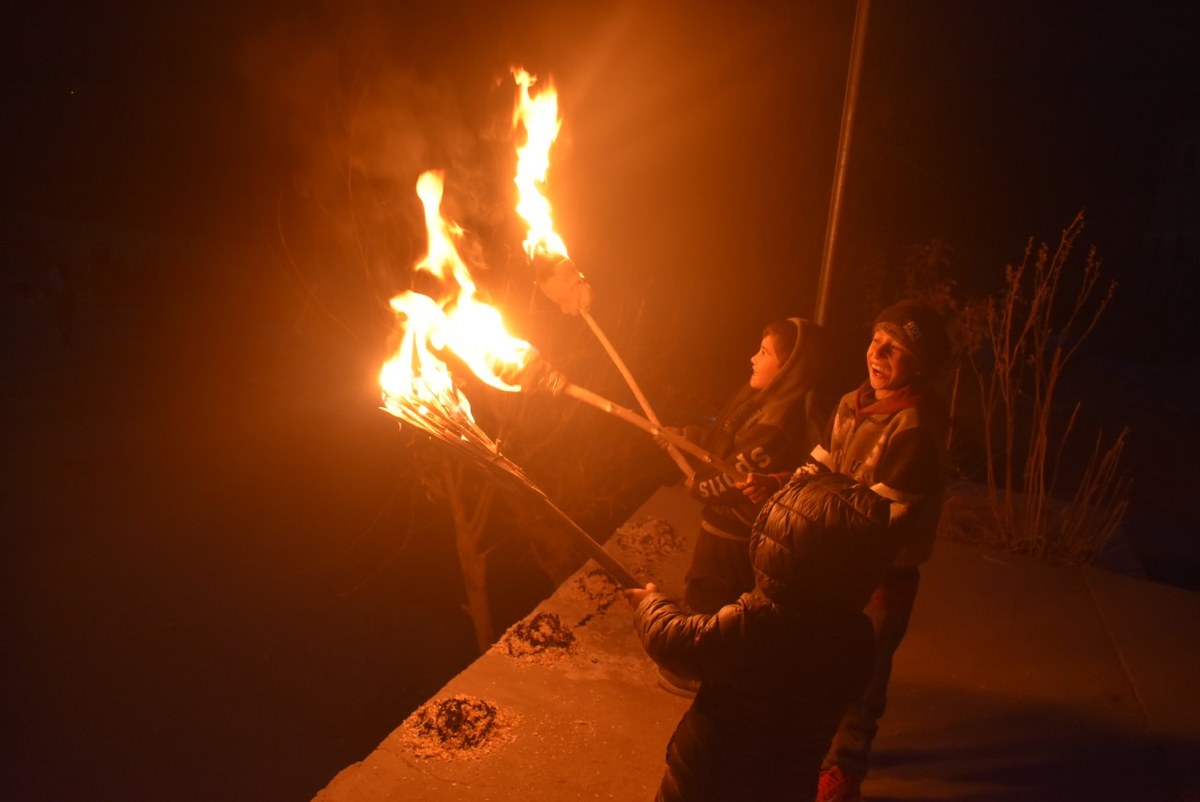


Children celebrate the May Fung festival at night in the Bara valley of Gilgit-Baltistan, Pakistan on December 21, 2021. (AN Photo) 

Hameed said December 21 was a happy day for the residents of the region since “it marks the beginning of the end of the winter season.” From next year, he said, they would make it a calendar event. 

The origins of the festival are obscure, but it is seen as a new year carnival by many people, according to local historian Muhammad Hassan Hasrat. 

Hasrat said it was also believed the festival began under the Maqpon dynasty that emerged in the region in the 12th century and lasted for about 700 years. A few people attributed it to the mythical man-eating 17th-century Maqpon ruler, Raja Abdal Khan, who was known for his cruelty, he added. 

“The festival is also celebrated in Chitral and Gilgit along with certain regions of China,” Hasrat said, adding though the celebrations had been on a decline for the last 40 to 50 years, they were once again getting popular with people. 

“When the sun sets on December 21, people, especially children and teenagers, carry burning sticks in their hands and give them a circular motion in the air,” he said. “The event ends with a traditional musical show.” 
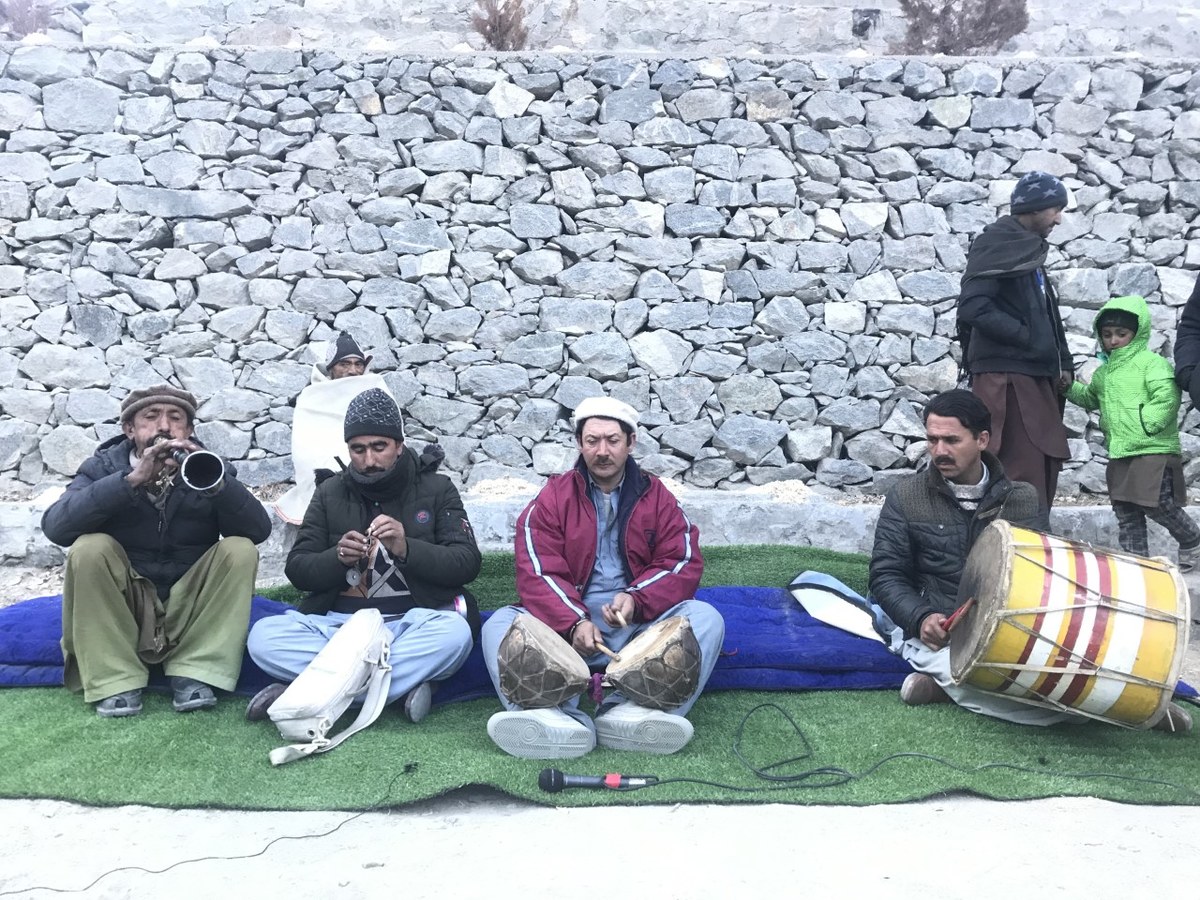


A group of local musicians poses for a photo ahead of the ancient May Fung festival in the Bara valley of Gilgit-Baltistan, Pakistan on December 21, 2021. (AN Photo) 

Ghulam Abbas Balghari, a percussion artist, told Arab News he liked performing at the festival. 

“I have been playing music on my locally manufactured drums that are made of goat skin since 1987,” he said. 

“Prior to 2005, the festival was celebrated in different Baltistan valleys, including Shigar, Rondu, Skardu, Kharmang and Khaplu. After a gap of many years, I have participated in a big colorful May Fung festival in the Bara valley today.” 

Balghari agreed with others that the night was celebrated to welcome springtime. 

Zahid Stoghi Yatow, a folk singer, said he had arrived in the valley only to participate in the celebrations since they were a part of the Balti culture. 

“I have never seen such enthusiasm among people,” he said. “You can see hundreds of people here who are cherishing this moment even in such a frosty weather. It is, after all, our responsibility to keep our cultural festivals alive.” 


Pakistan says 177 militants killed in Balochistan counteroffensive after wave of attacks

Updated 7 sec ago
Follow

Pakistan says 177 militants killed in Balochistan counteroffensive after wave of attacks

  • Authorities say coordinated attacks last weekend killed 31 civilians, 17 security personnel
  • Separatist BLA group claimed responsibility as operations expanded across multiple districts

ISLAMABAD: Pakistan’s security forces have killed 22 more militants in overnight counteroffensive operations in the southwestern province of Balochistan, state media reported on Monday, taking the total number of insurgents killed over the past three days to 177 following a wave of coordinated separatist attacks.

Militants launched simultaneous assaults across multiple districts in Balochistan on Friday and Saturday, targeting security installations and government facilities. The attacks marked one of the deadliest escalations in recent years in the resource-rich but restive province, with at least 31 civilians and 17 members of law enforcement agencies killed.

The banned separatist group, the Baloch Liberation Army, claimed responsibility for the attacks, saying it had launched a coordinated operation dubbed Herof, or “black storm,” targeting security forces across the province. The assault included pre-dawn strikes on high-security installations in the cities of Quetta, Gwadar, Dalbandin, Pasni, Nushki, Kalat, Turbat and Mastung.

Local residents look at a damaged bank on the outskirts of Quetta on February 1, 2026 a day after an attack by Baloch separatists. (AFP)

On Monday, state broadcaster Radio Pakistan said security forces carried out the latest “sanitization operations” against what it described as “Fitna-al-Hindustan” in Balochistan late Sunday night. Pakistan’s military and civilian authorities use the term to describe separatist militants in the province whom Islamabad alleges are supported by India, a charge New Delhi denies.

“According to security sources, 22 more terrorists were killed last night during pursuit operations,” Radio Pakistan said. “At least 177 terrorists have been eliminated in the operations conducted over the last three days.”

People gather as others collect recyclable items beside a burnt vehicle along a road on the outskirts of Quetta on February 1, 2026 a day after an attack by Baloch separatists. (AFP)

Balochistan, Pakistan’s largest province by area, has long been gripped by a separatist insurgency that has intensified in recent years. Militants frequently target security forces, government officials, infrastructure projects, foreigners and non-local workers.

Balochistan is strategically significant for Pakistan due to its vast reserves of minerals and hydrocarbons and its role as a transit hub for the multibillion-dollar China-Pakistan Economic Corridor (CPEC), a flagship component of China’s Belt and Road Initiative. The province is home to the deep-sea Gwadar Port on the Arabian Sea, which Islamabad views as critical to regional trade and energy routes linking China, Central Asia and the Middle East. 

Local residents look at a damaged bank on the outskirts of Quetta on February 1, 2026, a day after an attack by Baloch separatists. (AFP)

Separatist groups accuse the central government of exploiting the province’s natural resources while neglecting local communities. Islamabad rejects the allegations, saying it is investing in development and security to stabilize the province.
