

Pakistan army tests ‘enhanced’ version of locally developed Babur cruise missile

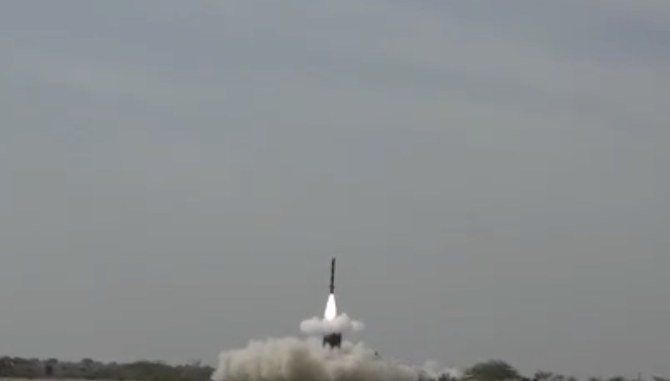
This photo shows Babur Cruise Missile 1B launched from an undisclosed location in Pakistan on December 21, 2021. (Photo courtesy: Screengrab from a video shared by ISPR)
Short Url
Updated 21 December 2021
Follow

Pakistan army tests ‘enhanced’ version of locally developed Babur cruise missile

  • Test if a show of force for a country that sees its missile development as a deterrent against arch-foe India
  • Analysts warn Asia may be sliding into an accelerating arms race as India and Pakistan continue to build their armors

ISLAMABAD: The Pakistan army said on Tuesday it had successfully tested an “enhanced range version” of the indigenously developed Babur Cruise Missile 1B, a show of force for a country that sees its missile development as a deterrent against arch-foe India.

The nuclear-armed neighbors have fought three wars since independence from Britain in 1947. Both nations have been developing missiles of varying ranges since they conducted nuclear tests in May 1998.

Tuesday’s launch ceremony was witnessed by Lt. Gen. Nadeem Zaki Manj, the Director General of the Strategic Plans Division, Dr. Raza Samar, Chairman National Engineering and Scientific Commission, Lt. Gen. Muhammad Ali, Commander Army Strategic Force Command, senior officers from the Strategic Plans Division, strategic forces, scientists and engineers of strategic organizations. 

“Director General, Strategic Plans Division, congratulated the scientists and engineers on achieving excellence in the domain of cruise missile technology and expressed his full confidence that this test will further strengthen Pakistan’s Strategic Deterrence,” the Pakistan army said in a statement.

“The President, Prime Minister of Pakistan, Chairman Joint Chiefs of Staff Committee and Services Chiefs have also congratulated the scientists and engineers on conduct of successful launch.”

Analysts warn Asia may be sliding into an accelerating arms race as India and Pakistan continue to build their military armors and countries react to China’s military growth and tensions around North Korea’s weapons programs linger.

India has a “no first use” nuclear policy, meaning it has pledged to not strike first. It aims to make retaliatory strikes so powerful that an opponent would be unable to strike back.

Pakistan has not stated a “no first use” policy and there is little known about its nuclear doctrine.


Pakistani president arrives in Iraq to deepen trade, energy cooperation

Updated 20 December 2025
Follow

Pakistani president arrives in Iraq to deepen trade, energy cooperation

  • Visit follows recent high-level contacts as Islamabad seeks to expand limited commercial ties with Baghdad
  • Talks are expected to cover investment, manpower and facilitation of Pakistani pilgrims visiting holy sites in Iraq

ISLAMABAD: President Asif Ali Zardari arrived in Iraq on Saturday on an official visit aimed at expanding cooperation in trade, energy and investment, as Pakistan seeks to deepen ties with Baghdad after years of limited engagement.

Pakistan and Iraq established diplomatic relations in 1947 and have traditionally maintained cordial ties, though commercial links remain modest, with officials and business groups identifying scope for cooperation in construction services, pharmaceuticals, manpower and agricultural exports.

“President Asif Ali Zardari arrived in Baghdad on a four-day official visit to Iraq,” his office said in a post on X. “He was received by Culture Minister Dr. Ahmed Fakkak Al-Badrani. During the visit, meetings with senior Iraqi leadership are expected to advance cooperation and further strengthen Pakistan-Iraq relations.”

Zardari’s visit follows a series of recent high-level contacts between the two countries, reflecting efforts to broaden bilateral engagement beyond traditional diplomatic ties and explore collaboration across economic, political and people-to-people domains.

According to Pakistan’s foreign office, the president is expected to hold meetings with Iraq’s senior leadership to discuss cooperation in various areas such as trade and investment, energy, technology, education and manpower.

He is also expected to discuss regional and international issues with Iraqi officials.

Earlier this month, Pakistan’s Interior Minister Mohsin Naqvi met his Iraqi counterpart, Abdul Ameer Al-Shammari, on the sidelines of meetings in Brussels, where both sides agreed to enhance cooperation on security and facilitate travel for Pakistani Shia pilgrims to Najaf and Karbala.

The two officials discussed measures to ensure the smoother movement of these pilgrims and their compliance with visa regulations.