

After OIC summit, Pakistan asks US to ‘reconsider’ Afghanistan position amid humanitarian crisis

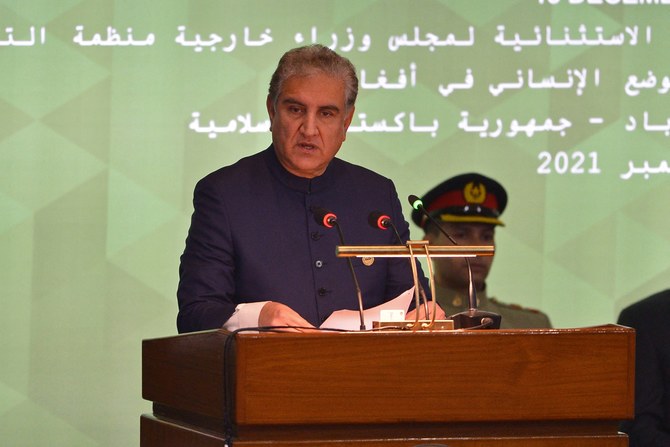
Pakistan's Foreign Minister Shah Mahmood Qureshi speaks during the opening of a special meeting of the 57-member Organisation of Islamic Cooperation (OIC) in Islamabad on December 19, 2021. (AFP)
Short Url
Updated 20 December 2021
Follow

After OIC summit, Pakistan asks US to ‘reconsider’ Afghanistan position amid humanitarian crisis

  • Since fall of Kabul, billions of dollars parked overseas with US Federal Reserve and other central banks in Europe have been frozen
  • US and international powers have made inclusive government and women rights key elements of future engagement with Afghanistan

ISLAMABAD: Pakistani Foreign Minister Shah Mahmood Qureshi said on Monday the United States should reconsider its position on Afghanistan given that the country was facing an acute humanitarian crisis and looming economic meltdown and a majority of its population faced extreme hunger.

The Taliban took back power in Afghanistan in August, almost 20 years after they were ousted in a US-led invasion for refusing to hand over al Qaeda leader Osama bin Laden following the September 11, 2001, attacks on the United States.

Since the fall of Kabul, billions of dollars in assets parked overseas with the US Federal Reserve and other central banks in Europe have been frozen. The US and the international community have made an inclusive government and women's rights key elements of any future engagement with Afghanistan.

The United Nations is warning that nearly 23 million people - about 55 percent of the Afghan population - face extreme levels of hunger, with nearly 9 million at risk of famine as winter takes hold in the impoverished, landlocked country.

“In view of the [Afghan] people, the United States should reconsider its decision,” Qureshi said.

His comments came a day after the conclusion of the 17th Extraordinary Session of the OIC’s Council of Foreign Ministers, called by Saudi Arabia and hosted at the Parliament House in Islamabad. The purpose of the summit was to rally Muslim and other countries and international institutions to come in aid of Afghanistan.

Participating OIC nations decided to establish a humanitarian trust fund to channel humanitarian assistance to Afghanistan, including in partnership with other international actors, and to appoint a special envoy on Afghanistan to the OIC Secretary General.

“Setting up a trust fund for Afghanistan was a success [of the OIC summit],” the foreign minister said. “We also passed a resolution on the restoration of Afghanistan's banking system.”

“Pakistan and Saudi Arabia together played their role [in making the summit possible],” Qureshi added.


Pakistan launches digital cash aid for low-income families during Ramadan, PM says

Updated 19 February 2026
Follow

Pakistan launches digital cash aid for low-income families during Ramadan, PM says

  • Ramadan relief moves from state-run Utility Stores to targeted digital wallet transfers
  • Government to transfer financial assistance through wallets to support sehri, iftar expenses

ISLAMABAD: Pakistan will provide financial assistance to low-income households through digital wallets during the fasting month of Ramadan, Prime Minister Shehbaz Sharif said on Thursday, announcing a government relief initiative aimed at helping families afford daily meals.

The support program comes as many Pakistanis continue to face elevated food and utility costs despite easing inflation, with Ramadan traditionally increasing household spending on staple foods, fruits and energy consumption.

For decades, government-run Utility Stores Corporation outlets were central to Ramadan relief in Pakistan, selling subsidized flour, sugar, ghee and pulses through special “Ramzan packages” that drew long queues in low-income neighborhoods. In recent years, however, authorities have steadily scaled back the system amid mounting losses, corruption complaints and logistical inefficiencies, shifting instead toward targeted cash transfers delivered through digital wallets and banking channels. 

The change reflects a broader policy move away from state-managed commodity distribution toward direct financial assistance intended to give households flexibility while reducing leakages in subsidy programs.

“The Government of Pakistan has launched a Ramadan package under which financial assistance will be transferred to deserving individuals through digital wallets so that households can maintain sehri and iftar meals,” Sharif said in a message issued by his office.

The prime minister said Ramadan encourages compassion and collective responsibility toward vulnerable segments of society, adding that welfare support was part of the state’s duty during the holy month.

Officials say the digital cash transfers approach improves transparency and reduces corruption risks while enabling faster payments nationwide, particularly in urban low-income communities.

But the shift to fully digital assistance also brings challenges. 

Access to smartphones and reliable mobile Internet remains uneven, particularly in rural areas and among older recipients, while many low-income households use SIM cards registered to someone else, complicating verification.