


In Pakistan, new animated superhero series helps children recognize and fight sexual abuse 

"Super Sohni," a new Pakistani animated series produced by Lahore-based NGO Samaaj, aims to create awareness about sexual abuse of children. (Photo courtesy: Samaaj)
Short Url
Updated 21 December 2021
Follow

In Pakistan, new animated superhero series helps children recognize and fight sexual abuse 

  • More than 10 children experienced sexual abuse in Pakistan every day between January and June
  • “Super Sohni” created by local non-profit organization Samaaj in collaboration with German embassy

ISLAMABAD: The producers of a new Pakistani animated series called “Super Sohni,” whose titular main character fights sexual violence against children, hope the show will help kids recognize what constitutes abuse and empower survivors to speak up.

More than 10 children experienced sexual abuse in Pakistan every day between January and June, an increase of two cases a day compared with the same period last year, according to data from child protection organization Sahil.

“Super Sohni,” which goes on air at the end of this month, was created by Lahore-based non-profit organization Samaaj in collaboration with the German embassy in Islamabad. The first season focuses on the sexual abuse of girls and has 10 episodes that will be released weekly on social media platforms. For the second season, the producers plan to cover the abuse faced by boys.

“We are hoping that when children get to watch ‘Super Sohni,’ they become more aware and they are well-equipped to recognize the signs of abuse and they can fearlessly speak up with their parents or caregivers,” Sehyr Mirza, executive director of Samaaj, told Arab News.
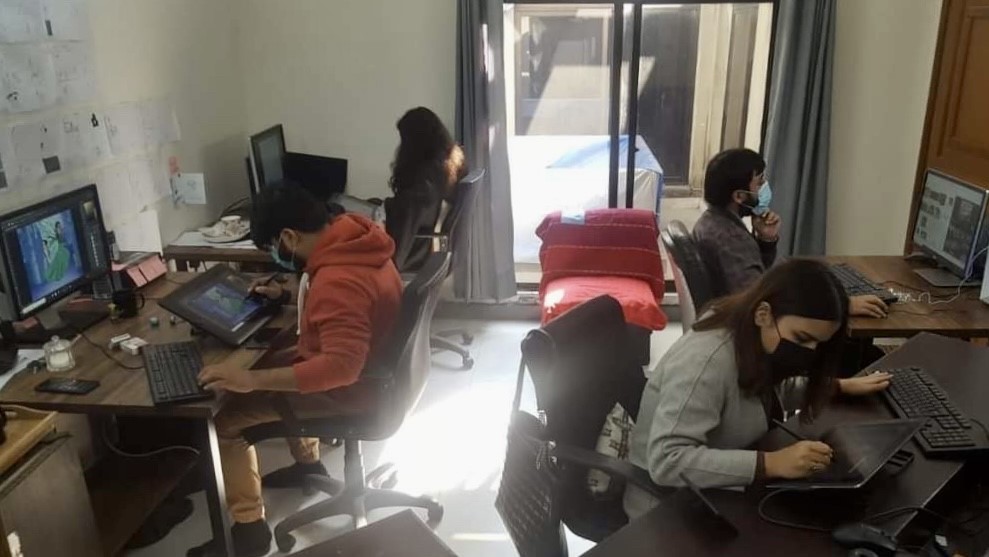


In this undated photo, Samaaj team members are seen working on the "Super Sohni" animated series at their office in Lahore, Pakistan. (Photo courtesy: Samaaj)

“Most of these cases still go unreported because of the element of shame and dishonor which is attached to it. Awareness is the first step toward prevention and eradication,” she said. “We thought that maybe it would be a good idea to use animation as a medium to grab the interest of a younger audience in order to educate them.”

Samaaj co-founder Ammar Aziz said making the series had been an emotional journey.

“Even though we’ve not covered boys’ experiences in the first season — the first phase of our project, the Girls’ Sexual Abuse Prevention Program — I could personally relate to a lot of experiences when we were researching and writing the series,” Aziz said.

Mirza added that though many boys were victims of child sexual abuse, the producers had decided to focus first on minor girls as they made up 70 percent of victims.

Germany’s ambassador to Pakistan, Bernhard Schlagheck, who shared the series trailer on social media earlier this month, expressed hope the project could help equip children with the knowledge and confidence they need to stay safe:

“Our partners @TheSamaaj are launching a video series to raise awareness about the important issue of sexual abuse. A very engaging project that can hopefully equip many children with the knowledge, skills & confidence they need to stay safe from harm. Really looking forward to it!”


Pakistan, 21 other countries condemn Israeli West Bank measures, warn of ‘de facto annexation’

Updated 5 sec ago
Follow

Pakistan, 21 other countries condemn Israeli West Bank measures, warn of ‘de facto annexation’

  • Joint statement says settlement expansion violates international law, cites UN resolutions, ICJ advisory opinion
  • Signatories include European and Latin American nations such as France and Brazil , alongside Muslim countries

ISLAMABAD: Pakistan and 21 other countries, including France, Brazil, Spain and Denmark, on Tuesday condemned sweeping Israeli measures to expand control over the occupied West Bank, warning the steps risk advancing “unacceptable de facto annexation” and undermining prospects for a two-state solution.

In a joint statement issued by the foreign ministers of countries from the Middle East, Europe and Latin America, as well as the secretaries general of the League of Arab States and the Organization of Islamic Cooperation, the signatories urged Israel to immediately reverse recent decisions reclassifying Palestinian land and accelerating settlement activity.

The statement marks a broadening of international criticism beyond Muslim-majority states that have long denounced Israeli settlement expansion, bringing together countries like Norway, Sweden, Portugal, Finland, Iceland, Ireland and Luxembourg alongside Arab and other Muslim-majority nations.

“Israel’s illegal settlements, and decisions designed to further them, are a flagrant violation of international law, including previous United Nations Security Council Resolutions and the 2024 Advisory Opinion of the International Court of Justice,” the ministers said.

They added the measures were “part of a clear trajectory that aims to change the reality on the ground and to advance unacceptable de facto annexation,” warning that they undermine ongoing efforts for regional peace and stability, including a proposed 20-Point Plan for Gaza, and threaten prospects for broader regional integration.

The ministers called on Israel “to reverse them immediately, to respect its international obligations, and to refrain from actions that would result in permanent changes to the legal and administrative status of the occupied Palestinian Territory.”

The latest statement follows mounting concern over Israel’s land and settlement policies in the West Bank.

Last week, Pakistan and seven other Muslim nations condemned Israel’s decision to approve land registration procedures in parts of the West Bank for the first time since 1967, a move widely seen as easing the path for settlement expansion and potential annexation.

Members of the Israeli cabinet have backed measures to tighten administrative control over areas of the West Bank, including Area C, which makes up around 60 percent of the territory and remains under full Israeli security and administrative control under the Oslo accords.

More than 500,000 Israeli settlers live in settlements and outposts in the West Bank, excluding Israeli-annexed East Jerusalem, alongside around three million Palestinians.

Settlements are considered illegal under international law, a position Israel disputes.

In the latest statement, the foreign ministers reiterated their rejection of “all measures aimed at altering the demographic composition, character and status of the Palestinian Territory occupied since 1967, including East Jerusalem,” and said they oppose “any form of annexation.”

“In view of the alarming escalation in the West Bank, we also call on Israel to put an end to settler violence against Palestinians, including by holding those responsible accountable,” they added.

The ministers pledged to take “concrete steps, in accordance with international law,” to counter the expansion of illegal settlements and policies or threats of forcible displacement and annexation.

Highlighting sensitivities around Jerusalem during Ramadan, they stressed the importance of preserving the historic and legal status quo at the city’s holy sites, recognizing the special role of the Hashemite custodianship of Jordan.

Reaffirming support for a negotiated settlement, the signatories said they remain committed to achieving “a just, comprehensive and lasting peace” on the basis of a two-state solution, in line with the Arab Peace Initiative and relevant UN resolutions, based on the June 4, 1967 lines.

“As reflected in the New York Declaration, the end of the Israeli-Palestinian conflict is imperative for regional peace, stability and integration,” the statement said, adding that only the realization of an independent, sovereign and democratic Palestinian state would allow coexistence among the region’s peoples and states.