

Pakistan amends rules on purchasing forex as rupee breaches psychological barrier against greenback 

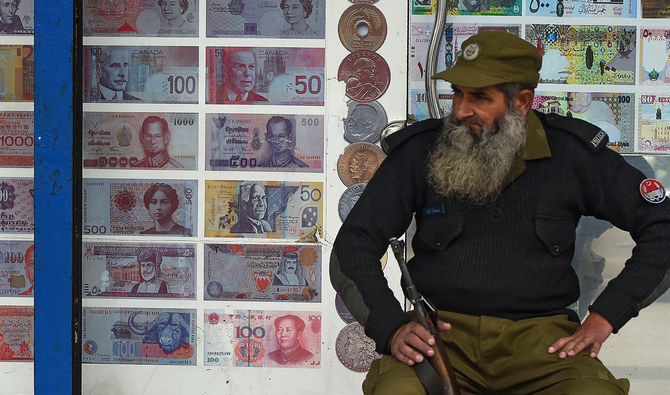
In this file photo, a Pakistani security guard sits outside the currency exchange shop in Lahore on Jan. 3, 2018. (AFP)
Short Url
Updated 20 December 2021
Follow

Pakistan amends rules on purchasing forex as rupee breaches psychological barrier against greenback 

  • Exchange companies must ensure no individual can buy foreign exchange of over $10,000 per day, $100,000 per calendar year
  • On Friday rupee crossed psychological barrier of Rs178 in the interbank market, closed at Rs178.04 against greenback

KARACHI: The State Bank of Pakistan (SBP) has amended its rules on the purchase of foreign currency, binding all exchange companies to ensure that no individual can buy foreign exchange of more than $10,000 per day and $100,000 per calendar year. 

The new rules have been announced as the greenback continues to climb against the rupee and the central bank struggles to stop the flow of foreign currency out of Pakistan and enhance transparency in transactions by exchange companies.

On Friday the rupee crossed the psychological barrier of Rs178 in the interbank market, losing its value by 0.03 percent to close at Rs178.04 against the greenback.

“In order to enhance documentation and transparency and to further strengthen the foreign exchange regulatory regime, the State Bank of Pakistan has amended the regulations governing sale of foreign exchange to individuals by exchange companies,” the central bank said on Sunday.

“This step, which is in continuation of other measures being taken by SBP, is primarily to discourage speculative buying and selling of foreign exchange from the exchange companies without affecting the ability of the market to serve the genuine needs of the public.”

Listing the new rules, the bank said exchange companies were now bound to ” ensure that any individual shall not purchase foreign exchange from all exchange companies in excess of USD 10,000 per day and USD 100,000 (or equivalent in other currencies) per calendar year, in the form of cash or outward remittances.”

Additionally, the statement said, individuals could remit educational and medical expenses abroad up to $70,000 per calendar year and $50,000 per invoice respectively, from banks as per existing regulations.

“For remittance of any amount in excess of these limits, or for any other purposes, individuals can approach Foreign Exchange Operations Department of SBP-BSC, through their bank. Further, there is no change in regulations with respect to foreign currency accounts of the individuals,” the statement said. 

Under new rules for exchange companies announced in October, people traveling to Afghanistan were allowed to carry only $1,000 per person per visit, with a maximum annual limit of $6,000. Exchange companies were required to conduct biometric verification for all foreign currency sale transactions equivalent to $500 and above and outward remittances, effective from October 22, 2021.

Exchange companies were also asked to sell foreign currency in cash and make outward remittances equivalent to $10,000 and above against receipt of funds through cheque or banking channels only.


Pakistani president arrives in Iraq to deepen trade, energy cooperation

Updated 20 December 2025
Follow

Pakistani president arrives in Iraq to deepen trade, energy cooperation

  • Visit follows recent high-level contacts as Islamabad seeks to expand limited commercial ties with Baghdad
  • Talks are expected to cover investment, manpower and facilitation of Pakistani pilgrims visiting holy sites in Iraq

ISLAMABAD: President Asif Ali Zardari arrived in Iraq on Saturday on an official visit aimed at expanding cooperation in trade, energy and investment, as Pakistan seeks to deepen ties with Baghdad after years of limited engagement.

Pakistan and Iraq established diplomatic relations in 1947 and have traditionally maintained cordial ties, though commercial links remain modest, with officials and business groups identifying scope for cooperation in construction services, pharmaceuticals, manpower and agricultural exports.

“President Asif Ali Zardari arrived in Baghdad on a four-day official visit to Iraq,” his office said in a post on X. “He was received by Culture Minister Dr. Ahmed Fakkak Al-Badrani. During the visit, meetings with senior Iraqi leadership are expected to advance cooperation and further strengthen Pakistan-Iraq relations.”

Zardari’s visit follows a series of recent high-level contacts between the two countries, reflecting efforts to broaden bilateral engagement beyond traditional diplomatic ties and explore collaboration across economic, political and people-to-people domains.

According to Pakistan’s foreign office, the president is expected to hold meetings with Iraq’s senior leadership to discuss cooperation in various areas such as trade and investment, energy, technology, education and manpower.

He is also expected to discuss regional and international issues with Iraqi officials.

Earlier this month, Pakistan’s Interior Minister Mohsin Naqvi met his Iraqi counterpart, Abdul Ameer Al-Shammari, on the sidelines of meetings in Brussels, where both sides agreed to enhance cooperation on security and facilitate travel for Pakistani Shia pilgrims to Najaf and Karbala.

The two officials discussed measures to ensure the smoother movement of these pilgrims and their compliance with visa regulations.