

Pakistan says will ‘fight’ Tehreek-e-Taliban militants if they don’t respect constitution, law 

FILE - Armed militants of Tehreek-e-Taliban Pakistan (TTP) pose for photographs next to a captured armored vehicle in the Pakistan-Afghanistan border town of Landikotal on November 10, 2008. (AFP/FILE)
Short Url
Updated 13 December 2021
Follow

Pakistan says will ‘fight’ Tehreek-e-Taliban militants if they don’t respect constitution, law 

  • In November, the government and the outlawed TTP agreed on a month-long cease-fire  
  • Last week, TTP said it won't extend the deal, accused government of not honoring truce conditions

ISLAMABAD: Pakistani Information Minister Chaudhry Fawad Hussain said on Monday his country was ready to "fight" the outlawed Tehreek-e-Taliban Pakistan (TTP) militant group again if it didn't respect the constitution and law of the country. 

The TTP or the Pakistani Taliban, a separate entity from the Afghan Taliban but often aligned with them in conflicts, have fought for years to overthrow the government in Islamabad and rule the South Asian nation of 220 million with their own brand of Islamic law.  

In November, the government and the TTP agreed on a month-long cease-fire but last week, the group said it would not extend the deal, accusing the government in Islamabad of not honoring the truce and failing to release 102 of their fighters. 

In response, Hussain said the Afghan Taliban had given "sane advice" to the TTP to abide by the agreement, warning that Pakistan would "again fight" the group if they chose to violate the truce. 

"The [Afghan] Taliban government once again stressed the TTP to value the agreement and heed. Their advice is a sane advice," Hussain said at a press briefing. "It's a very simple thing, whoever would respect our constitution and law, [we] will talk to them. Otherwise [we] have fought earlier, will again fight." 
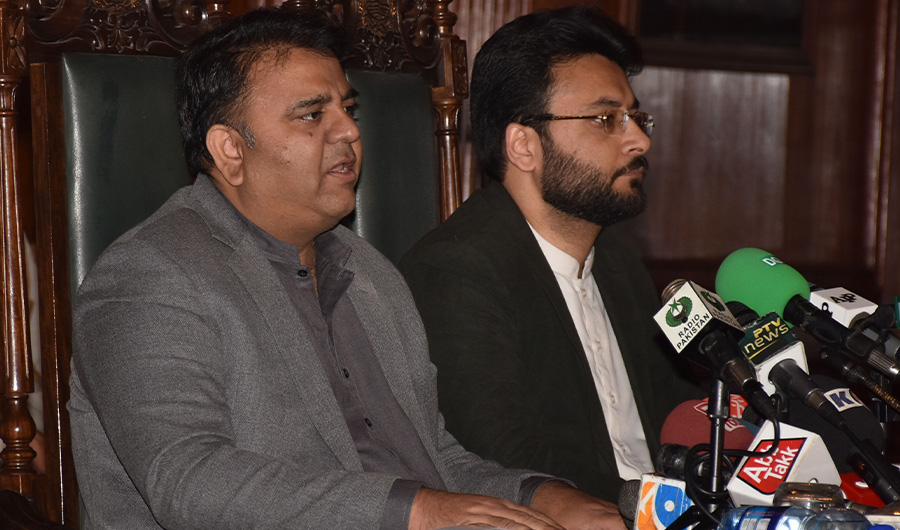


Pakistan's Federal Minister for Information and Broadcasting Chaudhry Fawad Hussain (L) talking to media in Lahore on Dec 12, 2021. (PID)

Last week, the Afghan Taliban said the banned TTP was not part of their movement and called on the group to focus on securing peace with the Pakistani government. 

Video footage circulating on social media had shown TTP chief Noor Wali Mehsud claiming the group was a branch of the Taliban's Islamic Emirate of Afghanistan (IEA). 

Afghan Taliban government spokesman Zabihullah Mujahid denied the claim. 

“They are not, as an organization, part of IEA and we don’t share the same objectives,” Mujahid told Arab News. 

“We advise TTP to focus on peace and stability in their country. This is very important so they can prevent any chance for enemies to interfere in the region and in Pakistan. And we request Pakistan to look into their demands for the better of the region and Pakistan.” 

The TTP has been behind numerous attacks on Pakistani security forces and civilians over the last 14 years. It was also behind the 2014 attack on an army-run school in the northwestern Pakistani city of Peshawar that killed 154 people, mostly schoolchildren. 

They are a separate group from the Taliban in Afghanistan, who took over that country in August. However, the two groups are close allies and TTP leaders and fighters have over the years sought sanctuary across the border in Afghanistan. 

There have been numerous failed attempts to reach peace agreements between Islamabad and the TTP in the past.  

A statement from TTP spokesman Mohammad Khurasani last week said despite the agreement on the cease-fire — which went into effect on November 9 and was meant to give time for peace talks between the two sides — government forces were continuing to carry out operations against the group. 

Over the weekend, two policemen providing security for polio vaccination workers in northwest Pakistan were killed in shootings that Khurasani said were carried out by the TTP. The two separate attacks on polio teams were the first since the end of the TTP’s cease-fire with the government. 

Pakistan is one of two countries where polio remains endemic but only one case has been reported this year after 84 in 2020, according to the Global Polio Eradication Initiative. 

Polio Eradication Initiative.


Pakistan urges world to treat water insecurity as global risk, flags India treaty suspension

Updated 5 sec ago
Follow

Pakistan urges world to treat water insecurity as global risk, flags India treaty suspension

  • Pakistan says it is strengthening water management but national action alone is insufficient
  • India unilaterally suspended Indus Waters Treaty last year, leading to irregular river flows

ISLAMABAD: Pakistan on Tuesday urged the international community to recognize water insecurity as a “systemic global risk,” warning that disruptions in shared river basins threaten food security, livelihoods and regional stability, as it criticized India’s handling of transboundary water flows.

The call comes amid heightened tensions after India’s unilateral decision last year to hold the 1960 Indus Waters Treaty “in abeyance,” a move Islamabad says has undermined predictability in river flows and compounded climate-driven vulnerabilities downstream.

“Across regions, water insecurity has become a systemic risk, affecting food production, energy systems, public health, livelihoods and human security,” Pakistan’s Acting Permanent Representative to the United Nations, Ambassador Usman Jadoon, told a UN policy roundtable on global water stress.

“For Pakistan, this is a lived reality,” he said, describing the country as a climate-vulnerable, lower-riparian state facing floods, droughts, accelerated glacier melt, groundwater depletion and rapid population growth, all of which are placing strain on already stressed water systems.

Jadoon said Pakistan was strengthening water resilience through integrated planning, flood protection, irrigation rehabilitation, groundwater replenishment and ecosystem restoration, including initiatives such as Living Indus and Recharge Pakistan, but warned that domestic measures alone were insufficient.

He noted the Indus River Basin sustains one of the world’s largest contiguous irrigation systems, provides more than 80 percent of Pakistan’s agricultural water needs and supports the livelihoods of over 240 million people.

The Pakistani diplomat said the Indus Waters Treaty had for decades provided a framework for equitable water management, but India’s decision to suspend its operation, followed by unannounced flow disruptions and the withholding of hydrological data, had created an unprecedented challenge for Pakistan’s water security.

Pakistan has said the treaty remains legally binding and does not permit unilateral suspension or modification.

The issue has gained urgency as Pakistan continues to recover from last year’s monsoon floods, which killed more than 1,000 people and devastated farmland in Punjab, the country’s eastern breadbasket, in what officials described as severe riverine flooding.

Last month, Deputy Prime Minister Ishaq Dar said Pakistan had observed abrupt variations in river flows from India, creating uncertainty for farmers in Punjab during critical periods of the agricultural cycle.

“As we move toward the 2026 UN Water Conference, Pakistan believes the process must acknowledge water insecurity as a systemic global risk, place cooperation and respect for international water law at the center of shared water governance, and ensure that commitments translate into real protection for vulnerable downstream communities,” Jadoon said.