

Lebanon thwarts attempt to smuggle drugs to Saudi Arabia

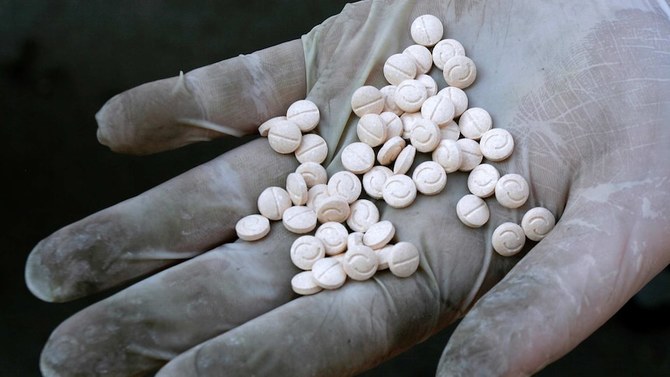
Lebanon’s Internal Security Forces intercepted quantities of Captagon pills hidden in a coffee shipment. (Reuters)
Short Url
Updated 18 January 2022
Follow

Lebanon thwarts attempt to smuggle drugs to Saudi Arabia

  • Lebanon’s Internal Security Forces raided a warehouse in Bir Hassan, in the southern suburbs of Beirut, and found 4 million Captagon pills in a shipment of coffee bags
  • Last month, the ISF thwarted the smuggling of 1.5 million Captagon pills hidden in the base of wooden pallets that had been prepared for export through Beirut

BEIRUT: Lebanon’s Internal Security Forces thwarted an attempt to smuggle huge quantities of Captagon pills in a coffee shipment that was heading to Saudi Arabia through Jordan, it announced Saturday.

“The information division in the Internal Security Forces received a tipoff on the preparation of this smuggling operation,” it said. “Through its investigative procedures, the special forces identified all the members of the smuggling network, including W. A. (born in 1973, Lebanese) and M. H. (born in 1962, Syrian). It appears that the Lebanese smuggler has been previously convicted, as he was detained for smuggling Captagon pills to the Kingdom and was released around a year ago. Orders were given to monitor and detain the network’s members and raid the warehouse where the Captagon was hidden.”

The ISF said that, on Dec. 4, 5 and 8, special forces raided a warehouse in Bir Hassan, in the southern suburbs of Beirut, and found 4 million Captagon pills in a shipment of coffee bags that were ready for transportation.

“The first smuggler was detained during his attempt to flee Lebanon to Turkey. A division’s patrol was able to detain the Syrian smuggler in Aramoun, south of Beirut. Upon investigation, they confessed to the crime. The first smuggler said he was in charge of transporting the shipment and keeping it in a safe place.”

Last month, the statement added, security forces thwarted the smuggling of 1.5 million Captagon pills hidden in the base of wooden pallets that had been prepared for export through Beirut. One of the smugglers was detained.

Lebanon’s Interior Minister Bassam Mawlawi said at the start of the week that he was “following up on the border procedures implemented to combat smuggling.”

Saudi Arabia and other Gulf states have cut diplomatic and economic ties with Lebanon until “comprehensive reforms are implemented and Lebanon is no longer the source of any terrorist acts and drug scourge that threaten the integrity of the region and the world.”


Trump claims Iran working on missiles that could hit US

Updated 42 min 42 sec ago
Follow

Trump claims Iran working on missiles that could hit US

  • Trump says his preference is diplomacy, but would never allow Tehran to have a nuclear weapon

WASHINGTON: US President Donald Trump on Tuesday claimed Iran is seeking to develop missiles that can strike the United States and accused Tehran of working to rebuild a nuclear program that was targeted by American strikes last year.

The United States and Iran are engaged in high-stakes negotiations over Iran’s atomic program and other issues including missiles, with Trump saying he prefers diplomacy but is willing to use force if talks fail.

“They’ve already developed missiles that can threaten Europe and our bases overseas, and they’re working to build missiles that will soon reach the United States of America,” Trump said during his State of the Union address.

In 2025, the US Defense Intelligence Agency said Iran could potentially develop a militarily viable intercontinental ballistic missile by 2035 “should Tehran decide to pursue the capability,” but did not say if it had made such a decision.

Tehran currently possesses short- and medium-range ballistic missiles with ranges that top out at about 1,850 miles (3,000 kilometers), according to the US Congressional Research Service.

The continental United States is more than 6,000 miles from Iran’s western tip.

Washington and Tehran have concluded two rounds of talks aimed at reaching a deal on Iran’s nuclear program to replace the agreement that Trump tore up during his first term in office.

 ‘Preference’ is diplomacy

The United States has repeatedly called for zero uranium enrichment by Iran but has also sought to address its ballistic missile program and support for armed groups in the region — demands Iran has rejected.

Iran has also repeatedly rejected that it is pursuing nuclear weapons.

Trump ordered strikes on three Iranian nuclear sites last year, claiming afterward that Tehran’s atomic program was obliterated.

On Tuesday, he said Iran wants “to start all over again,” and that it is “at this moment again pursuing their sinister nuclear ambitions.”

Trump has sent a massive US military force to the Middle East, deploying two aircraft carriers as well as more than a dozen other ships, a large number of warplanes and other assets to the region.

He has repeatedly threatened to strike Iran if negotiations fail to reach a new agreement. Talks with Tehran are currently set to continue on Thursday.

“My preference is to solve this problem through diplomacy but one thing is certain: I will never allow the world’s number one sponsor of terror, which they are by far, to have a nuclear weapon,” Trump said.

The US president’s speech primarily focused on domestic issues, making no mention at all of China — Washington’s primary military and economic rival — and only briefly referring to Russia.

Trump said he was working to end the bloody conflict between Russia and Ukraine, and repeated his inaccurate claim that he had brought eight other wars to an end since returning to office in January 2025.

He also hailed NATO’s decision to spend five percent of gross domestic product on defense — a move made under heavy pressure from Trump and his administration.