

RIYADH: Continuing his tour of Gulf countries in the run-up to the annual Gulf Cooperation Council summit, Crown Prince Mohammed bin Salman arrived on Wednesday evening in the Qatari capital Doha, where he was expected to build on the past year’s progress on reconciliation.
Relations between the Kingdom and Qatar have improved palpably since the AlUla Declaration was signed at the Saudi-hosted 41st GCC Summit in January, which ended the almost four-year-long dispute that had marred Gulf relations.
The crown prince’s arrival in Doha is seen as a new milestone in the resetting of relations and a recognition that ties of blood, common history, and shared policy concerns are more durable than the disagreements that led to the breakdown in relations in mid-2017.
Bandar Mohammed Al-Attiyah, the recently appointed Qatari ambassador to Saudi Arabia, told Arab News: “The visit signifies the excellent and strong Qatar Saudi bilateral relationship and the positive developments that preceded the AlUla agreement.
“During the visit, the two countries will discuss ways to enhance their strong ties in all fields of collaboration, and coordinate on regional and international issues.”
In September, Crown Prince Mohammed and the UAE’s national security adviser, Sheikh Tahnoon bin Zayed Al-Nahyan, were pictured with the Qatari Emir Sheikh Tamim bin Hamad Al-Thani following a “cordial” meeting on the Red Sea coast.

The widely publicized photo of their meeting, originally shared on Twitter by Crown Prince Mohammed’s private office director, showed the three men dressed informally and smiling broadly for the camera. The candid moment aptly conveyed a message of enduring solidarity.
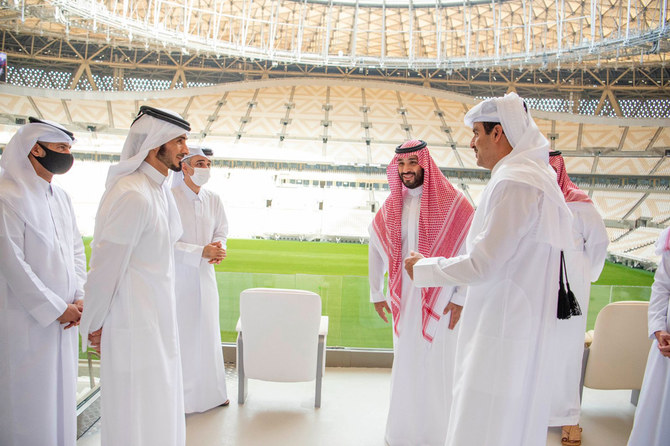
On Thursday afternoon, the crown prince and Qatar’s emir were photographed with other dignitaries while visiting Lusail Stadium, one of the new facilities built to host the FIFA World Cup Qatar 2022.
Al-Attiyah said: “Since the Gulf reconciliation, our two countries have moved to strengthen their ties and regional coordination robustly in a manner that reflects the vision of our leaderships
“Qatar and Saudi share their shared Arab and Islamic heritage, their forward-looking leaderships, and their common fate and destiny. Hence, the pace in which our cooperation is moving will undoubtedly contribute to the prosperity of the two countries.”
The two OPEC members have common economic interests as they both strive to diversify their economies into other more sustainable sectors. To obtain maximum mileage from these efforts, Saudi Arabia and Qatar in August set up a new bilateral coordination council.
In an agreement signed in the Red Sea smart city of NEOM, the Saudi-Qatari Co-ordination Council was created, chaired jointly by the crown prince and Qatar’s emir.
“The Saudi-Qatari Coordination Council is a comprehensive framework for strengthening bilateral relations and pushing the partnership between them to broader horizons in accordance with the Kingdom’s Vision 2030 and Qatar’s 2030 vision in a way that meets the aspirations of the leadership in the two countries and achieves the interests of their people,” Al-Attiyah added.
One important aspect of this cooperation is the sharing of responsibility for tackling climate change and reducing greenhouse gas emissions. Saudi Arabia has taken the lead, establishing the Saudi Green and the Middle East Green initiatives earlier this year.
Al-Attiyah said: “Climate change is the single largest threat to our planet. The participation of the emir in the Middle East Green Initiative reflects Qatar’s seriousness in tackling this issue through a regional and multilateral framework. Qatar thanks Saudi Arabia for this important initiative and its leadership in tackling this issue.”

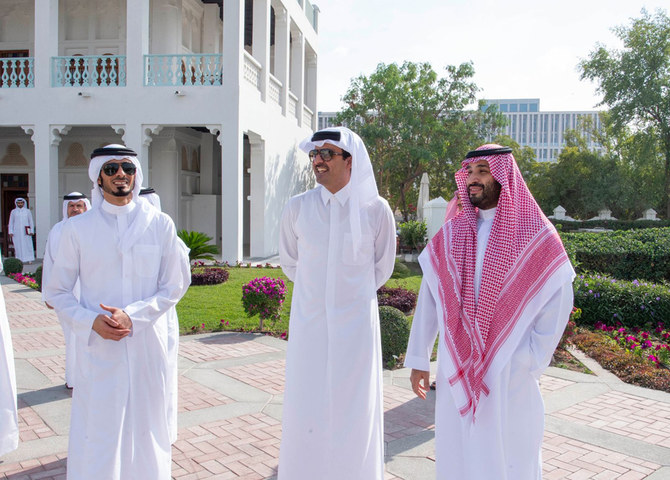
Relations between the Kingdom and Qatar have improved palpably since the AlUla Declaration. (Supplied)
As part of these initiatives, Saudi Arabia aims to plant 50 billion trees throughout the Middle East region — 10 billion of them in the Kingdom alone. Tree planting is viewed as an effective way to capture carbon dioxide from the air and prevent further desertification.
Saudi Arabia aims to reach net-zero greenhouse gas emissions by 2060. According to the Saudi government, the transition “will be delivered in a manner that preserves the Kingdom’s leading role in enhancing the security and stability of global energy markets.”
Saudi and Qatari officials are all too aware that such a transition away from fossil fuels will require close coordination between the Gulf’s biggest energy exporters.
“As two global leading energy exporters, Qatar and Saudi’s contribution will be vital for the energy transition needed to cut down on global greenhouse emissions.
“Realizing the important role they must play, the two countries, alongside the US, Canada, and Norway, have established the Net-Zero Producers Forum,” Al-Attiyah added.
The forum is developing and deploying pragmatic net-zero emission strategies, including methane abatement, the circular carbon economy model, and clean energy, carbon capture, and storage technologies.
“This approach will require diversification away from reliance on hydrocarbon revenues and other measures in line with each country’s national circumstances,” Al-Attiyah said.