Saudi Arabia and Greece sign cooperation agreement on maritime transport

1 / 2
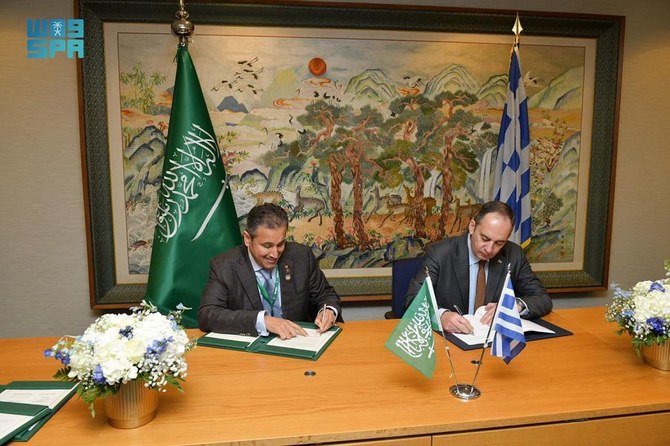
Saudi Minister of Transport and Logistics Services Saleh Al-Jasser and Greek Minister of Maritime Affairs and Island Policy Giannis Plakiotakis sign an agreement. (SPA)
2 / 2
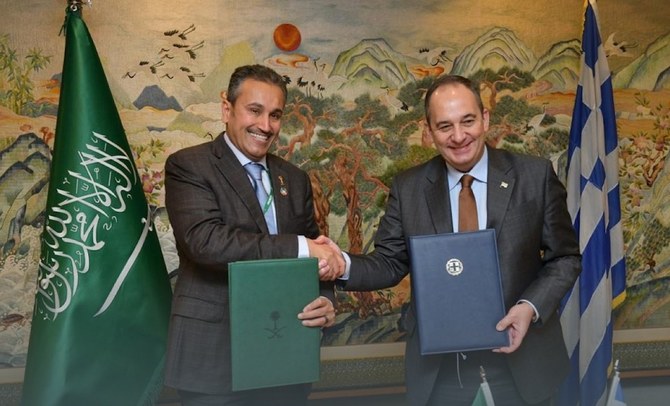
Saudi Minister of Transport and Logistics Services Saleh Al-Jasser and Greek Minister of Maritime Affairs and Island Policy Giannis Plakiotakis sign an agreement. (SPA)
Short Url
Updated 09 December 2021
Follow

Saudi Arabia and Greece sign cooperation agreement on maritime transport

  • The deal includes developing commercial maritime navigation, increasing traffic of commercial ships
  • It also aims to provide facilities to maritime transport companies

RIYADH: Saudi Arabia and Greece on Wednesday signed a joint cooperation agreement in the field of maritime transport, Saudi Press Agency reported.
The deal was signed by Saudi Minister of Transport and Logistics Services and Chairman of the Public Transport Authority Saleh Al-Jasser and Greek Minister of Maritime Affairs and Island Policy Giannis Plakiotakis in the British capital, London.
The agreement aims to strengthen relations between the Kingdom and Greece at the strategic level and open new horizons for cooperation in various fields, especially maritime transport.
It includes developing commercial maritime navigation, increasing traffic of commercial ships to transport passengers and goods, as well as supporting and encouraging trade exchange and facilitating the requirements and procedures for accessing the ports of both countries.
The agreement also aims to enhance the exchange of expertise and technologies between companies, institutions and maritime organizations in this field.
The deal also included a mechanism for the treatment of ships of both countries when accessing their ports, stay and departure, and in cases of emergency and maritime accidents in their territorial waters.
Al-Jasser said the agreement aims to provide facilities to maritime transport companies, their ships and crews, and will mutual recognize the documents of ships and seafarers of both countries.
He said it will held develop joint investment opportunities in the field of maritime transport and logistics services to achieve strategic goals and diversify the sources of income for the total output of both countries’ economic sectors.


Multilateralism strained, but global cooperation adapting: WEF report

Updated 10 January 2026
Follow

Multilateralism strained, but global cooperation adapting: WEF report

DUBAI: Overall levels of international cooperation have held steady in recent years, with smaller and more innovative partnerships emerging, often at regional and cross-regional levels, according to a World Economic Forum report.

The third edition of the Global Cooperation Barometer was launched on Thursday, ahead of the WEF’s annual meeting in Davos from Jan. 19 to 23.

“The takeaway of the Global Cooperation Barometer is that while multilateralism is under real strain, cooperation is not ending, it is adapting,” Ariel Kastner, head of geopolitical agenda and communications at WEF, told Arab News.

Developed alongside McKinsey & Company, the report uses 41 metrics to track global cooperation in five areas: Trade and capital; innovation and technology; climate and natural capital; health and wellness; and peace and security.

The pace of cooperation differs across sectors, with peace and security seeing the largest decline. Cooperation weakened across every tracked metric as conflicts intensified, military spending rose and multilateral mechanisms struggled to contain crises.

By contrast, climate and nature, alongside innovation and technology, recorded the strongest increases.

Rising finance flows and global supply chains supported record deployment of clean technologies, even as progress remained insufficient to meet global targets.

Despite tighter controls, cross-border data flows, IT services and digital connectivity continued to expand, underscoring the resilience of technology cooperation amid increasing restrictions.

The report found that collaboration in critical technologies is increasingly being channeled through smaller, aligned groupings rather than broad multilateral frameworks.  

This reflects a broader shift, Kastner said, highlighting the trend toward “pragmatic forms of collaboration — at the regional level or among smaller groups of countries — that advance both shared priorities and national interests.”

“In the Gulf, for example, partnerships and investments with Asia, Europe and Africa in areas such as energy, technology and infrastructure, illustrate how focused collaboration can deliver results despite broader, global headwinds,” he said.

Meanwhile, health and wellness and trade and capital remained flat.

Health outcomes have so far held up following the pandemic, but sharp declines in development assistance are placing growing strain on lower- and middle-income countries.

In trade, cooperation remained above pre-pandemic levels, with goods volumes continuing to grow, albeit at a slower pace than the global economy, while services and selected capital flows showed stronger momentum.

The report also highlights the growing role of smaller, trade-dependent economies in sustaining global cooperation through initiatives such as the Future of Investment and Trade Partnership, launched in September 2025 by the UAE, New Zealand, Singapore and Switzerland.

Looking ahead, maintaining open channels of communication will be critical, Kastner said.

“Crucially, the building block of cooperation in today’s more uncertain era is dialogue — parties can only identify areas of common ground by speaking with one another.”