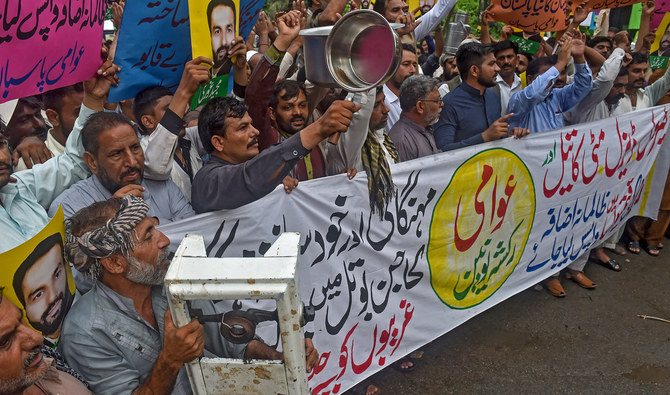
ISLAMABAD: A nationwide perceptions survey by Transparency International Pakistan has revealed that more than 92 percent Pakistanis believe inflation and price hikes have been highest during the present government of Prime Minister Imran Khan compared to previous governments.
The South Asian country is facing growing economic challenges, with high inflation, sliding forex reserves, a widening current account deficit and a depreciating currency. Pakistan’s total liquid foreign reserves stand at $22,498.8 million, based on central bank data.
Pakistan's central bank has raised its benchmark interest rate by 150 basis points to 8.75% to counter inflationary pressures.
Inflation had reached 11.5% in November, up from 9.2% a month earlier. The Pakistani rupee has depreciated more than 11% since the start of this year.
“Compared to the three federal governments, majority of Pakistanis (92.9%) consider inflation and price hike to be highest in the current PTI government (2018-2021), compared to 4.6 % in PML N government (2013-2018) and 2.5% in PPP government (2008-2013),” Transparency said in its report, issued on Tuesday, adding that 85.9% Pakistanis said their income levels had been squeezed or had decreased during the last three years.
“National Corruption Perception Survey 2021 has revealed that police remains the most corrupt sector, Judiciary was seen as 2nd most corrupt, Tendering and Contracting 3rd most corrupt while Health has climbed to become 4th most corrupt since the last NCPS 2011,” the report read.
According to the Judicial Statistics of Pakistan 2020 report by the National Judicial (Policy Making) Committee, there are 46,698 cases pending in the Supreme Court and 1,772,990 cases pending with the district courts.
“Three most important causes of corruption, according to NCPS 2021 are Weak Accountability (51.9%), Greed of Powerful People (29.3%) and Low salaries (18.8%),” it said.
Khan won power in 2018 vowing to root out corruption among what he cast as a venal political elite. While few dispute the need to clean up Pakistani politics, the campaign by Pakistan’s National Accountability Bureau (NAB) in the last three years has become a topic of fierce political debate, with many saying its focus is just on the government’s political foes. The government denies targeting political opponents.


Over 92% Pakistani believe inflation highest during current government’s rule – Transparency International survey
https://arab.news/8swue
Over 92% Pakistani believe inflation highest during current government’s rule – Transparency International survey

- Pakistan Tehreek-e-Insaf government considers inflation its major challenge
- Nearly 86 Pakistanis said income levels squeezed during last three years

Security forces kill four militants in Pakistan’s volatile southwest, military says
- Balochistan, Pakistan’s largest province by land area bordering Iran and Afghanistan, has long been the site of a low-level insurgency
- The Balochistan government has recently established a threat assessment center to strengthen early warning, prevent ‘terrorism’ incidents
ISLAMABAD: Pakistani security forces gunned down four militants in an intelligence-based operation in the southwestern Balochistan province, the military said on Tuesday.
The operation was conducted in Balochistan’s Kalat district on reports about the presence of militants, according to the Inter-Services Public Relations (ISPR), the Pakistani military’s media wing.
The “Indian-sponsored militants” were killed in an exchange of fire during the operation, while weapons and ammunition were also recovered from the deceased, who remained actively involved in numerous militant activities.
“Sanitization operations are being conducted to eliminate any other Indian-sponsored terrorist found in the area,” the ISPR said in a statement.
There was no immediate response from New Delhi to the statement.
Balochistan, Pakistan’s largest province by land area bordering Iran and Afghanistan, has long been the site of a low-level insurgency involving Baloch separatist groups, including the Balochistan Liberation Army (BLA) and the Balochistan Liberation Front (BLF).
Pakistan accuses India of supporting these separatist militant groups and describes them as “Fitna Al-Hindustan.” New Delhi denies the allegation.
The government in Balochistan has also established a state-of-the-art threat assessment center to strengthen early warning and prevention against “terrorism” incidents, a senior official said this week.
“Information that was once scattered is now shared and acted upon in time, allowing the state to move from reacting after incidents to preventing them before they occur,” Balochistan Additional Chief Secretary Hamza Shafqaat wrote on X.
The development follows a steep rise in militancy-related deaths in Pakistan in 2025. According to statistics released by the Pakistan Institute for Conflict and Security Studies (PICSS) last month, combat-related deaths in 2025 rose 73 percent to 3,387.
These included 2,115 militants, 664 security forces personnel, 580 civilians and 28 members of pro-government peace committees, the think tank said.


