

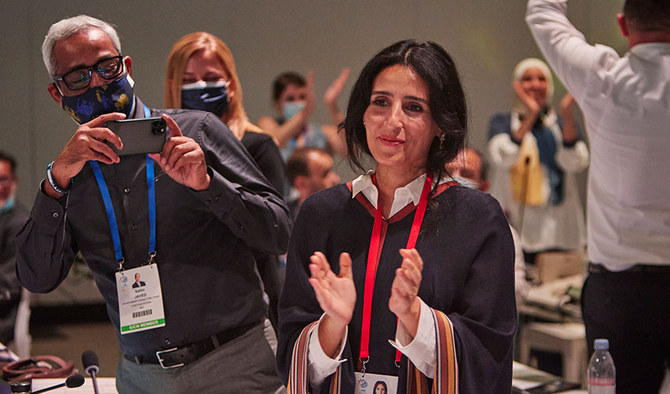

LONDON: The managing director of the Abu Dhabi Environment Agency on Tuesday urged the international community to take action to prevent global biodiversity loss, which she said often “plays second fiddle” to the issue of climate change in international agreements.
Speaking at an online event hosted by the Emirates Society and attended by Arab News, Razan Khalifa Al-Mubarak said: “Often we link biodiversity and climate change as one and the same … But what’s important for us to understand and recognize is that addressing the issue of climate change won’t necessarily address the issue of biodiversity loss … because the drivers are different.”
She added that the disconnect between addressing climate change, which is caused largely by excess greenhouse gas emissions, and tackling biodiversity loss, which has an array of localized causes, became abundantly clear during the height of the coronavirus pandemic.
“The economic slowdown, particularly in aviation and transportation, reduced global greenhouse gas emissions by 8 percent — the greatest decrease in 100 years. But if you look at what happened in the biodiversity agenda, it actually increased,” said Al-Mubarak.
This was partly because urban-to-rural population flows increased, but global lockdowns also meant that conservation workers were prevented from carrying out their essential duties that preserve biodiverse systems.
The Zoological Society of London’s Director General Dominic Jermey told participants that a key indicator of global biodiversity change that his organization produces, the Living Planet Index, shows that land use for products such as palm oil or cotton is “one of the critical killers of wildlife.”
Al-Mubarak, who was recently appointed as president of the International Union for the Conservation of Nature, said biodiversity, and nature more broadly, are essential to human survival, but the “myth” that addressing climate change will also protect diverse biological systems needs to be “debunked.”
In her home country of the UAE, her work has already proved successful in protecting or rejuvenating ecosystems, while also building relationships with international partners.
One of the Abu Dhabi Environment Agency’s crowning successes was the re-introduction of the scimitar-horned oryx, which is extinct in the wild, back into its native Saharan habitat, an initiative carried out jointly with Chadian environmental officials, the ZSL and others.
In Europe, too, Al-Mubarak’s team has made inroads to protect endangered species. The UK and the UAE are signatories to the Raptors Memorandum of Understanding, an international agreement that protects the migration routes of birds of prey such as falcons.
And Abu Dhabi is host to the only office dedicated to the administration of the UN’s Bonn Convention on Migratory Species.
Al-Mubarak said: “What spurred the Raptors MoU between the UK and the UAE is the story of falconry. If you trace the story of falconry and falcon conservation in the UAE context … it was this fantastic bird, the fastest animal on the planet, that spurred the imagination of the leadership of institutions in the UAE to protect it.”
This went “beyond borders,” she added, explaining that their work to protect falcons and other migratory birds now extends to cooperation with Kazakhstan, China and Kyrgyzstan.
She said cooperation with the UAE’s neighbors, such as Saudi Arabia and Oman, could also improve conservation efforts.
Responding to a question by Arab News, she said: “In our region we share species, and we need to be able to share and work on cross-boundary protected areas, which we really haven’t exploited yet. It’s something that we really need to do more of.”
Adding to the point, Jermey said: “Wild animals don’t have passports. It’s news to them that there are borders between countries, and we do need to think in a trans-border, trans-boundary way.”


