

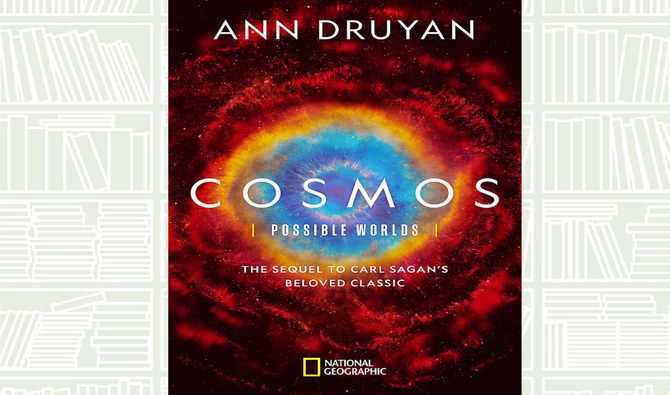
What We Are Watching Today: Cosmos: Possible Worlds

Short Url
Updated 07 December 2021
Follow

What We Are Watching Today: Cosmos: Possible Worlds

Authors:  Ann Druyan, Brannon Braga

Ever look up and wonder what lies behind the sparkle of each star? Are we alone in the universe? Is it possible that our planet, Earth, is the only habitable planet out there in the vastness of space?
“Cosmos: Possible Worlds” is a documentary television series that follows up with famous astrophysicist Carl Sagan’s 1980 television series “Cosmos: A Personal Voyage.” Following his one-time mentor’s footsteps, the show is presented by astrophysicist Neil deGrasse Tyson.
The series consists of 13 episodes. Viewers are transported through time to a possible future for mankind, first contact with aliens, exploring old civilizations that lived thousands of years ago, and discussing current challenges facing mankind and what the future will hold for today’s children.
While watching, a curious child within you will emerge, asking a thousand deep questions. How will the future of space exploration make the lives of future generations better? Can we explore the universe? Can we survive outside of our comfort zone, our home planet, or will we continue damaging it at such an alarming rate that we one day have to leave?


What We Are Reading Today: A Capital’s Capital

Updated 16 February 2026
Follow

What We Are Reading Today: A Capital’s Capital

Authors: Gilles  Postel-Vinay and Jean-Laurent Rosenthal

Successful economies sustain capital accumulation across generations, and capital accumulation leads to large increases in private wealth. In this book, Gilles Postel-Vinay and Jean-Laurent Rosenthal map the fluctuations in wealth and its distribution in Paris between 1807 and 1977. 

Drawing on a unique dataset of the bequests of almost 800,000 Parisians, they show that real wealth per decedent varied immensely during this period while inequality began high and declined only slowly. 

Parisians’ portfolios document startling changes in the geography and types of wealth over time.

Postel-Vinay and Rosenthal’s account reveals the impact of economic factors (large shocks, technological changes, differential returns to wealth), political factors (changes in taxation), and demographic and social factors (age and gender) on wealth and inequality.

Before World War I, private wealth was highly predictive of other indicators of welfare, including different forms of human capital, age at death, and access to local public goods.