Saudi desalination corporation reveals environmental sustainability road map

Image: Shutterstock
Short Url
Updated 06 December 2021
Follow

Saudi desalination corporation reveals environmental sustainability road map

  • Kingdom’s plans for improving environment, combating climate change, reaching carbon neutrality shared at global industry forum

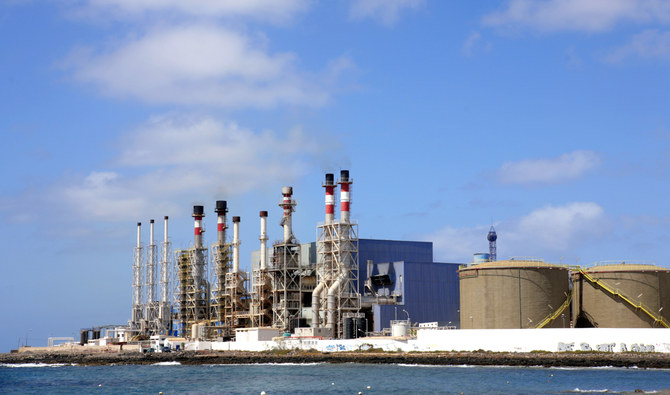
JEDDAH: A Saudi government institution responsible for the desalination of seawater has revealed its road map to achieving environmental sustainability at a major international industry conference.

Officials from the Saline Water Conversion Corp. shared their Saudi Green Initiative action plans — aimed at improving the environment, combating climate change, and reaching carbon neutrality ­— at a recent forum in London attended by more than 90 global leaders and investors.

By taking part in the event, the SWCC not only hoped to strengthen its world leadership role in the desalination industry, but also look at ways to further reduce production costs while increasing the involvement of relevant Saudi companies and organizations in current and future projects.

Saudi Ambassador to the UK Prince Khalid bin Bandar bin Sultan was among forum delegates who heard how the corporation was focused on enhancing the use of clean energy sources in place of thermal heating systems.

Addressing the meeting, Saleh Al-Mana, the SWCC’s assistant deputy governor for technical affairs and projects, said that by reusing water and recycling filters in production systems, and developing engineering principles in technical designs for beneficiaries including the agriculture, industrial, and urban sectors, the transition to low carbon activated the circular economy.

The corporation has been working on initiatives to achieve environmental sustainability in all areas of desalination supply, from production to transportation.

At the Saudi Green Initiative forum held in Riyadh in October, the Kingdom revealed its blueprint for dealing with climate change by increasing the reliance on clean energy, protecting the environment, and offsetting millions of tons of carbon emissions annually by 2030.

The country was investigating more ways to produce, treat, and distribute water locally using energy systems that ensured sustainable growth.

The initiative aims to protect the marine environment by investing in zero liquid discharge systems, a wastewater management system that extracts salts and minerals and converts them into products of high economic value for use in the industrial sector.

Earlier this year, the SWCC set a world record for the lowest energy consuming desalination plant.

The transition to a low-carbon future will be a complex process. Alternatives will take significant time and sustained investment to meet the rising global energy demand.


First EU–Saudi roundtable on critical raw materials reflects shared policy commitment

Updated 16 January 2026
Follow

First EU–Saudi roundtable on critical raw materials reflects shared policy commitment

RIYADH: The EU–Saudi Arabia Business and Investment Dialogue on Advancing Critical Raw Materials Value Chains, held in Riyadh as part of the Future Minerals Forum, brought together senior policymakers, industry leaders, and investors to advance strategic cooperation across critical raw materials value chains.

Organized under a Team Europe approach by the EU–GCC Cooperation on Green Transition Project, in coordination with the EU Delegation to Saudi Arabia, the European Chamber of Commerce in the Kingdom and in close cooperation with FMF, the dialogue provided a high-level platform to explore European actions under the EU Critical Raw Materials Act and ResourceEU alongside the Kingdom’s aspirations for minerals, industrial, and investment priorities.

This is in line with Saudi Vision 2030 and broader regional ambitions across the GCC, MENA, and Africa.

ResourceEU is the EU’s new strategic action plan, launched in late 2025, to secure a reliable supply of critical raw materials like lithium, rare earths, and cobalt, reducing dependency on single suppliers, such as China, by boosting domestic extraction, processing, recycling, stockpiling, and strategic partnerships with resource-rich nations.

The first ever EU–Saudi roundtable on critical raw materials was opened by the bloc’s Ambassador to the Kingdom, Christophe Farnaud, together with Saudi Deputy Minister for Mining Development Turki Al-Babtain, turning policy alignment into concrete cooperation.

Farnaud underlined the central role of international cooperation in the implementation of the EU’s critical raw materials policy framework.

“As the European Union advances the implementation of its Critical Raw Materials policy, international cooperation is indispensable to building secure, diversified, and sustainable value chains. Saudi Arabia is a key partner in this effort. This dialogue reflects our shared commitment to translate policy alignment into concrete business and investment cooperation that supports the green and digital transitions,” said the ambassador.

Discussions focused on strengthening resilient, diversified, and responsible CRM supply chains that are essential to the green and digital transitions.

Participants explored concrete opportunities for EU–Saudi cooperation across the full value chain, including exploration, mining, and processing and refining, as well as recycling, downstream manufacturing, and the mobilization of private investment and sustainable finance, underpinned by high environmental, social, and governance standards.

From the Saudi side, the dialogue was framed as a key contribution to the Kingdom’s industrial transformation and long-term economic diversification agenda under Vision 2030, with a strong focus on responsible resource development and global market integration.

“Developing globally competitive mineral hubs and sustainable value chains is a central pillar of Saudi Vision 2030 and the Kingdom’s industrial transformation. Our engagement with the European Union through this dialogue to strengthen upstream and downstream integration, attract high-quality investment, and advance responsible mining and processing. Enhanced cooperation with the EU, capitalizing on the demand dynamics of the EU Critical Raw Materials Act, will be key to delivering long-term value for both sides,” said Al-Babtain.

Valere Moutarlier, deputy director-general for European industry decarbonization, and directorate-general for the internal market, industry, entrepreneurship and SMEs at European Commission, said the EU Critical Raw Materials Act and ResourceEU provided a clear framework to strengthen Europe’s resilience while deepening its cooperation with international partners.

“Cooperation with Saudi Arabia is essential to advancing secure, sustainable, and diversified critical raw materials value chains. Dialogues such as this play a key role in translating policy ambitions into concrete industrial and investment cooperation,” she added.