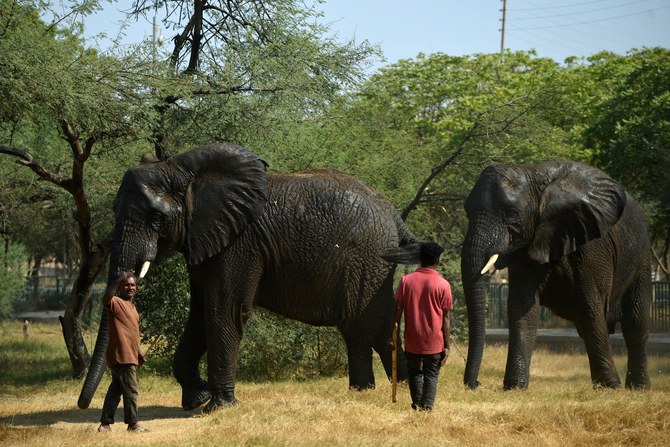

KARACHI: A Pakistani expert, who assisted a team of international veterinarians in assessing the health of four elephants in Pakistan’s Karachi city, has said Pakistan did not have the equipment to ascertain the gender of elephants.
Last week, a team of international veterinarians and wildlife experts examined four elephants in Karachi and reported that one of the elephants needed a “complicated” surgery to remove damaged and infected tusks. A second elephant had dental problems and a medical issue with a foot, according to the vets dispatched by international animal advocacy Four Paws.
The visit came months after the Sindh High Court (SHC) granted permission to Dr. Frank Goritz, the head veterinarian at the Leibniz Institute for Zoo and Wildlife Research (IZW), to visit Pakistan to inspect the health of four African elephants: Malika and Sonu at Karachi’s Safari Park, and Noor Jehan and Madhubala at the Karachi Zoo. The order was passed after animal rights activists moved the court following a viral video that revealed cracks in Malika’s foot.
In its preliminary report submitted to the court on November 30, the team recommended medical interventions and also revealed that Sonu, which Pakistani authorities had listed as male, was actually a female elephant.
Dr. Isma Gheewala, who assisted the international team, told Arab News it was not possible to ascertain the gender of an elephant with the equipment available in Pakistan and only international experts could do it using specialized tools.
“If Pakistan is keeping wildlife, it is the responsibility of our government to provide tools and medicine required for the screening and treatment of animals, which are currently not available in the country,” Gheewala said, adding that even the international team, which included the world’s most highly qualified experts in elephant reproduction and treatment, couldn’t have ascertained the gender of the elephants without conducting a special screening.
“How could local vets ascertain the gender without having access to advanced diagnostic and screening tools,” the expert asked, explaining that elephants do not have exposed genitals outside their bodies. “The specialist who came here used a very long ultrasound probe. In this examination, they discovered that the animal had ovaries and a uterus and no testicles. Without this special equipment there is no way to figure it out.”
Pakistan, Gheewala said, didn’t even have the necessary medicines to sedate elephants for the test, or to reverse the sedation.
Mansoor Kazi, a Karachi Zoo and Safari Park senior director, said Sonu was only 16 years old and elephant genitalia became more evident as the animal neared full adulthood.
Elephants often continue to grow in size and weight until they’re about 20 years old. Males might fill out for a bit longer, but by age 25, both males and females are at their full size and strength
“Sonu has been in the Safari Park for the last 11 years and our veterinarians haven’t noticed its menstrual cycles. Sonu has behaved completely differently from its partner, Malika, as far as its cycles are concerned,” Kazi told Arab News, citing former vet Dr. Syed Kazim Hussain, who has been looking after the animals since they were imported to Pakistan in 2010.
All four elephants were imported by an animal trader, Irfan Ahmed, who had said he had captured three females and one male elephant aged 2 to 3.
“Our very experienced veterinarian Dr. Syed Kazim Hussain has been closely monitoring the animals. Sonu has a male reproductive organ and we strongly believe that once the elephant reaches its complete adulthood, its gender will be clearer,” Kazi added.
In their report, however, the international experts wrote that “Elephant ‘Sonu’ presented as a male turned out proven female.” The experts ultrasonographically visualized its uterus and inactive ovaries, the report said.
“However, an oversized clitoris has been palpated inside the vestibulum, which is getting exposed very often by Sonu as reported by local staff. Latter may explain the assumption to see a penis and could be indicative of a hormonal imbalance. Measurements of female and male sexual hormones in the blood scrum are still pending,” the report said.
The focus on Karachi’s four African elephants comes a year after Kaavan, called the “world’s loneliest elephants,” was released from a ramshackle, now-closed zoo in Islamabad. Animal rights activists had campaigned against the plight of 35-year-old Kaavan, the last remaining Asian elephant in the country, who had lived alone since the death of his mate eight years earlier.
Kaavan was transferred to Cambodia in November last year in a blaze of publicity after his plight caught the attention of US superstar Cher, who helped raise funds for the jumbo relocation.
Owais Awan, an animal rights activist who pleaded the case for Kaavan’s relocation and is also a co-petitioner in the case to examine the Karachi elephants by international experts, said whatever the reason for the misgendering, it indicated that local authorities did not have the required expertise, tools and medicines to deal with wildlife they were keeping at Pakistani facilities.
“We need to enhance our expertise and capacity,” Awan said, “and ensure that we have proper tools and medicine to treat elephants.”