

Late goal salvages point for Saudi Arabia against Palestine and maintains hopes of FIFA Arab Cup progress

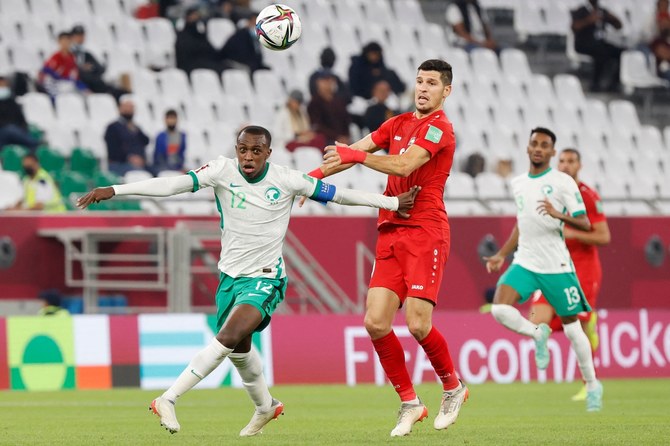
Saudi Arabia's defender Saud Abdulhamid (L) and Palestine's midfielder Tamer Seyam vie for a header during the FIFA Arab Cup 2021 group C football match. (File/AFP)
Short Url
Updated 05 December 2021
Follow

Late goal salvages point for Saudi Arabia against Palestine and maintains hopes of FIFA Arab Cup progress

  • A 1-1 draw leaves Green Falcons needing a win in last match against Morocco to have chance of reaching the quarterfinals

Abdullah Al-Hamdan’s late goal earned Saudi Arabia a 1-1 draw with Palestine on Saturday and kept alive their hopes of progressing into the quarterfinals of the Arab Cup. 

A first-half stunner from Mohammed Rashid in Qatar’s Education City looked to have condemned the young Green Falcons to a second successive defeat, three days after losing 1-0 to Jordan, but an equalizer with eight minutes remaining from the Al-Hilal striker earned the men in white a vital point.

The draw leaves Saudi Arabia in third in Group C with one point from two games and above Palestine on goal difference. Jordan have three points, while Morocco, the next opponents for Laurent Bonadei’s men, are already assured of a place in the last eight after winning both games so far 4-0. Only the top two teams progress.

With Saudi Arabia, who made eight changes from the Jordan game, fielding an inexperienced U-23 team, it was always going to be a difficult test and so it proved.

The first half was cagey, though Palestine started a little livelier, with both teams lacking quality in delivering the final ball. The first sight of goal for Saudi Arabia came with a free-kick after 14 minutes. Mohammed Al-Qahtani, the Al-Hilal teenager making his first start for the national team, curled a shot over the Palestine bar.

Palestine came close in the 37th minute. Tamer Seyam, the best player on the pitch in the first half, beat two men and his cross from the byline was heading for Khaled Salam, but Saudi goalkeeper Zaid Al-Bawardi managed to palm the ball away from the forward’s foot.

Then, in added time before the break, Palestine took the lead in some style. Rashid received the ball in the middle of the Saudi Arabia half, took two touches and then let loose an unstoppable shot that flew into the roof of the net to give the Indonesia-based defender his first international goal.

Saudi Arabia began the second half with purpose, moving the ball around quickly. Soon after the restart, Abdullah Radif forced a save from Amr Kaddura, the Palestine goalkeeper’s first real stop of the game. Moments later, Al-Qahtani’s low shot went just wide of the left post.

With 18 minutes remaining, Ayman Yahya’s shot from the edge of the box was deflected wide. On more than one occasion, there was frustration from the Saudi players waiting in the area at the quality of the final ball.

There was always a danger from Palestine counterattacks, which became more frequent the more Saudi Arabia pushed forward. Seyam, perhaps, should have scored and almost certainly sealed the win with a quarter of an hour remaining, but instead blasted the ball over.

Palestine rued that miss after 82 minutes when Saudi Arabia scored their first goal of the tournament. A long ball out of defense found Haitham Asiri on the right and his low pass was coolly slotted home by Al-Hamdan.

It was no less than this rookie Saudi Arabia team deserved, and they could even have won had Waleed Al-Ahmad not headed wide in injury time.

Next comes Morocco — the form team of the tournament so far — on Wednesday. The Atlas Lions have won both games, against Palestine and Jordan 4-0, and were impressive. 

Morocco are already through to the last eight and may rest a few players, but regardless, for Saudi Arabia, a win is needed and then it depends on what happens during the showdown between Palestine and Jordan.


How international academies are shaping Saudi football’s next generation

Updated 05 January 2026
Follow

How international academies are shaping Saudi football’s next generation

  • Building a unified national footballing philosophy in Saudi Arabia is no simple task

Saudi Arabia’s football transformation has been impossible to ignore since the arrival of Cristiano Ronaldo at the end of 2022. An influx of global stars followed, and with it, unprecedented attention on the Saudi Pro League.

Yet beneath the spotlight, a more pressing question emerged amongst domestic fans: “What is the long-term strategy for developing local players?”

Building a unified national footballing philosophy in Saudi Arabia is no simple task. The sheer size of the Kingdom presents logistical challenges unlike those faced by smaller neighbouring nations, making grassroots development harder to centralize. In this landscape, the work of individual institutions can contribute significantly to the broader football ecosystem.

One such contributor is Juventus Academy Saudi Arabia, an official extension of one of world football’s most historic clubs, operating under the umbrella of Al-Shoaibi Group. Arab News spoke to head of public relations at Juventus Academy, Malak Al-Awami, based in Alkhobar, to understand how the academy fits into the Kingdom’s long-term football vision.

“Saudi Arabia is experiencing a transformational moment under Vision 2030, prioritizing youth development and active lifestyles,” Al-Awami explained. “The  academy arrives at a perfect time to contribute to a world-class methodology while helping nurture the next generation of Saudi footballers.”

At Juventus Academy, success is deliberately defined beyond results and trophies.

“We’re not just training players,” Al-Awami said. “We’re shaping future leaders for the Kingdom.”

That philosophy has been reflected in how the academy balances Juventus’ global philosophy with local Saudi culture. While all coaches undergo Juventus’ training standards, cultural understanding remains a priority.

“All of our coaches are guided to respect Saudi values, culture and communication styles,” Al-Awami said. “Technical excellence matters, but the coach’s character is just as important as their certification.”

One of the academy’s defining features has been its inclusivity and cultural awareness. Players can join as young as four years old and continue until the age of 18, with programs open to both boys and girls.

That inclusivity has had a tangible impact. Juventus Academy played a role in the formation of Khobar FC, a women’s team that competed in the inaugural season of the SAFF Women’s Second Division League.

“We even used the same kit style as Juventus, getting approval from the club itself,” revealed Al-Awami.

Operating as an extension of the academy, the team finished just a few points behind established clubs like Al-Nahda and Al-Fateh in their regional group.

Al-Awami noted that the group is also exploring complementary initiatives aimed at elite player development beyond the academy itself. Among them is the planned Superior Striker Project, a specialized program designed to bring international attacking expertise to Saudi Arabia through short-term clinics for youth and professional players.

It is this broader contribution that highlights the growing importance of international academies in Saudi Arabia. Beyond providing structured training, they are helping build communities, instil values and strengthen the foundations of the domestic football pyramid. 

When asked about what success would look like for Juventus Academy in 5-10 years, Al-Awami was clear. “It is definitely not about trophies or big contracts,” he said, before adding, “it is the legacy we leave behind. If, in 10 years we see confident young Saudi players competing at elite levels, local coaches growing through our programs, and families trusting football as a tool for personal development, then we will know that we have truly succeeded.”

Juventus Academy Saudi Arabia builds on Al-Shoaibi Group’s original ambition in 2018: to create meaningful football opportunities for families in the Kingdom. Today, that ambition has evolved into a structured pathway contributing to Saudi football future, blending global expertise with local identity to help shape the next generation.