Pakistan court awards lengthy sentences to Tehreek-i-Labaik members for riots, attacking police 

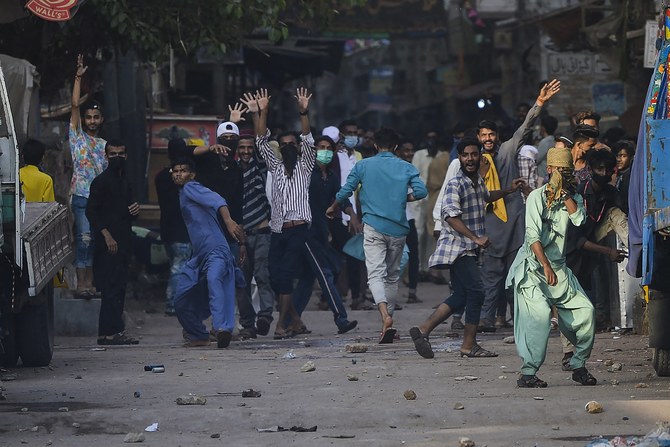
Supporters of Tehreek-e-Labbaik Pakistan (TLP) party throw stones toward police during a protest after their leader was detained following his calls for the expulsion of the French ambassador, in Karachi, Pakistan, on April 19, 2021. (AFP)
Short Url
Updated 04 December 2021
Follow

Pakistan court awards lengthy sentences to Tehreek-i-Labaik members for riots, attacking police 

  • Government banned TLP after violent protests in April, designated it a terror group and arrested its chief Saad Rizvi
  • Last month, government unbanned TLP, freed thousands of jailed activists and allowed party to contest upcoming elections

ISLAMABAD: An anti-terrorism court (ATC) in the Pakistani city of Gujranwala has convicted 19 members of the Tehreek-i-Labbaik Pakistan (TLP) and awarded them 16-year prison sentences each for attacking police during riots in October, Pakistani media reported on Saturday. 

ATC judge Natasha Naseem Sipra also imposed a fine of Rs30,000 on each of the convicts while acquitting 15 others in the case.

The TLP has repeatedly paralysed the country with protests, including an anti-France campaign after Paris-based satirical magazine Charlie Hebdo last year republished cartoons depicting the Prophet Mohammed (pbuh). This October, the party held weeks-long protests and engaged in violent clashes with police, dispersing only after the government unbanned the group, freed thousands of its jailed activists and allowed TLP to contest upcoming elections.

Earlier this year, Pindi Bhattian police had filed cases against 34 TLP members on charges of killing a policeman, injuring several others, blocking roads, snatching anti-riot jackets and other related offences.

“The judge awarded 15 years’ imprisonment and a fine of Rs30,000 each in three different offences of section 6 of ATA [Anti-Terrorism Act] and one-year imprisonment in section 148 of PPC [Pakistan Penal Code],” Dawn reported. “The convicts have already been arrested and kept in the Hafizabad district jail.”

Prime Minister Imran Khan's government banned the TLP after its protests turned violent in April this year, designated it a terror group and arrested its chief Saad Rizvi.

The group, which can mobilise thousands of supporters, was born in 2015 out of a protest campaign to seek the release of a police guard who assassinated a provincial governor in 2011 over his calls to reform blasphemy legislation. TLP entered politics in 2017 and secured over 2 million votes in the 2018 election.

The next national election is scheduled for 2023.


Pakistan’s defense minister backs army spokesman’s criticism of Imran Khan

Updated 5 sec ago
Follow

Pakistan’s defense minister backs army spokesman’s criticism of Imran Khan

  • Khawaja Asif calls the military’s response to Khan’s recent remarks ‘measured’
  • He accuses Khan’s PTI party of ‘changing its identity’ by siding against Pakistan

ISLAMABAD: Pakistan’s Defense Minister Khawaja Asif on Saturday defended a scathing news conference by the military’s spokesman a day earlier, in which the latter accused former prime minister Imran Khan of promoting an anti-state narrative that he said had become a national security threat.

Lt. Gen. Ahmed Sharif Chaudhry, who heads the military’s media wing as director general of Inter-Services Public Relations (ISPR), addressed journalists on Friday in response to Khan’s latest social media post accusing Chief of Defense Forces Field Marshal Asim Munir of being responsible for “the complete collapse of the constitution and rule of law in Pakistan.”

During the briefing, Chaudhry described the incarcerated former premier as a “narcissist” and a “mentally ill individual,” though he said it up to the government to determine how it wanted to deal with him.

Asked about the military’s viewpoint against Khan and his Pakistan Tehreek-e-Insaf (PTI) party, Asif told reporters in the city of Sialkot the former premier had long used harsh language against state institutions and political opponents.

“When this kind of language is used for individuals as well as for institutions, then a reaction is a natural outcome,” he said. “The same thing is happening on the Twitter accounts being run in his [Khan’s] name. If the DG ISPR has given any reaction to it, then I believe it was a very measured reaction.”

The minister said Khan and PTI leaders had continued to target the army despite the sacrifices made by soldiers in the fight against militancy and during the four-day conflict with India in May.

He said PTI should recognize those sacrifices by supporting “our soldiers and martyrs” rather than “the terrorists.”

“Imran Khan speaks on every issue. Why did he not speak [in favor of the military] during the war [with India]?” Asif said. “Even during the war he kept targeting the military leadership. He continued to use inappropriate language for them.”

“People whose conduct is like this, whose language does not spare even the martyrs, how can they say ... that the DG ISPR should not say this or should not say that?” he continued. “He absolutely should.”

Asif added that Khan and his party had “changed their identity,” adding they were no longer standing with Pakistan.

PTI has not officially responded to his comments yet.