

Pakistani president ratifies bill allowing use of electronic voting machines 

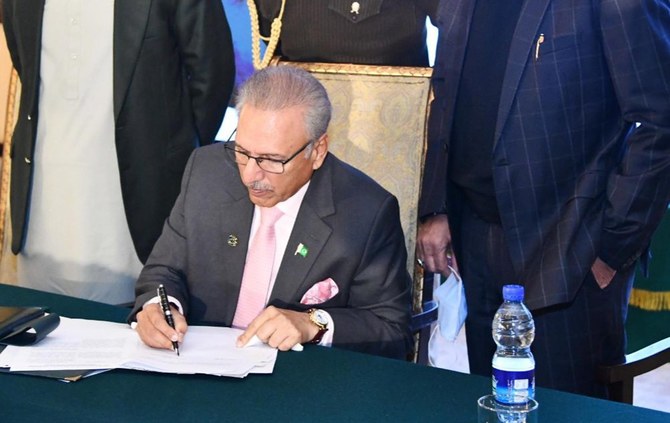
Pakistan President Dr Arif Alvi signing the Election (Amendment) Bill 2021 into law at, Aiwan-e-Sadar, Islamabad, Pakistan, on December 2, 2021. (PID Photo)
Short Url
Updated 03 December 2021
Follow

Pakistani president ratifies bill allowing use of electronic voting machines 

  • Last month, a joint parliamentary sitting sanctioned use of EVMs for next general elections in the country 
  • Government has been pushing for use of technology but opposition accuses it of trying to manipulate system 

ISLAMABAD: Pakistani President Arif Alvi on Thursday signed the Election (Amendment) Bill, 2021 that allows the use of electronic voting machines (EVMs) in the country, Pakistani state-run APP news agency reported. 

Last month, a joint parliamentary sitting sanctioned the use of EVMs for the next general elections, though opposition factions resisted the move and vowed to challenge it in the country’s top court. 

The government has lately pushed for the use of technology to make future Pakistani elections fairer and more transparent, but opposition parties accuse it of trying to manipulate the voting system by introducing technology, which has not been tested in Pakistan before. 

Alvi, however, asked critics not to be afraid of a “simple” electronic voting machine (EVM), which he said would help hold a fair election and bring an end to poll rigging. 

“People will have to trust it. It involves no advancement. It is too simple. The country achieves progress by adopting new things,” the president said, addressing a ceremony wherein he signed the bill into law. 

The bill also provides for the right of vote to overseas Pakistanis. 

EVMs will ensure holding a fair election that has long been desired in Pakistan as every election followed controversies and rigging allegations, which also impacted credibility of respective governments, according to Alvi. 

These machines would help print votes on the spot, instead of printing ballot papers at the press. They would help do away with the practice of printing extra ballot papers that used to be sold out later, kidnapping of presiding officers, and confusion in vote count. 

He said the voter would cast their vote by touching the EVM screen, instead of stamping the ballot paper. “The process is the same. Then what is the resistance for?” 

While the machine would use an in-built calculator to count votes, manual counting would also be available for skeptics, the president said, adding that the Ministry of Science and Technology was not a manufacturer of EVMs, it rather made a prototype for experiment. 

It would be the Election Commission of Pakistan (ECP) to select the EVM based on the required specifications, he explained. 

About Internet-voting (I-voting) for overseas Pakistanis, Alvi recounted the ruling Pakistan Tehreek-e-Insaf’s (PTI) legal and political struggle for voting right to Pakistani expatriates. He said physical voting for expatriates was not possible due to multiple complications. 

The countries, which had rejected EVMs, had their own better systems in place, according to the president. Contrarily, Pakistan needed it owing to weaknesses in its system. 

EVMs would help alleviate confusion caused by post-election rigging allegations and bring about a strong government to support democracy, he said. 

“Don’t worry, the nation will be convinced,” the president remarked. “Just like this one, the country will make progress in other fields too.” 


Pakistan saw up to 17% drop in cross-border attacks after Afghan border closure — think tank

Updated 5 sec ago
Follow

Pakistan saw up to 17% drop in cross-border attacks after Afghan border closure — think tank

  • CRSS calls 2025 the deadliest year in a decade with 3,417 violence-linked fatalities nationwide
  • Violence remained concentrated in the western provinces as security forces killed 2,060 militants

ISLAMABAD: Pakistan recorded a sharp decline in cross-border militant attacks and violence-linked fatalities in the final months of 2025 after it closed its border with Afghanistan in October, even as the country endured its deadliest year in a decade overall, according to an annual security report released by a local think tank on Wednesday.

Pakistan has frequently accused Afghanistan of sheltering proscribed armed factions, such as the Tehreek-e-Taliban Pakistan (TTP) and the Balochistan Liberation Army (BLA), in the past, while also pointing a finger at the Taliban administration in Kabul for “facilitating” their attacks against Pakistani civilians and security forces.

The Center for Research and Security Studies (CRSS) said in its report that terrorist attacks fell by nearly 17% in December, following a 9% decline in November, after Pakistan shut the border on Oct. 11. It noted that violence-linked fatalities among civilians and security personnel also declined in the final quarter of the year, falling by nearly 4% and 19% respectively in November and December.

“Pakistan recorded a significant drop in cross-border terrorist attacks and violence-linked fatalities after it closed down the border to Afghanistan,” CRSS said.

Despite the late-year decline, the think tank said 2025 “went by as the most violent year for Pakistan in a decade,” with overall violence surging nearly 34% year-on-year.

Fatalities rose from 2,555 in 2024 to 3,417 in 2025 — an increase of 862 deaths — extending a five-year upward trend in violence that coincides with the Taliban’s return to power in Afghanistan in 2021, the report said.

“2025 marked another grim year for Pakistan’s security landscape,” it added, noting that violence has increased every year since 2021, with annual surges of nearly 38% in 2021, over 15% in 2022, 56% in 2023, nearly 67% in 2024 and 34% in 2025. 

REGIONAL CONCENTRATION

Violence remained heavily concentrated in Pakistan’s northwestern Khyber Pakhtunkhwa (KP) and southwestern Balochistan provinces, which together accounted for more than 96% of all fatalities and nearly 93% of violent incidents nationwide.

KP was the worst-hit region, recording 2,331 fatalities in 2025 — a 44% increase from 1,620 deaths in 2024 — accounting for more than 82% of the net national rise in violence.

Balochistan saw fatalities rise from 787 to 956, an increase of nearly 22%.

In contrast, Punjab and Sindh recorded relatively low levels of violence, together accounting for less than 3% of total casualties, which CRSS said pointed to “relative containment of violence despite the provinces’ large populations.”

The report also flagged the spread of violence into previously calmer regions, with Azad Jammu and Kashmir recording 15 fatalities in 2025 after reporting no violence a year earlier.

MILITANT DEATH TOLL

CRSS said 2025 was also the deadliest year in a decade for militant groups, with outlaws accounting for more than 60% of all fatalities.

“2025 turned out to be the deadliest year for outlaws in a decade,” the report said, with 2,060 militants killed during at least 392 security operations, surpassing the combined fatalities of civilians and security personnel.

Security forces, however, remained the primary targets of militant groups.

The army and Frontier Corps recorded 374 fatalities, including 22 officers, while police suffered 216 casualties.

The TTP claimed responsibility for the largest share of attacks on security personnel, followed by the BLA, the Baloch Liberation Front (BLF) and Daesh’s regional chapter.