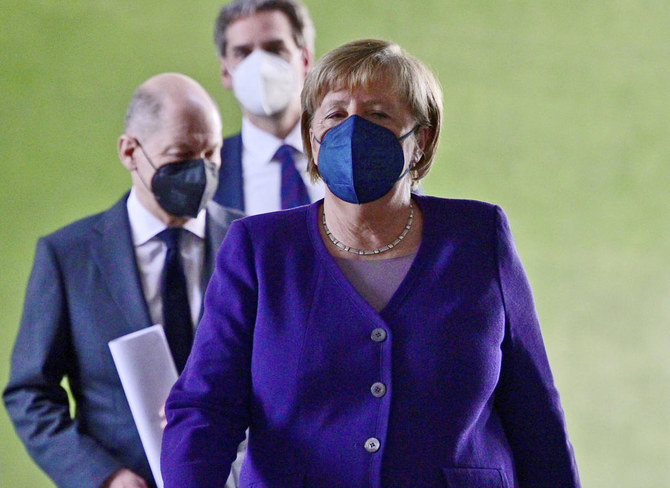
BERLIN: German Chancellor Angela Merkel said Thursday that people who aren’t vaccinated will be excluded from nonessential stores, cultural and recreational venues.
And parliament will consider a general vaccine mandate as part of efforts to curb coronavirus infections that again topped 70,000 newly confirmed cases in a 24-hour period.
Speaking after a meeting with federal and state leaders, Merkel said the measures were necessary in light of concerns that hospitals in Germany could become overloaded with people suffering COVID-19 infections, which are more likely to be serious in those who haven’t been vaccinated.
“The situation in our country is serious,” Merkel told reporters in Berlin, calling the measure an “act of national solidarity.”
She said officials also agreed to require masks in schools, impose new limits on private meetings and aim for 30 million vaccinations by the end of the year — an effort that will be boosted by allowing dentists and pharmacists to administer the shots.
Merkel herself backed the most contentious proposal of imposing a general vaccine mandate. She said parliament would debate the proposal with input from the country’s national ethics committee.
If passed, it could take effect as early as February, Merkel said, adding that she would have voted in favor of the measure if she were still a member of parliament.
About 68.7 percent of the population in Germany is fully vaccinated, far below the minimum of 75 percent the government is aiming for.
There have been large protests against pandemic measures in the past in Germany and the vaccine mandate is likely to be opposed by a minority, though opinion polls show most Germans are in favor.
Finance Minister Olaf Scholz, who is expected to be elected chancellor by a center-left coalition next week, has also backed a general vaccine mandate, but favors letting lawmakers vote on the issue according to their personal conscience rather than party lines.
“If we had a higher vaccination rate, we wouldn’t be discussing this now,”he said.
The rise in COVID-19 cases over the past several weeks and the arrival of the new omicron variant have prompted warnings from scientists and doctors that medical services in the country could become overstretched in the coming weeks unless drastic action is taken. Some hospitals in the south and east of the country have already transferred patients to other parts of Germany because of a shortage of intensive care beds.
Agreeing what measures to take has been complicated by Germany’s political structure — with the 16 states responsible for many of the regulations — and the ongoing transition at the federal level.
Germany’s disease control agency reported 73,209 newly confirmed cases Thursday. The Robert Koch Institute also reported 388 new deaths from COVID-19, taking the total since the start of the pandemic to 102,178.
To reduce the pressure on hospitals over the festive period, the sale of fireworks traditionally set off during New Year’s in Germany will be banned. Each year, hospitals treat hundreds of people with serious injuries because of mishandled fireworks.
The new measures will take effect once Germany’s 16 states incorporate them into existing rules, likely in the coming days.


Germany backs restrictions for unvaccinated as mandate looms
https://arab.news/6e9rg
Germany backs restrictions for unvaccinated as mandate looms

- Measures were necessary in light of concerns that hospitals in Germany could become overloaded
- “The situation in our country is serious,” Merkel told reporters in Berlin, calling the measure an “act of national solidarity”


UN chief calls Ukraine war ‘a stain on our collective conscience’
- Guterres warned that the fighting posed direct risks to the safe and secure operation of Ukraine’s nuclear sites
WASHINGTON: Four years after Russia’s full-scale invasion of Ukraine, UN Secretary General Antonio Guterres said the war there remained “as a stain on our collective conscience” and reiterated calls for an immediate ceasefire. In remarks for a session of the United Nations Security Council to mark the fourth anniversary of Russia’s invasion, Guterres commended the efforts of the United States and others to end the war, but said concrete measures were needed to de-escalate and create space for diplomacy.
Referring to Russia’s invasion, Guterres said: “We have witnessed the cascading consequences of this blatant violation of international law.”
He said more than 15,000 civilians had been killed in Ukraine since the start of the war and over 41,000 hurt. Among those killed or hurt were 3,200 children.
Guterres’ remarks were read on his behalf by Rosemary DiCarlo, the UN under-secretary-general for peacebuilding.
Guterres warned that the fighting posed direct risks to the safe and secure operation of Ukraine’s nuclear sites, and added: “This unconscionable game of nuclear roulette must cease immediately.”
He urged UN member states to fully fund humanitarian assistance and said that any settlement to the war must uphold the sovereignty, independence and territorial integrity of Ukraine within its internationally recognized borders.
“Enough with the death. Enough with the destruction. Enough with the broken lives and shattered futures,” he added.
“It is time for an immediate, full and unconditional ceasefire – the first step toward a just peace that saves lives and ends the endless suffering.