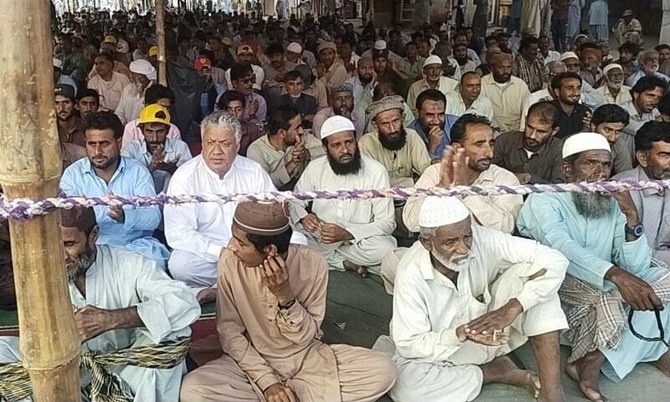
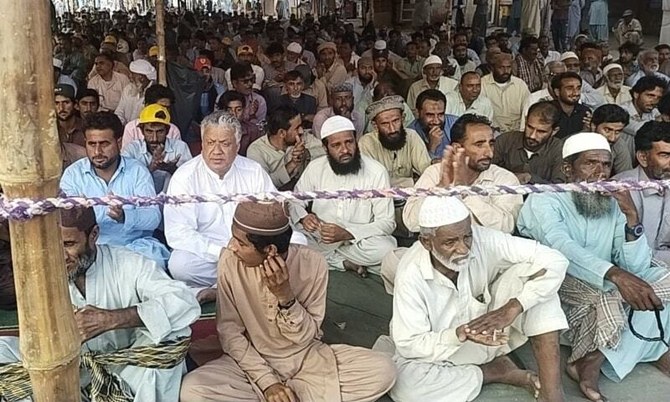
ISLAMABAD: Authorities in Balochistan have sent an additional force of 5,500 police personnel to the country’s Gwadar port city which has been witnessing a prolonged protest by residents over a lack of basic facilities for more than two weeks, an official notification confirmed on Thursday.
Gwadar is in Pakistan’s impoverished southwestern province of Balochistan, a sparsely populated, mountainous, desert region bordering Afghanistan and Iran. China is involved in the development of the Gwadar port on the Arabian Sea as part of a $60 billion China-Pakistan Economic Corridor (CPEC), which is itself part of China’s Belt and Road infrastructure project.
Balochistan Police said in their notification that additional police personnel were deployed in the city to perform “anti-riot duties” in the wake of the current situation in the area.
“Senior most DSP [Deputy Superintendent Police] shall be the overall commander of the concerned district police,” said the official statement.
It added no official would carry weapons except for the assistant superintendent police (ASP), deputy superintendent police (DSP) and station house officers (SHO).
“Two gunmen with each ASP/DSP and each SHO shall accompany the police personnel and ensure their security and safety,” it informed.
Locals in Gwadar have long complained that Chinese presence and investment in the area has done little to improve their lives. The ongoing protest in the city began over two weeks ago. In an unprecedented development earlier this week, thousands of women also took out a demonstration while demanding the rights of the local population.
Balochistan’s planning minister Mir Zahoor Ahmed Buledi on Wednesday reported progress in talks with a local religious and political leader Maulana Hidayat-ur-Rehman who is spearheading the movement.
“Meaningful negotiations were held with Maulana Hidayat-ur-Rehman Sahib and his team,” he said in a Twitter post in Urdu, hoping for “positive result in favor of the people of Balochistan” while announcing headway on the demands made by the demonstrators.
As residents of Gwadar continue their protest, China said on Monday it was willing to work with Pakistan to ensure that the joint corridor project launched by the two countries would benefit the local population of the region.
The corridor is designed to give China a shorter, more secure trading route, via Pakistan, to the Middle East and beyond, while also boosting Pakistan’s economy.
Speaking at a weekly press briefing on Monday, Chinese foreign ministry spokesperson Wang Wenbin said that CPEC had long focused on “people’s livelihood and well-being and [on] benefiting the local people.”
“China is ready to work with Pakistan to advance the high-quality development of CPEC so as to deliver more benefits to the local people,” he said. “The Gwadar Port, a leading project of CPEC, focuses on development and people’s livelihood.”
Wang mentioned the China-Pakistan Gwadar Faqeer Middle School, a vocational training institute, and the China-Pakistan Fraternity Emergency Care Center in Gwadar, saying they had “played important roles in and made China’s contributions to creating education opportunities, improving employment skills and responding to COVID-19 for the benefit of the local people.”
He reiterated that China was ready to work with Pakistan to “jointly advance high-quality development of CPEC, build and operate all CPEC projects including the Gwadar Port well, play a more positive part in improving people’s livelihood in both countries, and build an even closer China-Pakistan community with a shared future in the new era.”


5,500 additional police deployed on ‘anti-riot duties’ as protests continue in Pakistan’s Gwadar
https://arab.news/rmwq8
5,500 additional police deployed on ‘anti-riot duties’ as protests continue in Pakistan’s Gwadar
- Residents of the country’s southern port city have been protesting over a lack of basic facilities for more than two weeks
- The provincial planning minister of Balochistan reports progress on all demands of protestors

Pakistan regulator amends law to facilitate capital raising by listed companies
- The amendments address challenges faced by listed companies when raising further capital from existing shareholders through a rights issue
- Previously, listed companies were prohibited from announcing a rights issue if the company, officials or shareholders had any overdue amounts
KARACHI: The Securities and Exchange Commission of Pakistan (SECP) has notified amendments to the Companies (Further Issue of Shares) Regulations 2020 to facilitate capital raising by listed companies while maintaining adequate disclosure requirements for investors, it announced on Monday,
The amendments address challenges faced by listed companies when raising further capital from existing shareholders through a rights issue. Previously, listed companies were prohibited from announcing a rights issue if the company, its sponsors, promoters, substantial shareholders, or directors had any overdue amounts or defaults appearing in their Credit Information Bureau (CIB) report.
This restriction constrained financially stressed yet viable companies from raising capital, even in circumstances where existing shareholders were willing to support revival, restructuring, or continuation of operations, according to the SECP.
“Under the amended framework, the requirement for a clean CIB report will not apply if the relevant persons provide a No Objection Certificate (NOC) regarding the proposed rights issue from the concerned financial institution(s),” the regulator said.
The notification of the amendments follows a consultative process in which the SECP sought feedback from market stakeholders, including listed companies, issue consultants, professional bodies, industry associations, law firms, and capital market institutions.
The amendments are expected to enhance market confidence, improve access to capital for listed companies, and strengthen transparency within the rights issue framework, according to the SECP.
“To ensure transparency and protect investors’ interests, companies in such cases must make comprehensive disclosures in the rights offer document,” the regulator said.
“These disclosures must include details of any defaults or overdue amounts, ongoing recovery proceedings, and the status of any debt restructuring.”
The revised regulations strike an “appropriate balance” between facilitating corporate rehabilitation and enabling investors to make informed investment decisions, the SECP added.


