Pakistan approves booster shots from December 1 over Omicron variant fears

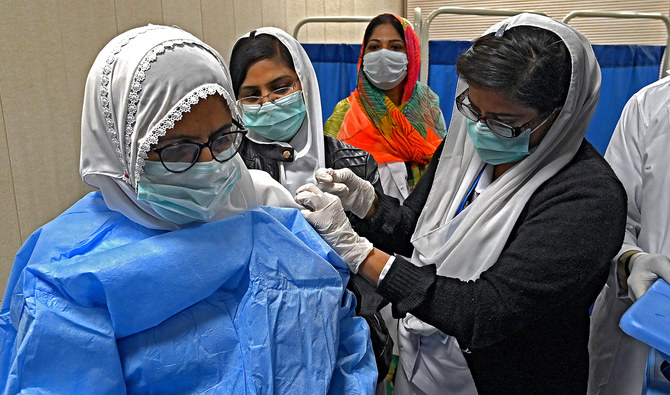
A doctor receives a dose of the Chinese-made Sinopharm Covid-19 vaccine, at a vaccination centre in Lahore, Pakistan, on February 3, 2021. (AFP/File)
Short Url
Updated 01 December 2021
Follow

Pakistan approves booster shots from December 1 over Omicron variant fears

  • Booster dose to be administered to healthcare workers, people over 50 and immunocompromised groups
  • Booster shot to be administered free of cost on voluntary basis after six months of last dose

ISLAMABAD: The National Command and Operation Centre (NCOC), Pakistan’s central pandemic response body, on Wednesday approved a COVID-19 vaccine booster shot for healthcare workers, immunocompromised groups of people and those aged over 50 years as fears spread globally over a new coronavirus variant. 

The discovery of Omicron has caused global alarm, with countries limiting travel from southern Africa for fear it could spread quickly even in vaccinated populations and the World Health Organization saying it carries a high risk of infection surges.

“Booster dose will be administered to three age groups including HCWs , over 50 years of age and immuno-compromised groups from 1st December,” the NCOC said. “Booster dose will be administered after six months of administration of last dose.”

The NCOC said getting a booster was not mandatory and would be free of charge, adding: “Selection of vaccine will be as per Individual choice / availability.”

On Monday Planning Minister Asad Umar, who also heads the NCOC, said it was “impossible” for Pakistan to block the Omicron coronavirus variant from entering the country and the only protection against it was to increase vaccinations.

On Saturday, Pakistan banned travel from six South African countries and Hong Kong following the emergence of the new coronavirus variant.

The Omicron variant spread around the world last week, with new cases found in the Netherlands, Denmark and Australia even as more countries imposed travel restrictions to try to seal themselves off.


Pakistan sells 480MHz for $507 million in 5G spectrum auction

Updated 10 March 2026
Follow

Pakistan sells 480MHz for $507 million in 5G spectrum auction

  • Mobile network operator Jazz buys 190 MHz, Ufone 180MHz and Zong 110MHz, says telecom authority chairman
  • Most mobile networks in Pakistan currently operate on fourth-generation (4G) infrastructure, while 5G rollout has faced delays

ISLAMABAD: Pakistan has sold 480 megahertz (MHz) of fifth-generation (5G) telecom spectrum for $507 million, the Pakistan Telecommunication Authority (PTA) confirmed after a live auction on Tuesday, marking a key step toward introducing faster mobile broadband.

The live auction was organized by the PTA to determine which telecom operators would acquire the frequencies needed to deploy 5G mobile networks across Pakistan.

Pakistan, a country of over 240 million people, is one of the world’s largest telecom markets by population, with over 190 million mobile phone users. However, most networks currently operate on fourth-generation (4G) infrastructure, and the rollout of 5G has faced delays in recent years due to regulatory, economic and spectrum-allocation challenges.

“In total out of 595 MHz, 480 MHz spectrum has been sold today,” PTA Chairman Hafeez-ur-Rehman said in a speech aired on state media. “This is a very big achievement and a big victory for Pakistan, in my opinion.”

Chinese mobile operator Zong ‌bought 110 MHz of the 5G spectrum, while Ufone bought ⁠180 ⁠MHz and Veon-backed firm Jazz bought 190 MHz, Rehman announced.

“And the price in total for this is $507 million,” the PTA chairman said. 

According to officials, 5G services are expected to be rolled out first in Islamabad, Lahore, Karachi, Peshawar and Quetta cities, before expanding nationwide as network infrastructure develops.

Information Technology Minister Shaza Fatima Khawaja has previously said the government is also encouraging wider adoption of 5G-compatible devices, noting that about 95 percent of mobile phones used in

Pakistan are locally manufactured, while premium models such as iPhones and Google Pixel devices are imported.

Officials say Pakistan currently uses around 274 megahertz of spectrum, much of it allocated decades ago, while the new auction will make 600 megahertz of spectrum available for next-generation services.

Under the government’s rollout plan, telecom operators are expected to add roughly 3,000 new network sites annually to support the expansion of 5G services.

PTA officials say Pakistan currently offers some of the world’s cheapest mobile data services and have pledged that consumer protection will remain a priority as the country moves toward next-generation connectivity.