

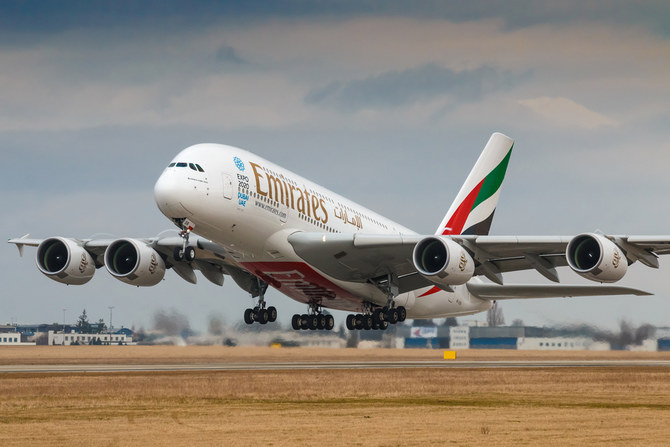
Emirates warns omicron could cause ‘significant traumas’ for aviation industry

Image: Shutterstock
Short Url
Updated 30 November 2021
Follow

Emirates warns omicron could cause ‘significant traumas’ for aviation industry

  • However, he said bookings generally remained strong despite the reintroduction of measures in some European markets

DUBAI: A major hit to the peak December travel season because of the omicron variant of the coronavirus would cause “significant traumas” in the global aviation business, Emirates airline President Tim Clark said on Tuesday.

Clark said Emirates was working on the basis the newly discovered variant could be dealt with effectively by vaccines, but acknowledged the next few weeks would prove critical for the industry as scientists assess the risks.

“I would say probably by the end of December, we’ll have a much clearer position,” Clark said in an interview for the Reuters Next.

“But in that time, December is a very important month for the air travel business,” he added. “If that is lost, or the winter is lost to a lot of carriers, there will be significant traumas in the business, certainly the aviation business and the periphery.”

The World Health Organization (WHO) warned on Monday that the heavily mutated omicron coronavirus variant is likely to spread internationally and poses a very high risk of infection surges that could have “severe consequences” in some places.

omicron was first reported on Nov. 24 in southern Africa, where infections have risen steeply. It has since spread to more than a dozen countries, many of which have imposed travel restrictions to try to seal themselves off.

Japan on Monday joined Israel in saying it would close its borders completely to foreigners.

“It’s likely to arrest, inhibit, but not stall the uptick in demand that we’ve all had the benefit of in the last month or two,” Clark said.

He noted, however, that it could also “go the other way,” with more draconian measures in response to a greater threat from the variant.

Clark said the airline’s decision to close down flights out of South Africa and a handful of surrounding countries was difficult, given strong demand for the December period.

However, he said bookings generally remained strong despite the reintroduction of measures in some European markets such as track and trace, quarantine and PCR testing.

“People haven’t made that decision to cancel or pull off, so we’re hoping that it doesn’t worsen, that the border procedures for re-entry are not so draconian that it prevents them from traveling at all,” he said.

Emirates Chief Executive Sheikh Ahmed bin Saeed Al-Maktoum said just two weeks ago at the Dubai Airshow that the airline planned to deploy a further 60 A380s in response to improving demand, adding to the 47 currently in operation.

“That will be tempered by whatever form this variant takes,” Clark said on Monday. “If it’s mild and its accepted as being mild in its effect and the efficacy of the vaccine shield is able to deal with it, then we hope to have all our aircraft flying, including all the 380s by the summer of next year.”

Clark said re-embedding cabin crews, pilots and engineers and re-training them for safety and other procedures was currently the “greatest inhibiter” for the airline.

“We are continuing to move as if this variant will be dealt with,” he said. “If it isn’t ... we will retard our plans accordingly.”


PIF-backed EV maker Lucid hits 16k 2025 deliveries, sets sights on robotaxi deployment

Updated 8 sec ago
Follow

PIF-backed EV maker Lucid hits 16k 2025 deliveries, sets sights on robotaxi deployment

RIYADH: Electric vehicle manufacturer Lucid Group, majority-owned by Saudi Arabia’s Public Investment Fund, announced a surge in deliveries in 2025 with volumes reaching 15,841 units, a 55 percent increase year-on-year.

According to a statement, the EV maker also provided an optimistic production outlook for 2026, signaling confidence in its operational turnaround and strategic shift toward autonomy.

In September 2023, the group opened its first-ever international car manufacturing facility in the Kingdom. The hub serves as the company’s second Advanced Manufacturing Plant and its first outside of the US.

According to the earnings report, the company delivered 5,345 vehicles in the fourth quarter of 2025, up 72 percent from the same period in the previous year, marking its eighth consecutive quarter of record deliveries.

Interim CEO Marc Winterhoff said that 2025 “was all about execution and strategy adjustment to set Lucid up for long-term success. Against a challenging macro backdrop, we nearly doubled production, gained market share, reduced unit costs, and strengthened our financial position.”

This commercial momentum translated directly into financial gains. Lucid’s fourth-quarter revenue soared 123 percent to $522.7 million, while full-year 2025 earnings climbed 68 percent to $1.35 billion. The company ended the quarter with a robust liquidity position of approximately $4.6 billion.

A key driver of the improved performance was the ramp-up of production, including the launch of the Lucid Gravity SUV. Despite facing supply chain and tariff headwinds, Lucid nearly doubled its total production for the year.

The company clarified its final production figures for 2025, reporting a total of 17,840 vehicles. This aligns with its previous guidance of approximately 18,000 units.

Lucid explained that a preliminary estimate of 18,378 units, announced in early January, was revised after 538 vehicles were found not to have completed the final internal validation procedures required to be classified as “produced.”

These vehicles are expected to be finalized in 2026, and the company stressed the revision does not impact previously reported financial results.

The manufacturer expects to produce between 25,000 and 27,000 vehicles in 2026, representing growth of up to 51 percent compared with 2025.

Chief Financial Officer Taoufiq Boussaid said: “Q4 marked a clear step-change in production and unit economics. The progress we made is structural, creating a more repeatable and stable operating cadence heading into 2026.”

Beyond the production numbers, Lucid outlined a pivot toward software and autonomy. Winterhoff highlighted the company’s ambition to become an “early mover in the emerging robotaxi market” by leveraging its industry-leading EV technology and strategic partnerships.

To fund these future growth platforms while maintaining financial discipline, the company is making targeted adjustments to its workforce.

“As we prepare for the next stage of our product and volume expansion, we are making targeted adjustments to our US-based, non-manufacturing workforce to reallocate resources to support the next stage of our growth and margin progression,” Boussaid added.

He reiterated the company’s commitment to “financial rigor, operational efficiency, and thoughtful capital allocation.”

In January 2025, the EV maker became the first global automotive company to join the Kingdom’s “Made in Saudi” program, granting it the right to use the “Saudi Made” label on its products, symbolizing the nation’s focus on quality and innovation.

Lucid’s facility, located in King Abdullah Economic City, can currently assemble 5,000 vehicles annually during its first phase. Once fully operational, the complete manufacturing plant, including the assembly line, is expected to produce up to 155,000 electric cars per year. 

This comes as the Kingdom is promoting the adoption of electric vehicles as part of its Vision 2030 strategy, which aims to achieve net-zero carbon emissions by 2060.
A critical target of the initiative is for 30 percent of all vehicles in Riyadh to be electric by 2030, contributing to a broader goal of reducing emissions in the capital by 50 percent.