WASHINGTON: The US military will re-inforce deployments and bases directed at China and Russia, while maintaining forces in the Middle East adequate to deter Iran and jihadist groups, the Pentagon said Monday, referencing results of a review.
The US Defense Department will be upgrading and expanding military facilities in Guam and Australia, underscoring its focus on China as the country's leading defense rival, officials said.
The details of the "global posture review," commissioned by President Joe Biden's administration early this year, would remain classified, the officials added, so as not to reveal plans to rivals.
The move comes in the wake of the formation of a new defense alliance, dubbed AUKUS, between the United States, Britain and Australia to counter a rising China, which has been building up its own navy and testing decades of US military dominance across Asia.
That pact was formed as Beijing solidifies its control over the disputed South China Sea and intensifies its military threats towards Taiwan, for which the United States is a key ally and arms supplier.
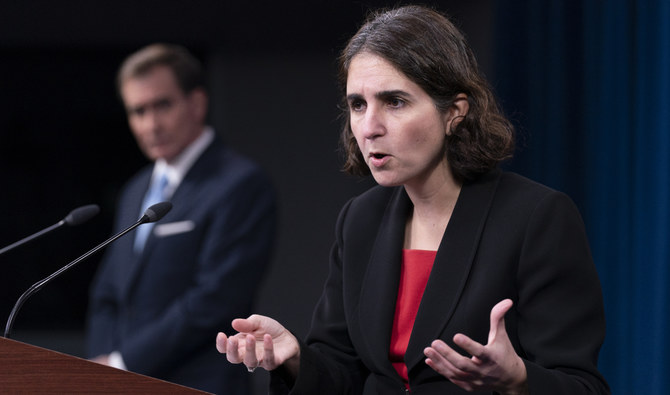
The review confirmed the priority region for the US military was the Indo-Pacific, said Mara Karlin, a top Pentagon policy official.
The review "directs additional cooperation with allies and partners across the region to advance initiatives that contribute to regional stability and deter potential military aggression from China and threats from North Korea," she told reporters.
In addition, it "strengthens the combat-credible deterrent against Russian aggression in Europe and enables NATO forces to operate more effectively," she said.
The Middle East, however, remains an area of flux for the Pentagon after the long wars in Iraq and Afghanistan.
Global responsibilities "require us to make continuous changes to our Middle East posture, but we always have the capability to rapidly deploy forces to the region based on the threat environment," Karlin said.
Speaking separately, a senior Pentagon official who declined to be identified, downplayed any idea of radical shifts.
"In the first year of an administration, it's not the time when we would develop a major strategic-level change to our posture," the official said.
However, the official added, the Biden team felt the review necessary after the disruptive approach of his predecessor Donald Trump, who altered US commitments abruptly.
Under Trump, "there were oftentimes a devaluing of ally and partner input and engagement, which eroded US credibility and hard-won trust," the official said.
The officials declined to answer questions on how the global posture review sees US force presence in ongoing conflict zones like the Middle East, East and West Africa, and Eastern Europe.
But they confirmed previously announced plans to do more in Guam and Australia.
"In Australia, you'll see new rotational fighter and bomber aircraft deployments, you'll see ground forces training and increased logistics cooperation," said Karlin.
In Guam, the Northern Mariana Islands and Australia there will also be upgrades to airports and fuel and munitions storage facilities, she said.
Asked if the review foresaw more increases in the US presence in the Pacific region, Karlin said: "We're moving the needle a bit."
"And what I'd like to think is, over the coming years, you will see that needle move more," she said.

Pentagon plans stronger US posture toward China, Russia
https://arab.news/r74tf
Pentagon plans stronger US posture toward China, Russia
- The US Defense Department will be upgrading and expanding military facilities in Guam and Australia
UK pays Guantanamo detainee ‘substantial’ compensation over US torture questions
- Abu Zubaydah has been held at Guantanamo Bay without charge for 20 years
- British security services knew he was subjected to ‘enhanced interrogation’ but failed to raise concerns for 4 years
LONDON: A Saudi-born Palestinian being held without trial by the US has received a “substantial” compensation payment from the UK government, the BBC reported.
Abu Zubaydah has been imprisoned at Guantanamo Bay in Cuba for almost 20 years following his capture in Pakistan in 2002, and was subjected to “enhanced interrogation” techniques by the CIA.
He was accused of being a senior member of Al-Qaeda in the aftermath of the Sept. 11 terror attacks on the US. The allegations were later dropped but he remains in detention.
The compensation follows revelations that UK security services submitted questions to the US to be put to Abu Zubaydah by their US counterparts despite knowledge of his mistreatment.
He alleged that MI5 and MI6 had been “complicit” in torture, leading to a legal case and the subsequent compensation.
Dominic Grieve, the UK’s former attorney general, chaired a panel reviewing Abu Zubaydah’s case.
He described the compensation as “very unusual” but said the treatment of Abu Zubaydah had been “plainly” wrong, the BBC reported.
Grieve added that the security services had evidence that the “Americans were behaving in a way that should have given us cause for real concern,” and that “we (UK authorities) should have raised it with the US and, if necessary, closed down co-operation, but we failed to do that for a considerable period of time.”
Abu Zubaydah’s international legal counsel, Prof. Helen Duffy, said: “The compensation is important, it’s significant, but it’s insufficient.”
She added that more needs to be done to secure his release, stating: “These violations of his rights are not historic, they are ongoing.”
Duffy said Abu Zubaydah would continue to fight for his freedom, adding: “I am hopeful that the payment of the substantial sums will enable him to do that and to support himself when he’s in the outside world.”
He is one of 15 people still being held at Guantanamo, many without charge. Following his initial detention, he arrived at the prison camp having been the first person to be taken to a so-called CIA “black site.”
He spent time at six such locations, including in Lithuania and Poland, outside of US legal jurisdiction.
Internal MI6 messages revealed that the “enhanced interrogation” techniques he was subjected to would have “broken” the resolve of an estimated 98 percent of US special forces members had they been subjected to them.
CIA officers later decided he would be permanently cut off from the outside world, with then-President George W. Bush publicly saying Abu Zubaydah had been “plotting and planning murder.”
However, the US has since withdrawn the allegations and no longer says he was a member of Al-Qaeda.
A report by the US Senate Select Committee on Intelligence said Abu Zubaydah had been waterboarded at least 83 times, was locked in a coffin-like box for extended periods, and had been regularly assaulted. Much of his treatment would be considered torture under UK law.
Despite knowledge of his treatment, it was four years before British security services raised concerns with their American counterparts, and their submission of questions within that period had “created a market” for the torture of detainees, Duffy said.
A 2018 report by the UK Parliament’s Intelligence and Security Committee was deeply critical of the behavior of MI5 and MI6 in relation to Abu Zubaydah.
It also criticized conduct relating to Guantanamo detainee Khalid Sheikh Mohammed, widely regarded as a key architect of the Sept. 11 attacks, warning that the precedent set by Abu Zubaydah’s legal action could be used by Mohammed to bring a separate case against the UK.
MI5 and MI6 failed to comment on Abu Zubaydah’s case. Neither the UK government nor Mohammed’s legal team would comment on a possible case over his treatment.