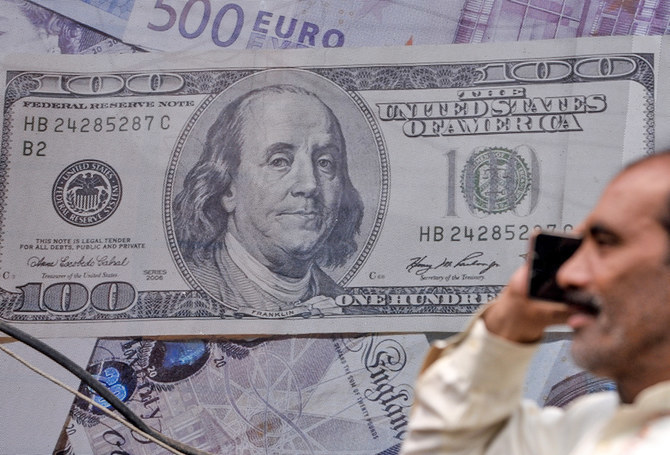
KARACHI: Pakistan’s national currency continued to lose its value against the US dollar and hit a new all-time low as the greenback closed at Rs176.20 on Monday.
The rupee has lost its value by 15.7 percent, or more than Rs24, since May this year, when the dollar was trading at around Rs152.
While analysts believe the rupee is weakening against the greenback due to a high demand for imports and an expectation of higher import bills for November 2021, currency dealers say the reasons for rupee’s depreciation were not clear, despite a decline in oil prices and the clearance of a Saudi financial package.
Pakistan and Saudi Arabia on Monday formally signed an agreement under which the Saudi Fund for Development (SFD) will deposit $3 billion in the State Bank of Pakistan (SBP).
In October, SFD announced a financial package of $4.2 billion to help the South Asian nation as it struggled with depleting foreign reserves. The package includes suppling $1.2 billion worth of oil to Pakistan on credit.
“The demand of dollar for imports is exerting pressure on Pakistani rupee besides it is expected that November import bill will be higher as well,” said Samiullah Tariq, research director at the Pakistan Kuwait Investment Company (PKIC).
Tariq said the flow of Saudi dollars into Pakistan would improve market sentiment despite an expected high demand for dollar for imports.
“The Saudi deposits will improve the sentiment of the market,” he said. “The deposit will increase the import coverage of the country for three months.”
But Zafar Paracha, general secretary of the Exchange Companies Association of Pakistan (ECAP), said analysts were unable to comprehend why the dollar was appreciating in the interbank market, despite the clearance of the Saudi deposit facility and around 10 percent decline in oil prices.
On Monday, the rupee appreciated in the open market and the US dollar traded at Rs177.80 for selling and Rs177.30 for buying. The greenback traded at Rs179 for selling and Rs178 for buying the previous day.
“There is more supply of dollar than the demand in the open market,” Paracha said, explaining the rupee’s appreciation.
Pakistan’s equity market jubilated over the clearance of the Saudi deposit facility, with the benchmark KSE 100 index gaining 1215.89 points on Monday.
“Stocks closed record higher after reports that federal cabinet approved terms of $4.2 billion Saudi package,” Ahsan Mehanti, chief executive of Arif Habib Corporation said. “Strong economic outlook ahead of release of IMF tranche and surging exports, remittances and global crude oil prices played a catalyst role in the bullish close.”


![]()

Pakistani rupee hits new all-time low against greenback
Short Url
https://arab.news/rx39c
Pakistani rupee hits new all-time low against greenback
- US dollar closed at Rs176.20 on Monday despite clearance of Saudi deposits
- Pakistani currency has lost 15.7 percent of its value since May this year
Latest updates


© 2026 SAUDI RESEARCH & PUBLISHING COMPANY, All Rights Reserved And subject to Terms of Use Agreement.