ISLAMABAD: The top official of a major online shopping company said on Wednesday e-commerce only accounted for two percent of Pakistan’s retail market while adding that his company was trying to create digital literacy to bring nearly 50 million customers to its platform within the next few years.
According to official statistics, 88 percent of the country’s population has access to internet and broadband services. However, e-commerce remains in a nascent stage in Pakistan with modest retail sales, though there has been a noticeable surge in online vendors and payment facilities introduced by banks and cellular companies.
International e-commerce platforms and investors have been pouring in a lot of money in Pakistan as the government tries to promote online markets to provide employment to about 130 million people in the country in another 30 years.
“By now, e-commerce is only two percent of the retail market in Pakistan,” Bjarke Mikkelsen, the founder and CEO of Daraz Group, told Arab News in a wide-ranging interview. “We are off to a good start, but it is still just the beginning.”
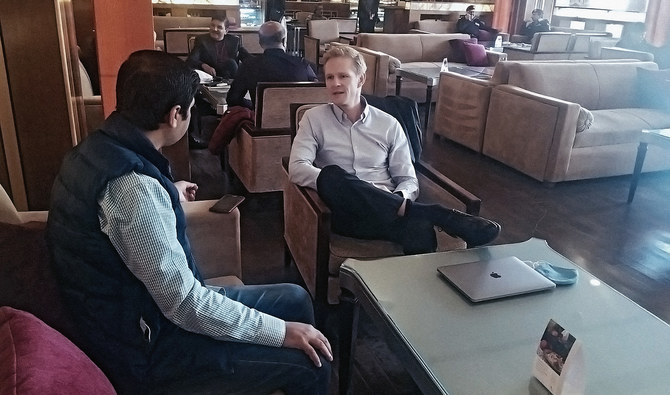
Founder and CEO of Daraz Group, Bjarke Mikkelsen, center, during an exclusive interview with Arab News in Islamabad, Pakistan, on November 24, 2021. (AN photo)
Daraz is not just into e-commerce but also logistics, payment infrastructure and financial services.
It started its operations in Pakistan in 2015 and soon became one of the leading online marketplaces in the country.
The company is also operating in Sri Lanka, Bangladesh, Nepal and Myanmar – giving it access to over 500 million people in the context of accelerated digitalization.
In 2018, Alibaba Group, a Chinese e-commerce giant, acquired it to boost its operations in the South Asian market.
Daraz not only connects customers to sellers but also creates opportunities for over 100,000 small and medium enterprises and provides its 35 million monthly customers access to 50 million products across 100 categories.
The CEO of the company said his platform was working to change the perception and mindset of people regarding e-commerce since most of them usually considered online platforms as places where they could get substantial discounts.
“But now, they have understood that e-commerce is about providing services and … helping people lead an easier and more exciting life,” he said.
Mikkelsen said he had promised Alibaba 100 million customers in the next couple of years from the South Asian market, excluding India, as part of the company’s global vision of two billion consumers.
“Almost half of these [100 million customers] need to come from Pakistan,” he added.
Currently, Daraz has about 20 million users in the regional market. It has been growing at about 100 percent on a yearly basis for the last four years.
The Daraz official said his company had invested over $100 million in Pakistan in the last three years and planned to spend at the same rate for the next few years.
“We are doing this because we see a long-term opportunity here,” he explained. “It is not only about foreign investment; it’s about bringing in technology to the country as well.”
Mikkelsen said e-commerce trends in South Asia, excluding India, were similar in terms of growth, internet penetration and adoption of payment methods. “What makes Pakistan different is its talent and young generation,” he added.
He informed that Daraz was working “very closely” with the government to document the national economy since it wanted a digital environment where sellers were registered and paid their taxes.
“That’s the goal that we have put together with the government, and we are helping the government in educating our sellers, educating them how to become a seller and pay their taxes,” he said, adding that digital economy also provided better financing facilities to sellers which made it easier for them to enhance their outreach and access to technology.
“We can prove with data that becoming part of the registered economy is a good thing for sellers,” he continued while referring to a recent study his company jointly conducted with the World Bank.
The Daraz CEO said his platform was currently trying to improve and promote Pakistan’s local market while working on greater exports opportunities for its sellers as well.
“We are figuring out how we can help our sellers reach other markets,” he said.
Mikkelsen assured online users of “complete protection” of their data and information on Daraz, adding that government regulations should also encourage data privacy.
“Regulation is good,” he continued. “It is required for the industry to scale. However, it is important that it is done as a collaborative effort, making sure that private sector is really taken into account.”