

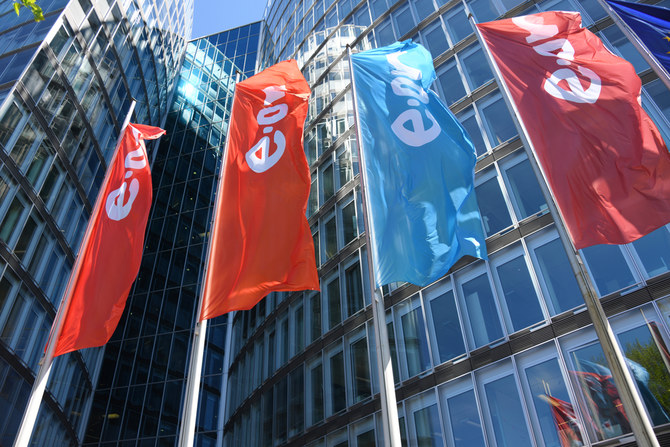
Germany’s E.ON plans to invest $30 billion in core business by 2026

Image: Shutterstock
Short Url
Updated 23 November 2021
Follow

Germany’s E.ON plans to invest $30 billion in core business by 2026

  • The investment program comes a week after RWE, Germany’s largest power producer, mapped out a 50 billion euro spending push

German energy group E.ON plans to invest about 27 billion euros ($30 billion) in its core business, including networks and retail power, by 2026, it said on Tuesday, joining rivals in launching ambitious funding offensives.


Around 22 billion euros will be spent on E.ON’s power and gas distribution network — Europe’s largest — and 5 billion on customer solutions through which E.ON supplies around 50 million customers across the continent.


The investment program comes a week after RWE, Germany’s largest power producer, mapped out a 50 billion euro spending push to expand its renewables capacity as Europe’s energy firms accelerate their green power ambitions.


“The decarbonization of Europe’s economies places the energy industry at the threshold of a key decade of growth,” Leonhard Birnbaum, who took over as E.ON’s CEO in April, said ahead of the group’s capital markets day.


“Having roughly 50 million customers in Europe and the continent’s biggest distribution network — which is the backbone of this transition — positions E.ON superbly to seize this opportunity.”


As part of the five-year plan, E.ON is also targeting 2 to 4 billion euros in proceeds from asset sales and partnerships, as well as additional annual savings of 500 million euros by 2026.


Adjusted earnings before interest, tax, depreciation and amortization (EBITDA) for its core business is expected to reach 7.8 billion euros in 2026, which would represent a compound annual growth rate of about 4 percent from 2021 to 2026, E.ON said.


E.ON also proposed to pay a dividend of 0.49 euros per share for 2021, up from 0.47 euros for 2020, and in line with the Refinitiv consensus.


Its current dividend policy, which foresees an annual growth rate of up to 5 percent, will be extended by three years until 2026, it said.


New Saudi draft project to regulate direct market entry of listed companies’ subsidiaries

Updated 59 min 40 sec ago
Follow

New Saudi draft project to regulate direct market entry of listed companies’ subsidiaries

RIYADH: The Saudi Capital Market Authority has launched a draft regulation for the direct listing of subsidiaries of companies already listed on the main market, inviting stakeholders to provide feedback over a 30-day period, according to a statement issued Feb. 26.

The proposed framework aims to allow subsidiaries of main-market companies to list their shares directly on the main market without undergoing an initial public offering, thereby shortening timelines, streamlining procedures, and reducing the costs associated with listing on the Saudi stock market.

It also seeks to create more investment opportunities in the Saudi financial market, contributing to market depth and product diversification, while maintaining high levels of transparency and protecting investors’ rights.

The proposals enable the issuer and its financial advisor to share information about the company and its financial statements with a select group of potential investors before obtaining CMA approval for the share registration request, allowing them to assess their interest in a direct listing on the main market.

They also allow a specific group of licensed financial advisory firms to prepare research and financial reports, provided these are not published before CMA approval.

The proposed framework emphasizes the importance of proper disclosure by setting out requirements for registering shares on the main market, including submitting a registration document to the CMA.

It also specifies the information that must be included in the registration document, such as the method for determining the reference share price and the risks associated with this method.

Under the draft regulation, securities offering rules, ongoing obligations, and the CMA’s glossary of terms and regulations will be updated to allow this type of listing.

This approach is expected to bring multiple benefits, including maximizing the overall value of the main market with lower risk by listing companies that have greater knowledge and experience of market regulations, as well as deepening the market by increasing the number of listed companies across multiple sectors.