Pakistan, Russia renew commitment to counter terrorist propaganda in information space

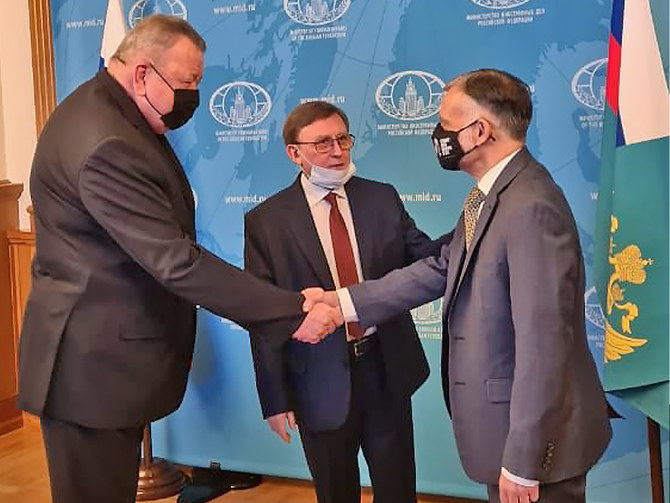
Deputy Minister of Foreign Affairs of Russia, Oleg V. Syromolotov (left) and Pakistan's Additional Secretary of Ministry of Foreign Affairs, Nabeel Munir (right), shake hands in Moscow, Russia, on November 22, 2021. (Pakistan Embassy in Russia) 
Short Url
Updated 23 November 2021
Follow

Pakistan, Russia renew commitment to counter terrorist propaganda in information space

  • Both agree spread of terrorist ideologies and emergence of its new forms pose a grave challenge
  • Moscow and Islamabad agree to focus their fight on the Internet and foreign terrorist fighters

ISLAMABAD: Pakistan and Russia on Monday renewed their commitment to fight back terrorist propaganda in the information space, the Pakistani foreign office said. 
The understanding was reached at the 9th meeting of the Russia-Pakistan Joint Working Group on Combatting International Terrorism and Other Challenges to Security in Moscow on November 22. 
During the meeting, the two sides exchanged ideas and discussed a broad range of issues relating to global fight against terrorism and extremism, including existing challenges as well as new and emerging threats to international and regional peace and security. 
“Russia and Pakistan acknowledged and appreciated each other’s efforts in countering international terrorism, underscored the need for greater collaboration between the two countries on addressing the challenges to security and renewed their commitment to counter the spread of terrorist propaganda in the information space, particularly on the Internet, and the phenomenon of foreign terrorist fighters,” the Pakistani foreign office said in a statement. 
“They highlighted that the spread of terrorist mindset and ideologies and emergence of new forms of terrorism posed a grave challenge. Both sides reaffirmed their commitment to continue dialogue on countering financing of terrorism.” 
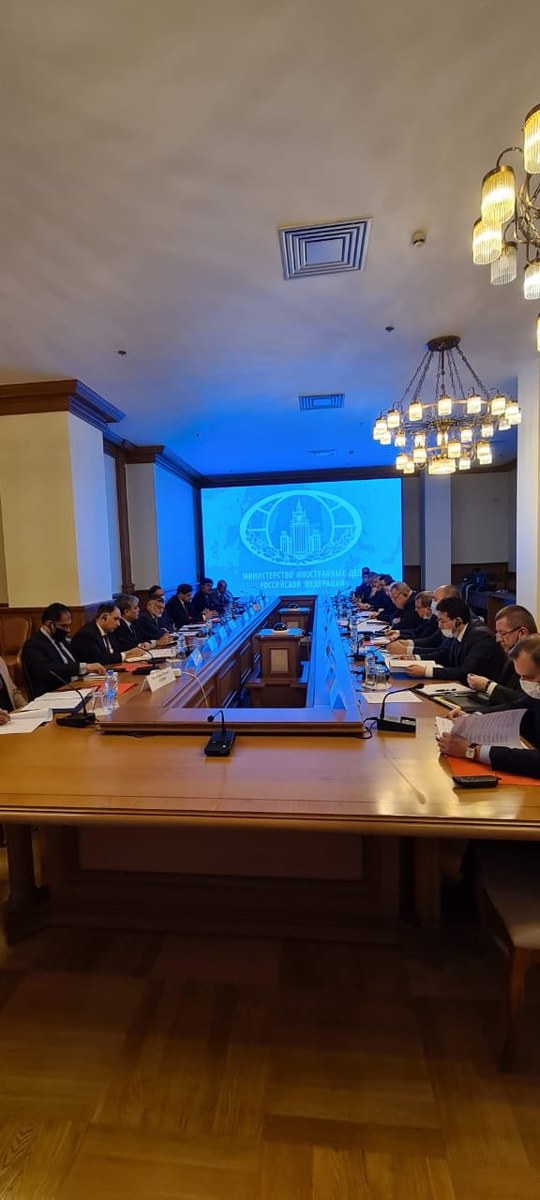


Pakistan and Russia hold the 9th meeting of the Russia-Pakistan Joint Working Group on Combatting International Terrorism and Other Challenges to Security in Moscow, Russia, on November 22, 2021. (Pakistan Embassy in Russia) 

As part of this strategic dialogue, Russia and Pakistan conducted a thorough exchange of assessment of global and regional terrorist threats, particularly in Afghanistan, the Middle East and North Africa, and Central and South Asia, according to the statement. 
Both countries agreed to further broaden their bilateral engagement on issues relating to combatting international terrorism and other challenges to security, and reaffirmed their willingness to work closely with each other on issues of common concern at key international platforms like the United Nations and regional bodies like the Shanghai Cooperation Organization (SCO). 
The next meeting of the Russia-Pakistan working group will be held in 2022. 
Earlier this month, Pakistan hosted special representatives from the United States, China and Russia for the Troika Plus meeting to discuss the situation in Afghanistan. 
The high-level meeting in the Pakistani capital came at a time when the Taliban’s interim foreign minister, Amir Khan Muttaqi, was also in Islamabad to discuss bilateral relations. 
This was the first visit of Muttaqi, the top Afghan diplomat, to Pakistan since the Taliban seized control of Afghanistan on August 15. 


Pakistan says responding to Afghan ‘offensive operations’ after border fire as tensions escalate

Updated 26 February 2026
Follow

Pakistan says responding to Afghan ‘offensive operations’ after border fire as tensions escalate

  • Afghan Taliban spokesperson says “large-scale offensive operations” launched against Pakistani military bases
  • Pakistan says Afghan forces opened “unprovoked” fire across multiple sectors along shared border

ISLAMABAD: Afghanistan’s Taliban authorities said on Thursday they had launched “large-scale offensive operations” against Pakistani military bases and installations, prompting Pakistan to say its forces were responding to what it described as unprovoked fire along the shared border.

The escalation follows Islamabad’s weekend airstrikes targeting what it said were Tehreek-e-Taliban Pakistan (TTP) and Daesh militant camps inside Afghanistan in response to a wave of recent bombings and attacks in Pakistan. Islamabad said the strikes killed over 100 militants, while Kabul said dozens of civilians were killed and condemned the attacks as a violation of its sovereignty.

In a post on social media platform X, Afghan government spokesperson Zabihullah Mujahid said Afghanistan had launched “large-scale offensive operations” in response to repeated violations by the Pakistani military.


Pakistan’s Ministry of Information said Afghan forces had initiated hostilities along multiple points of the frontier.

“Afghan Taliban regime unprovoked action along the Pakistan–Afghanistan border given an immediate, and effective response,” the ministry said in a statement.

The statement said Pakistani forces were targeting Taliban positions in the Chitral, Khyber, Mohmand, Kurram and Bajaur sectors, claiming heavy Afghan casualties and the destruction of multiple posts and equipment. It added that Pakistan would take all necessary measures to safeguard its territorial integrity and the security of its citizens.


Separately, security officials said Pakistani forces had carried out counterattacks in several border sectors.

“Pakistan’s security forces are giving a befitting reply to the unprovoked Afghan aggression with full force,” a security official said, declining to be named. 

“The Pakistani security forces’ counter-attack destroyed Taliban’s hideouts and the Khawarij fled,” they added, referring to TTP militants. 

The claims from both sides could not be independently verified.

Cross-border violence has intensified in recent weeks, with Pakistan blaming a surge in suicide bombings and militant attacks on militants it says are based in Afghanistan. Kabul denies providing safe havens to anti-Pakistan militant groups.

The clashes mark the third major escalation between the neighbors in less than a year. Similar Pakistani strikes last year triggered weeklong clashes before Qatar, Türkiye and other regional actors mediated a ceasefire in October.

The 2,600-kilometer (1,600-mile) frontier, a key trade and transit corridor linking Pakistan to landlocked Afghanistan and onward to Central Asia, has faced repeated closures amid tensions, disrupting commerce and humanitarian movement. Trade between the two nations has remained closed since October 2025.