US calls Venezuela elections ‘grossly skewed’

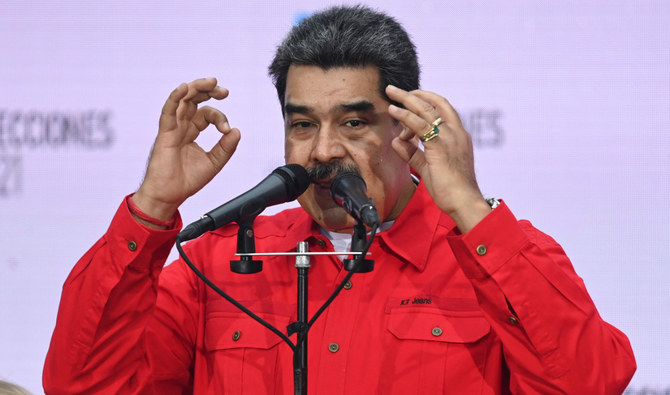
In this file photo taken on November 21, 2021 Venezuelan President Nicolas Maduro speaks during a press conference at a polling station after voting in Fuerte Tiuna in Caracas. (AFP)
Short Url
Updated 23 November 2021
Follow

US calls Venezuela elections ‘grossly skewed’

WASHINGTON: The United States said Monday that Venezuela's regional elections were not free and fair, and vowed to keep up pressure on leftist leader Nicolas Maduro, whom Washington considers illegitimate.
Maduro's forces were said to have won a landslide victory in Sunday's election, which saw the return of opposition parties to the ballot for the first time since 2017.
But US Secretary of State Antony Blinken pointed to detentions of political leaders, bans on opposition candidates, media censorship and manipulation of voter registration.
"Fearful of the voice and vote of Venezuelans, the regime grossly skewed the process to determine the result of this election long before any ballots had been cast," Blinken said in a statement.
"Maduro robs Venezuelans of their chance to shape their own future," he said.
"We call on the Maduro regime to cease its repression and allow Venezuelans to live in the peaceful, stable and democratic country they deserve and have long sought."
Blinken reiterated US support for opposition leader Juan Guaido, whom the United States considers to be the interim president after questioning the legitimacy of Maduro's last election.
European Union observers returned to the country after a 15-year absence and will present a report on Tuesday.
Weakened and fragmented, the opposition was only able to win in three states, although this significantly included oil-rich Zulia, the most populated region in the country whose capital Maracaibo is Venezuela's second-largest city.


IAEA board meets over Ukraine nuclear safety concerns

Updated 4 sec ago
Follow

IAEA board meets over Ukraine nuclear safety concerns

  • The war in Ukraine “continues to pose the world’s biggest threat to nuclear safety,” Grossi said
  • The mission will assess 10 substations “crucial to nuclear safety,” according to Grossi

VIENNA: The UN nuclear watchdog’s board of governors on Friday discussed nuclear safety in Ukraine, with several countries expressing “growing concern” following Russian attacks on the power grid.
Energy supplies to Ukraine’s nuclear plants have been affected as Russia has pounded its neighbor’s power sector since the start of its 2022 invasion, prompting fears of a nuclear disaster.
The war in Ukraine “continues to pose the world’s biggest threat to nuclear safety,” Rafael Grossi, director general of the International Atomic Energy Agency (IAEA), said when opening the board meeting.
The extraordinary meeting that lasted four hours was called after 13 countries led by the Netherlands expressed in a letter seen by AFP a “growing concern about the severity and urgency of nuclear safety risks” following a series of attacks.
Ukrainian ambassador Yurii Vitrenko told reporters before the meeting that it was “high time” for the IAEA board to discuss the situation.
A weeks-long IAEA expert mission to Ukrainian substations and power plants is under way and expected to wrap up next month, Vitrenko said.
The mission will assess 10 substations “crucial to nuclear safety,” according to Grossi.
Russian Ambassador Mikhail Ulyanov dismissed the board’s gathering as “absolutely politically motivated,” adding there was “no real need to hold such a meeting today.”
Last week, Ukraine’s Chernobyl nuclear power plant temporarily lost all off-site power.
Europe’s biggest nuclear power plant, Zaporizhzhia, occupied by Russian forces since March 2022, has also been repeatedly affected by fighting.
Earlier this month, Russia and Ukraine agreed to a localized ceasefire to allow repairs on the last remaining backup power line supplying Zaporizhzhia.
The line was damaged and disconnected as a result of military activity in early January.
The Zaporizhzhia plant’s six reactors have been shut down since the occupation. But the site still needs electricity to maintain its cooling and security systems.
Moscow and Kyiv have repeatedly accused each other of risking a nuclear catastrophe by attacking the site.